
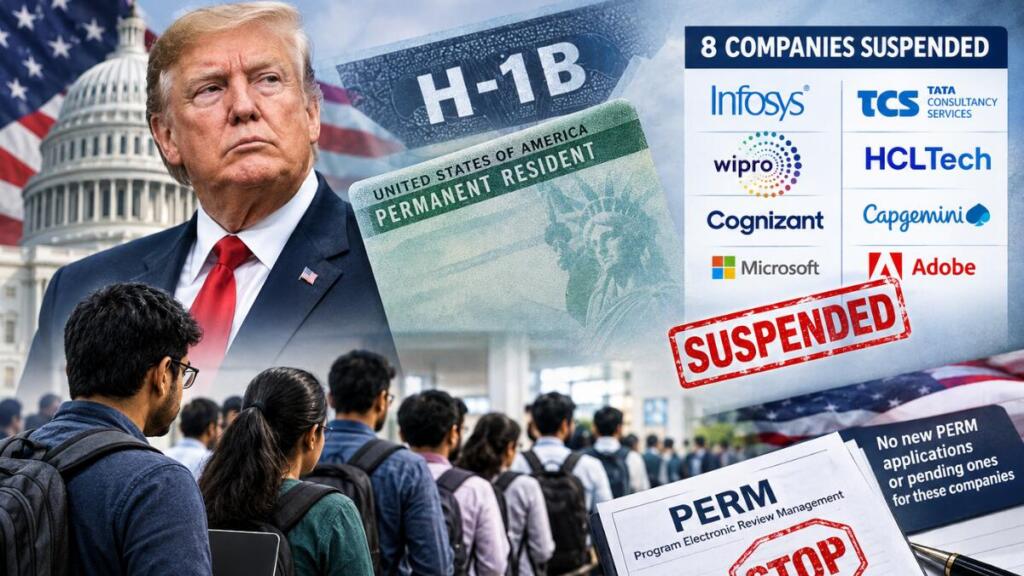
The Trump administration on Thursday suspended eight companies from the US programme that employers use to start the green card process for foreign workers, a move that lands squarely on India’s technology workforce. The firms are Infosys, Tata Consultancy Services, Wipro, HCLTech, Cognizant, Capgemini, Microsoft and Adobe. Labour Secretary Keith Sonderling said the department will not accept new PERM applications involving the companies or process pending ones, citing multiple active federal investigations.
The action does not touch the H-1B visa directly. As one report put it, it targets not the H-1B visa directly, but the green-card pipeline through which temporary skilled workers seek permanent residency. For the Indian professionals who make up the bulk of that pipeline, the distinction offers limited comfort.
What has and has not been suspended
PERM, short for Permanent Labour Certification, is a Labor Department process, not a green card. It is generally required before an employer can file petitions for most employment-based green cards, and it requires the employer to show there are no qualified, willing and available US workers for the job. Suspending it halts the first gate of a multi-stage process. It does not revoke green cards already issued, and the suspension does not automatically cancel existing H-1B visas. Employees can keep working on their current visas. What stops is the path to staying permanently, and the effect on any one worker depends on where their case stands.
The administration’s case
Officials say the suspension targets alleged fraud and misuse. Senior officials argued that companies have used the programme to replace American workers with cheaper foreign workers. Sonderling said the named companies alone have requested nearly three million foreign workers since 2009, arguing that the practice shut Americans out of the job market. The move follows a wider campaign that includes the $100,000 H-1B fee, which has been blocked by federal court orders.
That argument has force with voters who feel squeezed by tech layoffs. But the suspension rests on investigations, not findings, and filing large numbers of applications is not in itself evidence of wrongdoing.
Who bears the cost
For Indian workers, the cost is uncertainty layered on a backlog. India-born applicants already wait years for a green card: the latest visa bulletin figures show the India cut-off for final action at 15 October 2022 for EB-1, with EB-2 unavailable and EB-3 at 1 January 2014. A frozen PERM stage adds delay to a queue that is already measured in decades. Workers nearing the six-year H-1B limit, who rely on a PERM filing to qualify for extensions, are the most exposed.
For the companies, the picture is mixed. Indian IT firms have been cutting their reliance on sponsored workers for years, and Nasscom says they have significantly reduced their dependence on H-1B visas while expanding local hiring in the US. The direct operating hit may therefore be modest, while the damage to retention and morale could be larger. The inclusion of Microsoft and Adobe also complicates any reading of this as an action aimed only at India. American firms that rely on global engineers are caught in the same net.
The neo-isolationism question
Supporters of the “neo-isolationist” reading see a pattern: a $100,000 H-1B fee, a crackdown on student work routes, and now a freeze at the green card gate. Taken together, they argue, these steps turn the United States from a magnet for global talent into a country that guards its labour market and treats skilled migration as a threat to be policed. The costs are already visible. Layoffs at major tech firms and tougher visa rules are pushing some skilled workers out, and about 7,300 have already returned to India in 2026, according to the talent firm Xpheno.
The administration would reject the label. Its position is that it is not closing the door but enforcing rules that, in its view, were abused, and putting American workers first is a legitimate priority rather than isolationism. The honest reading is that both can be true: a defensible enforcement goal can still, in its design and scale, narrow the talent channels that American competitiveness has depended on.
The Chinese angle
The talent flow is not only an Indian story. Indian and Chinese nationals account for about 70 percent and 12 percent of the H-1B pool respectively, and the same reporting notes a return flow to both countries.
Three things will show how far this goes. The first is the duration of the suspension and whether investigators produce findings or the action quietly lapses. The second is whether more companies are added, since the list already includes American names. The third is whether Indian firms and workers respond by moving more work to India’s global capability centres, which would turn a US restriction into a shift of jobs rather than a loss of them.