
The Indian Navy is set to commission two new vessels this month, Samarthak and Mangrol. Together they target a problem the service has long worried about: threats beneath the surface close to India’s coast, and the need to test new weapons without pulling warships off duty.
Samarthak is the Navy’s first indigenous Multi-Purpose Vessel (MPV). It was built by Larsen & Toubro at Kattupalli near Chennai under an ₹887 crore contract signed in 2022, and was delivered on August 27. More than 75 per cent of its content is Indian. It is the first of two ships ordered.
The ship, about 107 metres long and displacing over 3,750 tonnes, is meant mainly for trials and evaluation. It can launch and recover torpedoes, tow other vessels and deploy and retrieve targets during anti-submarine exercises. It can also support trials of unmanned systems. Until now, such work has often tied up frontline combatants. With Samarthak taking it on, destroyers and frigates can stay focused on operations and readiness while new indigenous weapons and sensors are tested.
The ship also has a peacetime role. It can handle maritime surveillance, offshore patrols, salvage, pollution response, and humanitarian and disaster relief, and has limited hospital facilities.
Mangrol: a hunter for coastal waters
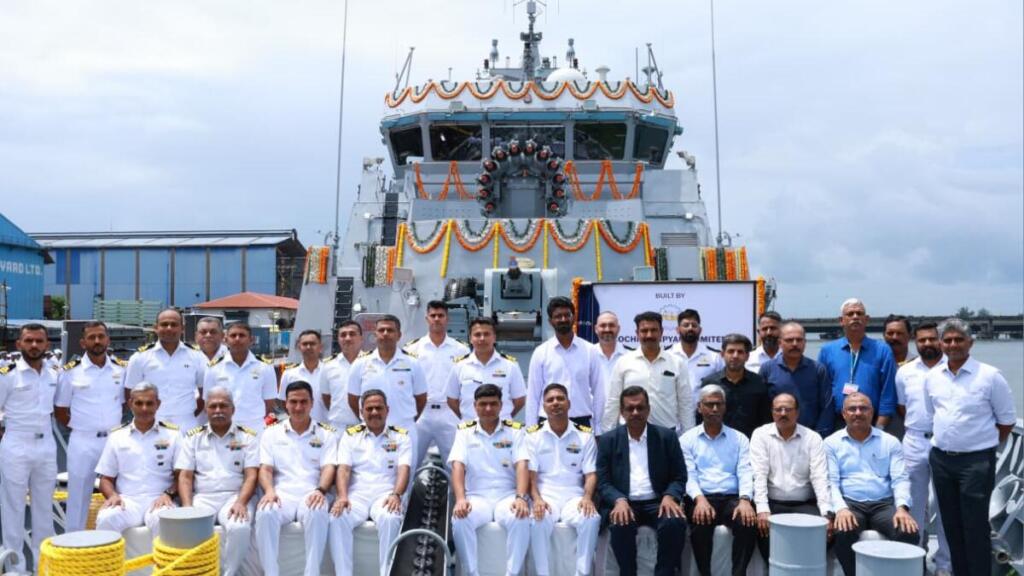
Mangrol is the third ship of the Mahe-class Anti-Submarine Warfare Shallow Water Craft, built by Cochin Shipyard Limited. The Navy plans 16 such vessels. The class is powered by waterjets, which allow operations in shallow water where larger ships cannot go.
Mangrol is designed to find, track and engage submarines in coastal and littoral waters. It carries indigenous underwater sensors, lightweight torpedoes, anti-submarine rockets and torpedo decoy launchers, and it can also lay mines.
Avoiding a Ghazi-type situation
The reference to PNS Ghazi points to a scenario from the 1971 war. The Pakistani submarine moved into waters off Visakhapatnam and was lost there in December that year, reportedly while trying to threaten the carrier INS Vikrant. How it was lost remains debated. The episode showed how a single submarine reaching India’s approaches can endanger a high-value asset.
Defence analysts see Mangrol-class craft as a layered answer to that risk. Deep-sea platforms such as frigates, helicopters and maritime patrol aircraft cover the open ocean. Shallow-water craft cover the final approaches to harbours, anchorages and naval bases, where an intruding boat must slow down, hug the coast and become easier to detect. A numerous fleet of such ships, built to patrol these waters continuously, helps close that gap. Mangrol alone will not do so, but the class is meant to work as a network.
The concern is current. Pakistan is adding eight Chinese-origin Hangor-class submarines, which have Air Independent Propulsion (AIP) for longer underwater endurance and a lower chance of detection. Pakistan recently fired an anti-ship cruise missile from PNS Hangor. The Navy is also watching Chinese research vessels in the Indian Ocean, which gather seabed and ocean data that could support submarine operations.
India has yet to field an operational submarine with indigenous AIP. INS Khanderi, the second Kalvari-class boat, is due to be the first, with a DRDO fuel-cell system expected to enter service around mid-2028. The six-submarine Project-75I, with Germany’s ThyssenKrupp Marine Systems, still awaits Cabinet Committee on Security approval.
The two ships come as the Navy works toward inducting 18 warships this year. The service has about 145 warships and aims for around 200 over the next decade. The Defence Acquisition Council has also given in-principle approval for 74 more naval platforms, including nine submarines.