
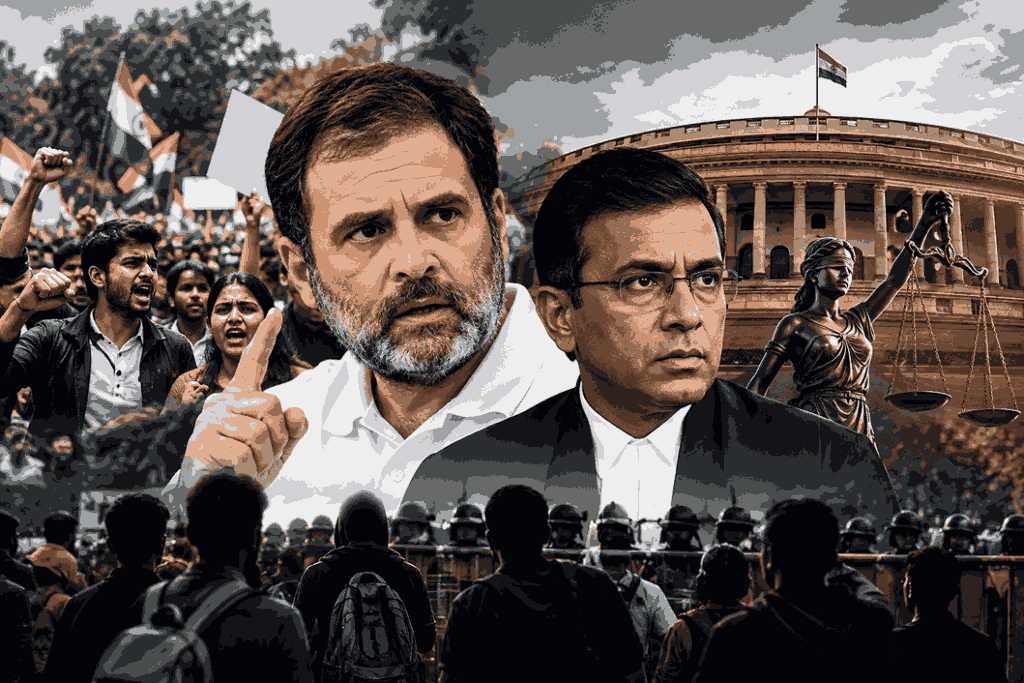
The political debate surrounding Rahul Gandhi and the CJP has increasingly raised questions about whether their approach to confronting the government and defending democratic values could inadvertently contribute to Anarchy rather than strengthen the institutions they seek to protect. Their supporters may describe street mobilisation, protests and public demonstrations as legitimate tools of democratic resistance, but critics argue that democracy ultimately depends on the credibility and functioning of constitutional institutions rather than sustained political confrontation on the streets.
India’s democratic framework provides multiple avenues through which political disagreements can be addressed. Parliament, the judiciary, independent election mechanisms, constitutional bodies, the media and established legal procedures all exist to provide citizens and political parties with institutional channels for resolving disputes. When political leaders increasingly rely on mass mobilisation outside these mechanisms, critics worry that public frustration can gradually turn into Anarchy, particularly when political rhetoric becomes more confrontational.
Rahul Gandhi has repeatedly positioned himself as a defender of constitutional values and democratic institutions. His political campaigns and public interventions have often focused on issues such as electoral integrity, accountability and the protection of democratic rights. Supporters argue that taking political issues to the streets is an essential component of democracy, especially when they believe institutions are failing to respond adequately. From this perspective, demonstrations are not necessarily Anarchy, but a form of political participation protected by democratic principles.
However, the distinction between legitimate protest and Anarchy becomes important when political mobilisation begins to undermine public order or weaken confidence in established institutions. Democracy requires the freedom to protest, but it also requires political actors to respect legal boundaries and accept institutional outcomes, even when those outcomes are inconvenient or politically damaging.
The CJP’s political activities and its broader engagement with public issues have similarly contributed to debate over the appropriate balance between institutional politics and street mobilisation. Political organisations can legitimately seek public support, organise demonstrations and challenge government decisions. Yet critics contend that political movements should ultimately channel public energy toward institutional reform rather than allowing anger to become an end in itself.
There is also a deeper question about the meaning of democratic resistance. A healthy democracy certainly needs citizens who are willing to challenge those in power. History demonstrates that peaceful public movements have sometimes played a significant role in forcing governments to reconsider controversial policies. But democratic stability depends on ensuring that political disagreement does not become a permanent struggle between opposing groups. Once political competition begins to treat every institutional decision as illegitimate, the resulting environment can create conditions resembling Anarchy.
The responsibility therefore rests not only with the government but also with opposition parties, civil society organisations and political movements. Those seeking to defend democracy must demonstrate that their own methods strengthen democratic norms. Calling for transparency, demanding accountability and challenging government decisions through courts and legislatures can reinforce institutions. By contrast, encouraging citizens to regard institutions themselves as fundamentally untrustworthy may eventually weaken the very democratic architecture that political leaders claim to defend.
India’s political system has survived intense disagreements, elections, protests and changes of government because institutions have provided mechanisms for peaceful competition. Parliament provides a forum for debate, courts provide legal remedies, elections provide the opportunity to change governments and citizens retain the right to express dissent. Preserving these mechanisms should remain central to any campaign claiming to defend democracy.
The concern about Anarchy, therefore, should not be interpreted as an argument against protest. Peaceful protest is an important democratic right. The real concern arises when street politics is presented as a substitute for institutions rather than a complement to them. Political leaders have an opportunity to mobilise citizens while simultaneously encouraging respect for law, constitutional processes and democratic procedures.
Ultimately, India’s democracy will not be protected simply by louder political battles or larger demonstrations. It will be protected when political disagreements can be channelled through institutions while citizens retain the freedom to protest peacefully when necessary. Rahul Gandhi, the CJP and other political actors therefore face a broader challenge: to ensure that their pursuit of democratic accountability does not unintentionally contribute to Anarchy, but instead strengthens public confidence in the institutions on which India’s democracy depends.