
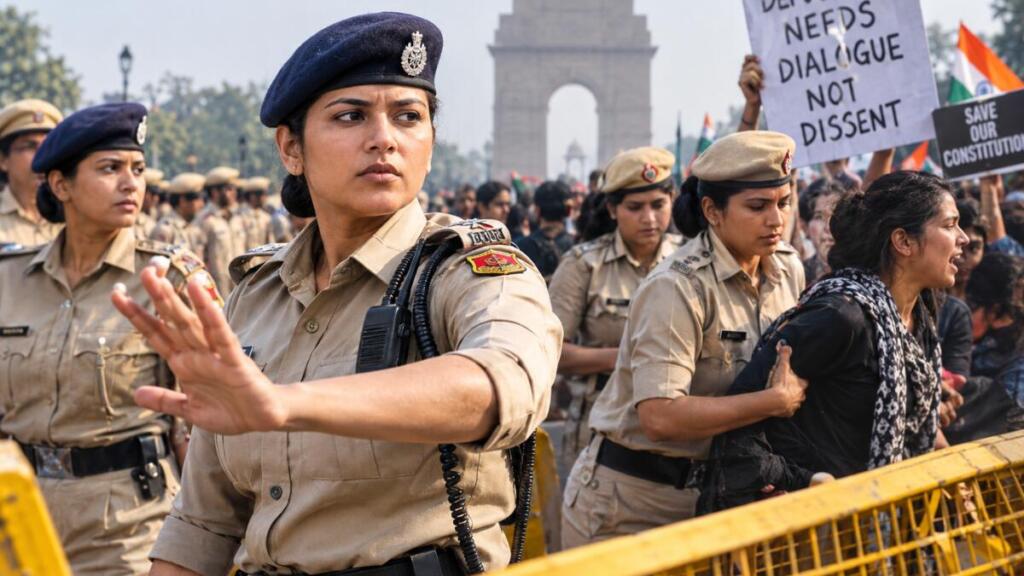
When Delhi Police moved to stop the Opposition’s march against the Chief Election Commissioner and the Cockroach Janta Party (CJP) protest at Jantar Mantar this month, women personnel were often the first line between the crowd and the barricade. They were the ones who physically removed protesters, many of them women, and they took the hits, according to the Centre and the police. Opposition leaders and student groups say women protesters were mistreated in the same confrontations.
The July lesson
The deployment this month followed a failure. Nearly three months after the 20 July Sansad Chalo march caught the Delhi Police unawares, they pulled out all the stops to make sure the CJP’s call to protest at Jantar Mantar against Chief Election Commissioner Gyanesh Kumar did not become a reality. On 20 July, police used lathis to disperse hundreds of protesters marching from Mandi House Metro Station towards the CJP protest site.
This time the preparation included more women personnel. More than 300 women police personnel from Uttar Pradesh were deployed in Delhi on Saturday to assist the Delhi Police, with 25 women constables sent from each of several districts. The aim was to have women on the ground wherever women protesters had to be stopped, moved or detained. Preventive detentions and barricades did the rest, according to the Tribune.
The first act came before the protest could start. CJP founder Abhijeet Dipke, with senior leaders Saurav Das and Ashutosh Ranka, was detained after their flight from Mumbai landed in Delhi. The CJP says police boarded the aircraft before passengers had disembarked. Police said the planned gathering at Jantar Mantar had not been authorised.
The Rahul Gandhi protests
The INDIA bloc march drew the sharpest confrontations. Police detained Rahul Gandhi for a second day as lawmakers staged an unannounced march demanding the chief election official’s resignation. Television footage showed women police personnel forcibly removing his sister, Priyanka Gandhi.
The Centre has described what the women police faced. It told the Supreme Court on Friday that women police personnel had been molested, attacked and injured at the Rahul Gandhi-led protests. The Week’s report adds that more than 200 police personnel were injured.
The politics followed. Delhi BJP’s Mahila Morcha protested near the Congress headquarters, accusing Rahul Gandhi of misbehaving with a woman police officer. Delhi Police registered an FIR against Rahul Gandhi, Priyanka Gandhi Vadra and others, invoking provisions on obstructing officials and allegedly assaulting police personnel. Delhi Police is examining videos that allegedly show police personnel, including women officers and constables, being assaulted near Jantar Mantar. One clip is reported to show Priyanka Gandhi Vadra elbowing a woman constable, and another appears to show Rahul Gandhi pushing or shoving a woman officer. These clips are under police scrutiny, and the Congress leaders have not been found guilty of anything.
The other side of the story
The Opposition tells it differently. Rahul Gandhi demanded that Home Minister Amit Shah answer allegations of misconduct with women by police personnel at Jantar Mantar. He said the police meant to protect women were raising hands against them. The left-wing All India Students Association made a similar complaint, saying male police officers openly abused women protesters. Gandhi also accused police of mistreating women journalists, alleging detentions and seized cameras.
That dispute is the context for why women police were deployed in numbers. Forces use women officers in front-line crowd control because they can detain and remove women protesters without the charges of misconduct that arise when male personnel do so. Under that logic, they absorb the risk of confrontation.
What remains to be reported
The brief for this story also asks how women officers defused tension on the ground. I found no first-hand account, from the officers or from police leadership, on how they did that, and no source on which personnel took part in the flight detentions. Those details need interviews with the officers, DCPs or the Delhi Police spokesperson before publication. The injured women personnel and the units they were drawn from are also worth identifying.