
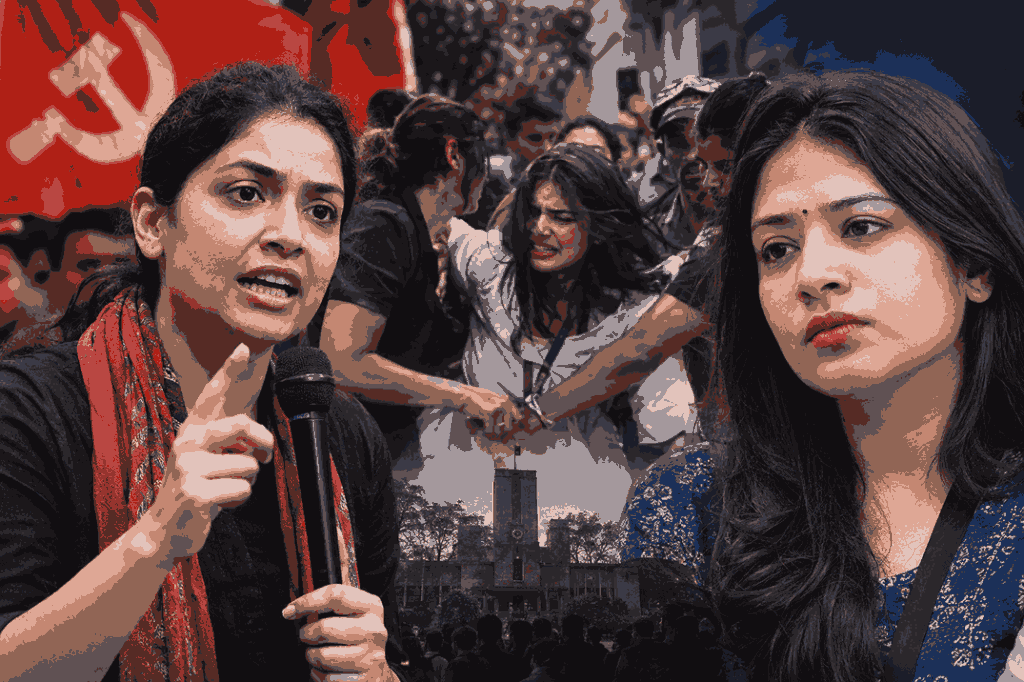
A fresh political controversy has erupted around Neha Bora, national president of the All India Students’ Association (AISA), after journalist Ruchi Tiwari accused her of hypocrisy over women’s safety. The controversy comes after Bora publicly criticised Delhi Police over alleged mistreatment of women protesters and journalists during recent demonstrations at Jantar Mantar, prompting Tiwari to revisit an alleged confrontation at Delhi University earlier this year.
Tiwari has now released videos and statements on social media questioning why concerns about women’s safety appear to receive different treatment depending on the political circumstances involved. According to the journalist, she was assaulted while covering a protest at Delhi University’s Arts Faculty on February 13, 2026. Tiwari has alleged that a group of protesters surrounded her, physically assaulted her and attempted to pull at her clothes.
At the centre of Tiwari’s allegations is Neha Bora, whom she accused of being present during the confrontation and participating in the physical altercation. Tiwari further alleged that members of the crowd made threatening remarks and that some people attempted to prevent others from intervening. These allegations have become the focus of renewed debate after Bora’s recent comments on alleged police action against women at Jantar Mantar.
The Delhi University confrontation took place during a protest concerning the University Grants Commission’s 2026 regulations relating to equity in higher educational institutions. The demonstration involved several left-wing student organisations, including AISA and the Students’ Federation of India. The protest itself was politically charged, with disagreements over caste, reservation and the proposed regulations contributing to tensions at the venue.
Tiwari has maintained that she attended the protest in her capacity as a journalist and that the confrontation escalated after protesters questioned her identity and views. Reports about the incident have included allegations that she was targeted after protesters identified her surname as Tiwari. Videos circulated online appeared to show a group of protesters surrounding and pulling at her, although the precise actions and responsibility of individual participants remain matters of dispute.
The renewed controversy involving Neha Bora stems from Tiwari’s contention that a person who speaks forcefully about women’s safety should apply the same standard when the alleged victim belongs to an opposing political camp. Tiwari has accused Bora of failing to condemn what she describes as an assault against her and has questioned the consistency of Bora’s feminist politics.
The issue has also reignited discussion about the role of political identity in public debates surrounding violence against women. Critics argue that allegations involving politically inconvenient victims can sometimes become secondary to ideological battles. Supporters of activists, however, have argued that the circumstances surrounding the Delhi University protest need to be examined in their full context rather than through selectively circulated videos.
The controversy surrounding Neha Bora has therefore moved beyond a dispute between two individuals. It has become part of a wider argument about political activism, student protests, journalism and the treatment of women who enter highly polarised public spaces. The competing narratives demonstrate how quickly incidents at demonstrations can become political flashpoints, particularly when footage circulates widely on social media.
Earlier reporting on the February incident said police registered separate complaints relating to the confrontation. Tiwari has said she continues to fear returning to the field to perform her journalistic work. At the same time, allegations concerning the conduct of protesters and individual participants should ultimately be evaluated through evidence, official investigations and due process rather than social-media claims alone.
For Neha Bora, the controversy presents a particularly difficult political challenge because her public profile is closely associated with student activism, feminism and protest politics. Her supporters can argue that criticism of her should be viewed in the context of a larger ideological campaign against AISA, while her critics are asking why allegations of mistreatment should be treated differently when the woman involved holds opposing political views.
The debate is unlikely to disappear quickly. Tiwari’s decision to revisit the February incident has placed renewed attention on the videos from the Delhi University protest and on the broader question of accountability within political movements. Neha Bora now faces intensified scrutiny over whether her public advocacy for women’s rights is applied consistently across ideological lines.
Ultimately, the controversy raises a straightforward but important question: should concern for women’s safety depend on who the woman is, what political views she holds, or which movement she is associated with? For many observers, the answer should be no. Allegations of assault, harassment or intimidation deserve serious examination regardless of political affiliation, while those accused should have the opportunity to respond and defend themselves through due process.
As the dispute continues to unfold, Neha Bora and her critics remain on opposite sides of a sharply polarised political debate. What began as a confrontation at a university protest has now become a larger test of how political organisations, activists and journalists address allegations of violence when the people involved belong to opposing ideological camps.