
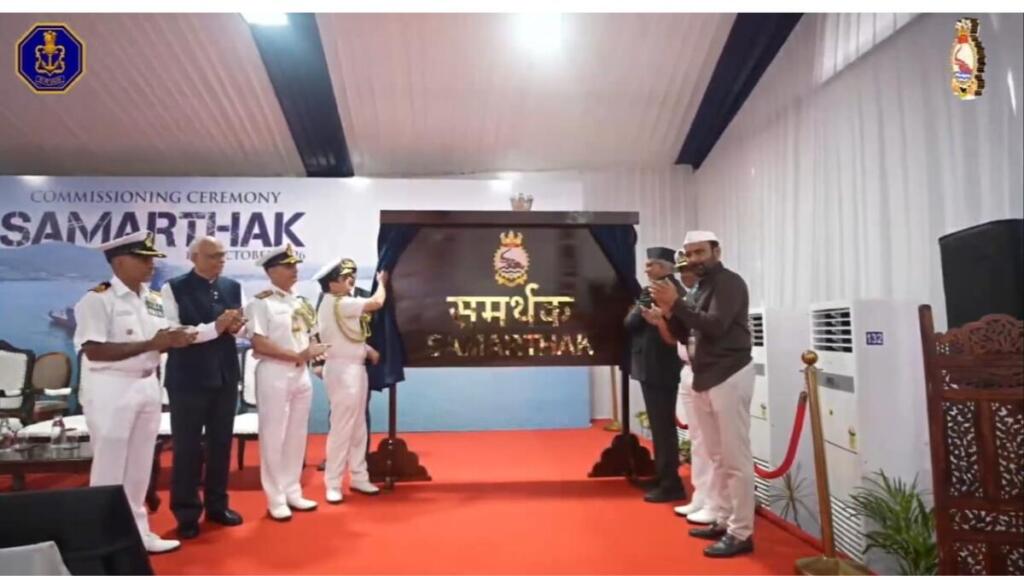
The Indian Navy on Friday commissioned INS Samarthak at Naval Base Karwar in Karnataka, adding an indigenously built multi-purpose vessel to a fleet that is growing at its fastest pace in decades. Built by Larsen & Toubro under the Make in India initiative, Samarthak is the first of four multi-purpose vessels being inducted into the Navy.
The defence ministry has described the ship as an ideal “utility” vessel for strategically important operations. Its crest shows an elephant rising from the sea, and its motto, Vijayarthama Ekanishtata, translates to “Victory is our sole aim”.
A ship for many missions
Samarthak is designed primarily for maritime surveillance and patrol. It can also undertake low-intensity maritime operations, serve as a target deployment and trials platform, act as a mothership for unmanned and autonomous systems, carry out disaster relief, convert to a limited hospital ship, and assist in salvage. It can launch and recover torpedoes and tow other ships. Its combat suite combines indigenous sensors, weapons and electronic systems optimised for challenging maritime conditions.
The vessel displaces more than 3,750 tonnes, measures about 107 metres and has a top speed of 15 knots. It carries over 75 per cent indigenous content and a Dynamic Positioning System for precise station-keeping. The ₹887 crore contract was signed in March 2022.
Naval planners value such ships for the workload they take over. Trials, target towing, patrol and relief tasks that once occupied frontline destroyers and frigates can now go to a dedicated platform, leaving combat ships free for operational deployments. The trials role also shortens the path from design to service for new weapons and sensors.
The fleet today
The Navy operates around 150 ships and submarines, roughly 135 of them frontline combatants, with close to 50 more hulls under construction in Indian yards. Induction has quickened sharply:
- The Chief of the Naval Staff has put the current pace at one indigenous warship or submarine every 40 days, following 12 warships and one submarine in 2025.
- The Navy planned to commission 19 warships in 2026, the largest force accretion in a single year.
- July brought the stealth frigate INS Mahendragiri, sixth of the Nilgiri class, and the anti-submarine vessel INS Malvan. Five indigenous vessels entered service in about six weeks.
- Samarthak and the anti-submarine craft INS Mangrol both feature in this month’s inductions, and the Navy is working towards 18 commissionings this year.
- The Defence Acquisition Council has cleared 74 further warships worth ₹2.35 lakh crore, along with the six-submarine Project 75(I).
Measuring up to China
Against the People’s Liberation Army Navy, India’s expansion still leaves a considerable gap. The US Defense Department estimates that China’s navy operates more than 370 warships, including modern carriers, destroyers and submarines. India’s total of around 150 includes small craft and support ships such as Samarthak, so the gap in frontline combat power is wider than the headline numbers suggest.
Build rates tell a similar story. An earlier Business Standard analysis found that China added 14 to 22 capital warships a year, compared with one or two for India. India’s recent acceleration narrows the difference, though many of its 2026 additions are corvettes, anti-submarine craft and auxiliaries, while Chinese yards are turning out large destroyers, amphibious assault ships and submarines. China commissioned its third carrier, Fujian, in November 2025, against India’s two, Vikramaditya and Vikrant.
The trajectories point to a persisting gap. US projections place China’s battle force at 435 ships by 2030, while India targets about 175 platforms by 2035. The Navy’s more recent planning speaks of over 200 ships by the mid-2030s, which would make it a far larger force than today while China continues to grow.
India’s advantages
Analysts point to geography as the main balancing factor. China’s numerical edge counts for less if the Indian Navy fights close to its own shores while the PLA Navy operates far from its bases. The Andaman and Nicobar chain overlooks the Malacca Strait, through which much of China’s energy trade passes, and India’s peninsular position gives it a central place in the Indian Ocean. Beijing’s response has included port access agreements and a larger presence of research vessels and submarines in the region.
The gaps that matter
Undersea warfare is the most frequently cited weakness. Reports point to a significant remaining capability gap below the surface, and the long-awaited Project 75(I) submarines are still ahead. Pakistan, meanwhile, is adding advanced Chinese-built attack submarines. Large surface combatants and amphibious lift are the other areas where Chinese output runs well ahead of India’s, and China’s shipbuilding base, among the largest anywhere, can sustain production rates that Indian yards are still working towards.
For the Navy, the aim is sea control in the Indian Ocean rather than parity with the PLA Navy ship for ship. Samarthak contributes to that goal through the support capacity it adds. Whether the 40-day cadence holds, and extends to destroyers and submarines through the 2030s, will determine how far the gap narrows.