
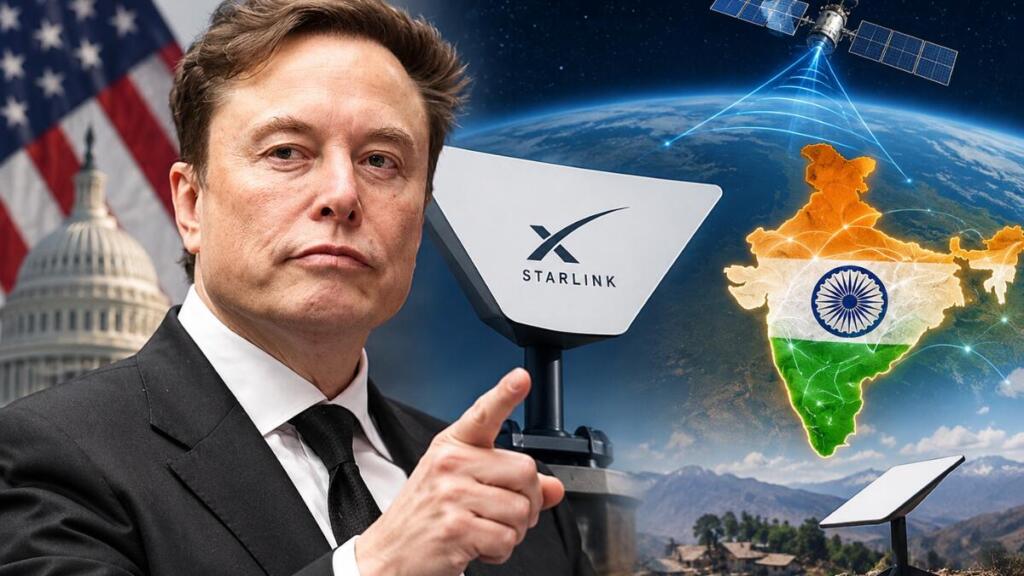
Elon Musk has spent this week telling India that its telecom market is rigged against him. A growing number of Indians are asking a harder question in return. If competition and open access are the principle, why does the principle seem to stop at the American border, particularly when it comes to the Indian IT sector that powers so much of Silicon Valley’s workforce?
The row began on Wednesday, when a day after a senior Starlink executive told the India Mobile Congress that the company was ready to support Prime Minister Narendra Modi’s goal of full national connectivity, Musk posted on X that Starlink was being blocked by “certain oligarchs” protecting a monopolistic chokehold. He did not name them, telling readers instead that they could guess. He described the alleged blocking as a crime against the people of India, and argued that Starlink would bring affordable high-speed internet to people who cannot afford current prices.
The remarks were mainly aimed at two telecom giants. One report noted that the comments appeared directed at Mukesh Ambani, whose Reliance controls Jio, and Sunil Bharti Mittal, founder of Airtel. Musk reportedly went further, asking whether Ambani was the real decision-maker in India’s market, though he offered no evidence of interference in the regulatory process.
Why it reads as trolling
Critics see the episode as a foreign billionaire using a social media post to pressure a sovereign government over a licence that has not yet been granted. The allegation is serious, but it rests on insinuation. It also sits awkwardly with the commercial facts. Former Rajya Sabha MP Priyanka Chaturvedi pointed out that the claim looks misplaced, given Starlink’s planned partnerships with Reliance Jio and Bharti Airtel. It is hard to cast two companies as the villains when they are also prospective partners. Former Telangana minister K.T. Rama Rao challenged Musk to name and shame the oligarchs, a demand that Musk had not answered in the coverage reviewed.
The reaction has not split neatly along party lines. On X, Rahul Gandhi welcomed Musk even as the row intensified, which suggests that Musk’s framing of India’s telecom market as a duopoly-dominated space resonates with some critics of the government and the big business groups, even if the specific allegation remains unproven.
What the government says
New Delhi was quick to reject the charge. The Ministry of Communications described the remarks as “baseless and misconceived” and said the country’s framework for satellite communication services is fair and non-discriminatory. The government’s position, as reported, is that competing satellite operators are at broadly the same regulatory stage. Starlink, for its part, has its infrastructure ready but still awaits spectrum and security clearance. Regulators have also raised security concerns about the service, which the company denies.
That distinction matters. A pending clearance is not the same as a blocked one, and India, like most countries, treats satellite spectrum and national security as matters of state. As one analysis put it, the real risk for Starlink is prolonged regulatory delay rather than direct competitive exclusion.
The question Musk has not answered
This is where the user’s question, and the anger behind it, becomes pointed. Musk’s case rests on the idea that markets should be open and incumbents should not be shielded from challengers. Applied consistently, that logic would suggest a welcoming stance toward the sector in which India is globally competitive: IT services and software talent.
The United States has moved in the opposite direction. In September 2025, the Trump administration imposed a $100,000 annual fee on H-1B visas, with Commerce Secretary Howard Lutnick arguing that the visas had been so cheap that companies hired foreign workers rather than training Americans. The burden falls heavily on India. About 71 percent of H-1B visas go to Indian citizens, most of them in IT and engineering. Wipro’s approvals reportedly fell 62 percent year on year in FY 2026, and White House data cited by one outlet claims registrations from large IT and outsourcing firms dropped 92 percent.
The legal picture is unsettled, and reports conflict. One account says that a federal court struck the fee down on 8 June 2026, and an appeals court declined to pause that ruling on 24 July, meaning it is not being collected for now. Another says Trump has extended the fee despite legal challenges, while the Department of Homeland Security pursues a replacement of roughly $103,000 through formal rulemaking. The most reasonable reading is that the presidential version is blocked in court while the administration seeks a firmer legal footing. Either way, the direction of policy is toward restriction.
The defence, and its limits
Musk’s defenders have a fair rebuttal. He is a company executive, not the American government, and Starlink’s licence in India has nothing legally to do with US visa policy. Every country, India included, restricts market access when it invokes security or sovereignty. Musk also has a long record of lobbying governments for approvals, and Tesla shelved an earlier India entry plan over high import taxes, so his frustration with market barriers is not new or unique to Starlink.
But that defence does not fully dispose of the charge of inconsistency. Musk is not a bystander to Washington’s politics. He led the Department of Government Efficiency in the Trump administration, and Modi met him in Washington earlier this year to discuss collaboration in space, AI and innovation. A man with that much access to both capitals is in a strong position to argue for openness in both directions. Lecturing India on competition while the US tightens the door on Indian technology workers invites exactly the double-standard question now being asked.
What happens next
The practical outcome will not be decided on X. It will turn on whether India grants Starlink its spectrum and security clearances, and on whether Musk can substantiate his claim or lets it fade. On the other side of the world, the fate of the H-1B fee will be settled by the courts and by the DHS rulemaking, and the Indian IT sector will be watching both closely. For now, Musk’s complaint has raised the temperature around Starlink’s launch without moving the licence any closer, and it has handed critics an easy reply: if competition is the cause, it should be everyone’s cause.