
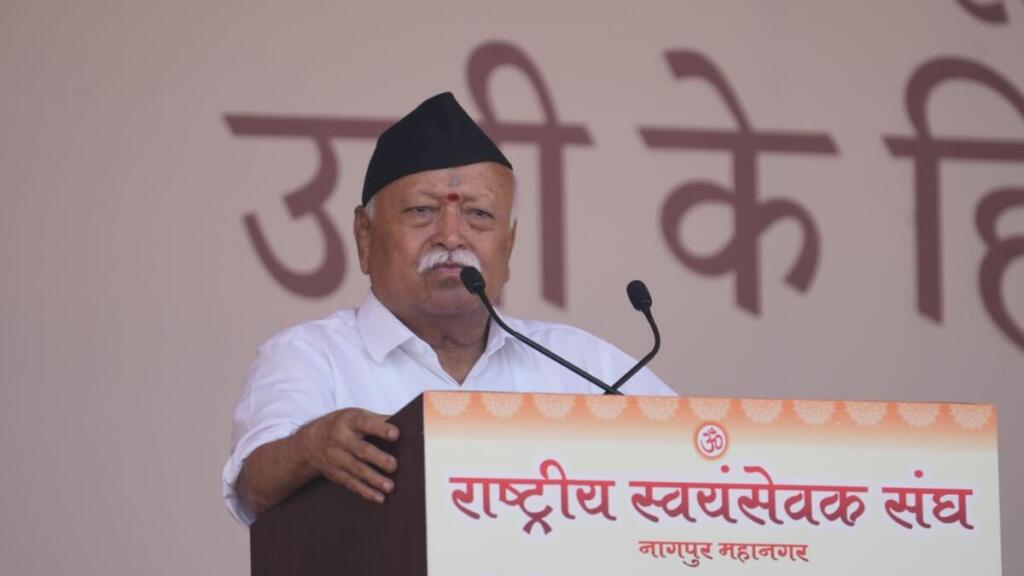
Rashtriya Swayamsevak Sangh (RSS) chief Mohan Bhagwat said on Tuesday that attempts at ‘regime change’ would not succeed in India, alleging that foreign and domestic forces were seeking to weaken the country by exploiting divisions. Addressing the organization’s Vijayadashami gathering in Nagpur, he argued that replacing governments did not necessarily resolve social or political problems.
Bhagwat, who performed shastra puja (weapon worship) at the event, cited Bangladesh, Nepal, France and Albania. “A storm has blown in the West. Look at what transpired in France, Bangladesh, and Nepal. Regime change will not happen in India. Such attempts continue in India as well. India has moved forward with steadfast resolve, and the collective vitality (purushartha) of its society has grown,” he said.
Sheikh Hasina’s government fell in Bangladesh in August 2024, while protests forced Nepal’s KP Sharma Oli from office in September 2025. The circumstances behind the upheavals differed.
Questioning the value of political upheaval, Bhagwat said, “They claim that changing a regime will change the situation, but that has never really happened.” He alleged that some global powers feared India’s growing strength. “Various forces are at work to foster a sense of victimhood, fuelling discontent and chaos. One must remain vigilant to avoid falling prey to attempts at sowing confusion and discord,” he said.
Electoral protests and political row
His remarks came amid protests over alleged irregularities in the Special Intensive Revision (SIR) of electoral rolls, an election commission process to verify and update voter lists. Senior Supreme Court lawyer, Prashant Bhushan recently described the demonstrations as “really a fight for regime change”, while the Bharatiya Janata Party accused organizers of pursuing the government’s removal.
The controversy does not establish every protester’s motives. Bhagwat acknowledged that public grievances could prompt legitimate agitation but insisted that demonstrations should not foster hostility.
“Problems will remain, and protests are inevitable in a democracy. But what should the purpose of protests be? They should be aimed at finding solutions,” he said. He also called on political leaders, protesters and administrators to respect constitutional limits and avoid provoking social divisions.
Pilot’s courage cited as Hindu consciousness
In another part of his address, Bhagwat praised captain Smit Machchhar, who survived an attack by his copilot aboard flydubai flight FZ1073 from Dubai to Tel Aviv on September 30. Despite injuries from a cockpit crash axe, Machchhar managed to open the cockpit door, allowing others to intervene and restrain the attacker.
Two other pilots landed the aircraft safely in Tabuk, Saudi Arabia, and everyone aboard survived. UAE prosecutors described the incident as an attempted suicide attack.
Bhagwat said Machchhar’s actions reflected inherited cultural values that encouraged people to risk their lives to protect others. “This Bharatiyata is Hindu consciousness. It can take everyone along without changing anyone,” he said, describing the outlook as transcending religious practices, food habits and political ideologies.
His description was a cultural interpretation of the pilot’s conduct. Bhagwat’s broader message emphasized social unity, respect for diversity and constructive approaches to national problems.