
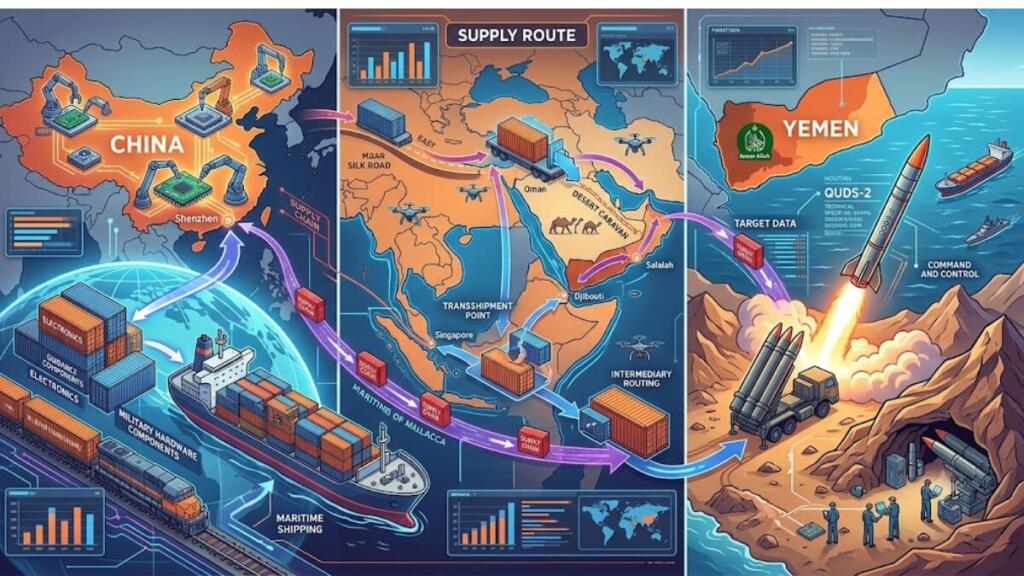
Four shipping containers sailed from China to Yemen’s Aden Free Zone in 2025. Their cargo was never meant to reach the government-held south. It was bound for the Houthi-controlled port of Hodeidah, but Yemeni government forces intercepted it first.
Conflict Armament Research (CAR), a UK-based group that tracks weapons, examined the contents. It found custom airframe sections, stabilising fins and parts for a solid-fuel rocket motor, all made by a Chinese company that markets made-to-order aerospace components. The parts fit a home-built copy of Iran’s Kheibar Shekan ballistic missile.
From assembling kits to building missiles
According to CAR, this marks a shift. For years the Houthis mostly put together weapons from Iranian kits. The seized parts suggest they now want to manufacture long-range missiles themselves.
The range is the worrying part. Iran’s original Kheibar Shekan flies roughly 1,450 km, while estimates for the Houthi version run to 1,800-1,900 km. That would put every part of Israel and much of the Gulf in reach. The group’s Palestine-2 missile is already reported to dive at around 6,000 km/h, which makes interception harder. The danger is not abstract: a Houthi strike on Riyadh’s main airport on 10 October reportedly killed 13 people, the deadliest attack on the kingdom since 2015.
The oil problem
This is awkward for Beijing. China is Saudi Arabia’s biggest trading partner, and trade between them hit $107.5bn in 2024, including 78.6 million tonnes of Saudi crude. Across the six Gulf monarchies, China’s annual trade is around $300bn, and about half its oil imports come from the Middle East.
Riyadh is at war with the Houthis, so Chinese parts reaching the group puts Beijing’s most valuable regional relationship in an uncomfortable position.
Denial, and the evidence against it
China says it does not arm the Houthis and that it honors the UN arms embargo. Outside investigators disagree. UN reporting has identified Chinese firms as the largest source of contraband headed for the group. In 2025, Washington accused Chang Guang Satellite Technology, a military-linked company, of providing imagery used to target shipping. The US Treasury has also sanctioned a Chinese logistics company for moving dual-use goods.
Why Beijing tolerates it
Analysts point to three incentives:
Shipping security: In 2024, Houthi leaders reportedly promised Chinese and Russian vessels safe passage through the Red Sea. For a country whose exports to Europe pass through the Bab el-Mandeb strait, that matters.
A stretched United States: The war involving Iran is absorbing American warships and munitions, giving China more room to advance its own interests.
Iran: China bought over 80 percent of Iran’s seaborne oil exports in 2025. Beijing has little reason to pressure Tehran’s allies.
Iran is still the Houthis’ main backer, supplying designs, components and technical advice. But the war and a US blockade have strained Iranian supply routes, pushing the Houthis to source more directly from Chinese suppliers.
A balancing act with limits
Beijing does not want to choose between Tehran and the Gulf, and it has real leverage with both after brokering the 2023 Saudi-Iran rapprochement. It also has assets to protect nearby, including a naval base in Djibouti.
The strain is showing. After rapid Houthi gains near the strait in September, Riyadh reportedly appealed to Beijing for help. China is said to have urged Tehran privately to restrain the group. Tehran’s answer, reportedly, was that regional calm depends on ending the US-Israeli war against Iran.
The CAR findings challenge China’s claim of neutrality, and they leave Saudi Arabia with a difficult choice about how hard to press its largest customer. Israel, meanwhile, faces a growing long-range missile threat from the south.
For now Beijing’s math looks unchanged: steady oil, open sea lanes and a distracted Washington. Looking away from Houthi supply chains serves all three, but only as long as the conflict stays clear of Chinese interests.
Note: A version of this article was published on TFI Global.