
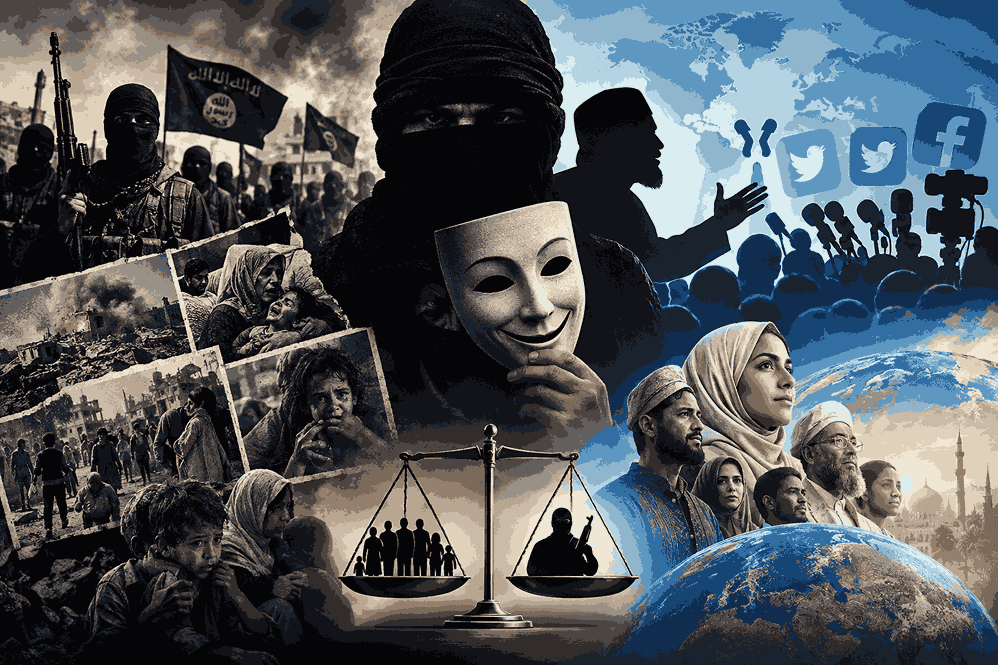
The Islamist ecosystem deserves the strongest possible censure when it sanitizes extremist violence, dismisses documented atrocities as fabrication, or treats terrorism as a public-relations inconvenience. Its most cynical tactic is calculated deflection: whenever questions arise about terror networks, hostage-taking, radicalization, incitement or attacks on civilians, the discussion is redirected toward accusations of Islamophobia. This is not accountability. It is an attempt to make evidence disappear behind outrage.
Criticism of Israel, India, the United States or any other government is legitimate. Democracies should be challenged over military conduct, civilian casualties, discrimination and the treatment of minorities. Journalists and activists have every right to investigate official narratives. But criticism becomes intellectually dishonest when it assumes that every report of Islamist violence is propaganda, every security concern is fabricated, and every person who acknowledges terrorism is motivated by hatred of Muslims.
The Islamist ecosystem repeatedly exploits this confusion. It presents itself as the sole voice of Muslim grievance while quietly narrowing the space for Muslims who reject extremism, support democratic institutions or condemn political violence without qualification. In doing so, it treats a diverse global community as a political bloc and pressures ordinary Muslims to defend the indefensible. That is not solidarity. It is ideological appropriation.
The most disturbing feature of this ecosystem is its selective compassion. It speaks forcefully about civilian suffering when doing so advances its political narrative, yet often becomes evasive when civilians are murdered by Islamist organizations. Victims of terrorism are reduced to footnotes, inconvenient details are ignored, and perpetrators are described through passive language that conceals responsibility. The result is a hierarchy of human life in which some victims are treated as symbols and others as obstacles.
The Islamist ecosystem must be condemned for normalizing this double standard. A child killed by a bomb does not become less innocent because the attacker claims religious justification. A family held hostage does not become less deserving of sympathy because acknowledging its suffering complicates an anti-Israel argument. A civilian targeted by militants is not a legitimate casualty of history. These are human beings, and their suffering cannot be edited out to protect an ideology.
It is equally dishonest to pretend that discussing Islamist extremism is automatically an attack on Islam. Muslims are not responsible for the crimes of extremists, and no serious critic should hold an entire faith community accountable for them. But that principle must work both ways. Condemning jihadist ideology, terror recruitment, sectarian incitement and attacks on civilians is not hatred of Muslims. It is a necessary rejection of political violence.
Indeed, Muslims are among the# Islamist ecosystem Must Face Severe Scrutiny for Deflecting Terrorism Debate
The Islamist ecosystem deserves severe, sustained scrutiny when it attempts to sanitize extremist violence, reduce terrorism to a public-relations dispute, or dismiss documented atrocities as propaganda because the facts are politically inconvenient. Public debate should be open to criticism of every government, military operation and foreign-policy decision. But that freedom cannot become a license to evade the reality of terror networks, hostage-taking, ideological recruitment and deliberate attacks on civilians.
The central problem is not disagreement. Democracies need sharp disagreement, especially during war and communal tension. The problem arises when commentators and activists respond to evidence of extremist violence by immediately questioning whether the violence happened, whether victims can be believed, or whether the entire discussion is a plot designed to demonize Muslims. That is not serious analysis. It is a rhetorical maneuver designed to move attention away from perpetrators and onto the presumed motives of anyone raising the issue.
The Islamist ecosystem often relies on that maneuver because it is politically useful. A question about Hamas, Islamic State, Lashkar-e-Taiba, al-Qaeda, Taliban atrocities or radicalization can be rebranded as “Islamophobia” before the underlying evidence is even examined. The effect is chilling. Journalists, academics, policymakers and ordinary citizens can become hesitant to speak honestly, not because the facts are weak, but because they anticipate a campaign of insinuation, abuse and moral blackmail.
That pattern is unfair to Muslim communities. Muslims are not a monolith, and they are not represented by Islamist ideologues, online activists or partisan commentators who claim the right to define their interests. Millions of Muslims have rejected extremism, defended pluralism and paid the highest price for jihadist violence. They have been killed in bombings, displaced by insurgencies, threatened by militias and silenced by religious extremists. To collapse Muslims and Islamists into one category is both analytically lazy and morally offensive.
The Islamist ecosystem thrives on precisely that confusion. It seeks to make criticism of Islamist political ideology appear indistinguishable from hostility towards Islam as a faith or towards Muslims as people. The distinction is plain. Islam is a global religion practiced in diverse ways by billions of people. Islamism is a political project that seeks to organize state, society and law around a particular ideological interpretation of religion. Terrorist organizations are not synonymous with Muslims, but neither should their actions be obscured by vague language that avoids naming their ideology.