
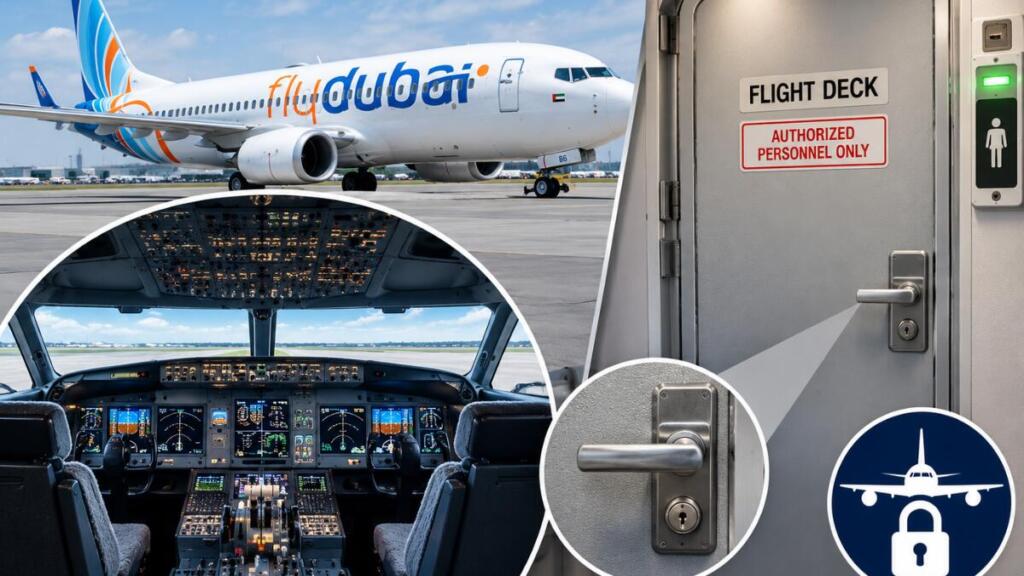
The most-asked question about Flydubai flight FZ1073 is how a stabbed captain got a reinforced cockpit door open. The airline has not yet explained it, and published accounts differ on the details.
FZ1073 left Dubai for Tel Aviv on a Boeing 737 MAX 8. According to One Mile at a Time, which drew on flight-tracking data, the aircraft descended from 34,000 feet to 19,000 feet in just over a minute. Al Jazeera cites Israeli officials as saying the drop was from 33,000 to 17,000 feet. The two figures differ, which is why the exact flight profile awaits investigators.
Israeli officials say the captain and co-pilot were fighting as the aircraft lost altitude. They also say Machchhar managed to activate the release to open the cockpit door, letting passengers and crew in to overpower the co-pilot. Reports that he opened the door despite being injured, according to Reuters.
The door is meant to resist exactly this
Cockpit doors were hardened after 9/11. An inkl report notes that before the attacks, flight deck doors were often as flimsy as lavatory doors. They are now a significant barrier for anyone outside the flight deck.
The design assumes the threat is outside. Cabin crew normally request entry, and the pilots decide whether to release the lock. NPR’s explainer, written after the Germanwings crash, describes the Airbus version: opening the door from the cabin requires a keypad code, with an override if the pilots are incapacitated. Boeing’s 737 uses a different arrangement, and Flydubai’s configuration hasn’t been published. As a general principle, though, the pilots’ own controls can unlock the door from the inside, and that is the part that matters here.
That is the design gap this incident exposes. The door can’t tell a captain letting in help from a pilot letting in an attacker. If one pilot turns hostile, the other pilot is the only person on the flight deck who can open it. If he is hurt, the door stays shut until help arrives, whether or not that help is needed.
Why the mechanics are still disputed
There are conflicting details:
- The door’s state. The Jerusalem Post reports passenger Yaniv Hayoun telling Prime Minister Netanyahu that Machchhar reportedly unlocked the cockpit door before losing consciousness. Hayoun also said the door was unlocked but Machchhar was close enough that it was difficult to open. That suggests the lock was released but the door was physically obstructed.
- The geometry. In a Substack analysis, writer Kedar Gadgil, who says his questions do not require an ATPL to ask, points out that he believes the 737 MAX door opens aft into the cabin. If so, a man lying on the cockpit side wouldn’t normally block it. Gadgil allows that “behind the door” may simply be imprecise wording. This is one writer’s reading and has not been confirmed.
- His movements. The same analysis raises how a seriously injured captain got from the left-hand seat to the door at all. OneWorldNews says passengers described him activating the door release mechanism, but these are second-hand accounts.
What happened after the door opened
Passengers and crew entered and restrained the co-pilot. Reports differ on who flew the aircraft afterwards. Outlook India says additional Flydubai crew members took control. One Mile at a Time says two off-duty pilots travelling as passengers flew the aircraft. Either way, the plane diverted to Tabuk in Saudi Arabia. Flydubai has confirmed the cockpit altercation, the diversion and the safe landing. It says the underlying reasons and motives remain unknown, and the allegations have not been independently established.
Newsweek reports that a passenger, a dentist, treated Machchhar for severe wounds.
The key questions are who operated the door controls and when, whether the lock was released or the door was forced, and how the captain moved with his injuries. The flight data and cockpit voice recorder will probably settle these. Until then, the version that holds up is that a wounded captain got help into the cockpit, and the mechanics remain unverified.