
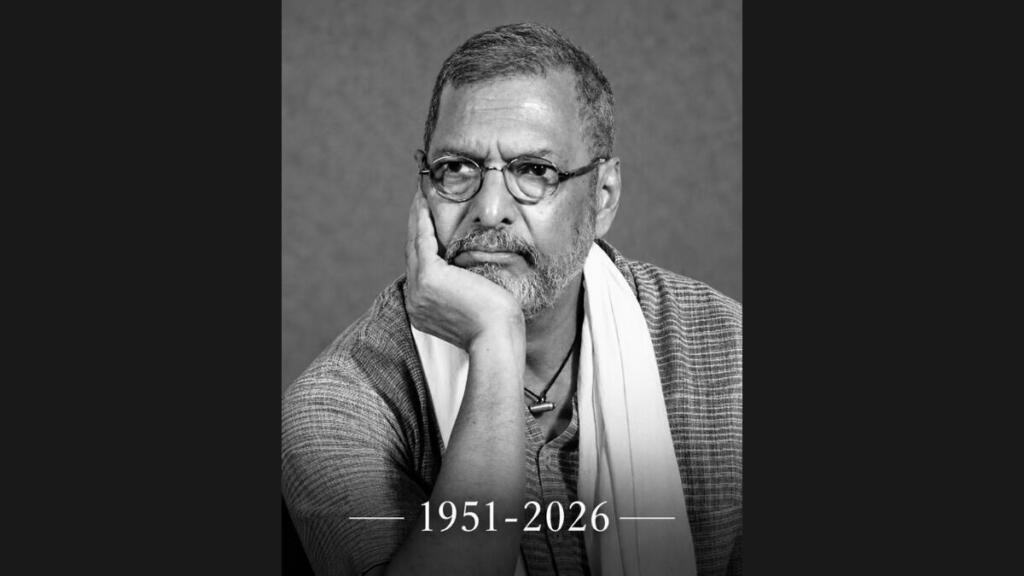
Nana Patekar, one of Indian cinema’s most acclaimed and least conventional actors, has died at 75. He died on Thursday after a severe cardiac arrest at his residence in Goa. Reports say he passed away at 5:20 AM, and 45 minutes of continuous CPR could not revive him. A medico-legal case has been registered and a post-mortem will be conducted, a routine step in such cases.
His career spanned nearly five decades across Hindi and Marathi cinema, and it was built on craft rather than conventional stardom.
The Unlikely Star
Patekar never looked or behaved like a matinee idol. He had a rasping voice, an intense gaze and a blunt manner, and he showed little interest in industry politics or image-building. He came to films through Marathi theatre, debuting with Gaman (1978) before moving into Hindi cinema. He also served in the Territorial Army, and lent his services in the Maratha Light Infantry during the 1999 Kargil War.
Stars typically bring one persona to every film. Patekar brought a different man each time, and directors kept casting him because he could make even a short role feel like a complete life.
The Roles That Defined Him
Parinda (1989): As the gangster Anna in Vidhu Vinod Chopra’s crime drama, he played a villain whose cruelty was calm and casual. The role won him a National Award for Best Supporting Actor.
Krantiveer (1994): As the angry, idealistic Pratap Narayan Tilak, he delivered monologues that audiences repeated for years. It earned him the National Award for Best Actor.
Prahaar (1991): He directed and starred in this drama about soldiers and disillusionment, drawing on his own military training. It marked his directorial debut.
Khamoshi: The Musical (1996): In Sanjay Leela Bhansali’s debut, he played a deaf-mute father and expressed tenderness and grief without speaking a line, the opposite of his fiery image.
Agni Sakshi (1996): The performance won him another National Award for Best Supporting Actor.
Ab Tak Chhappan (2004): As the weary encounter specialist Sadhu Agashe, he gave Hindi cinema one of its more morally ambiguous screen cops.
Welcome (2007) and Welcome Back (2015): He drew wide praise as the good-hearted gangster Uday Shetty, a “don” who was also a hopeless romantic. The role showed that his comic timing was as precise as his menace, and it gave him some of his biggest commercial hits.
Raajneeti (2010): As a politician in Prakash Jha’s political thriller, he added another shrewd power-broker to his gallery.
Natsamrat (2016): As an ageing stage actor undone by family betrayal, he drew on his theatre roots. Many critics and fans regard it as his finest work.
His later projects included Vanvaas (2024), where critics praised the cast’s performances, Patekar’s especially, and O’Romeo (2026), one of his final screen appearances.
Beyond the Screen
Patekar’s offscreen life was as unvarnished as his acting. He lived modestly, reportedly in a one-bedroom flat in Mumbai, and was close to his mother, who died in 2019 at 99. He was also known for the Naam Foundation, which he co-founded to support drought-hit farmers in Maharashtra. He received the Padma Shri in 2013.
In an industry that rewards charisma, Patekar showed that an actor’s work can outlast his fame. Younger performers still study his dialogue delivery, his stillness and his willingness to play angry, broken and flawed men. He is survived by his son, Malhar.