
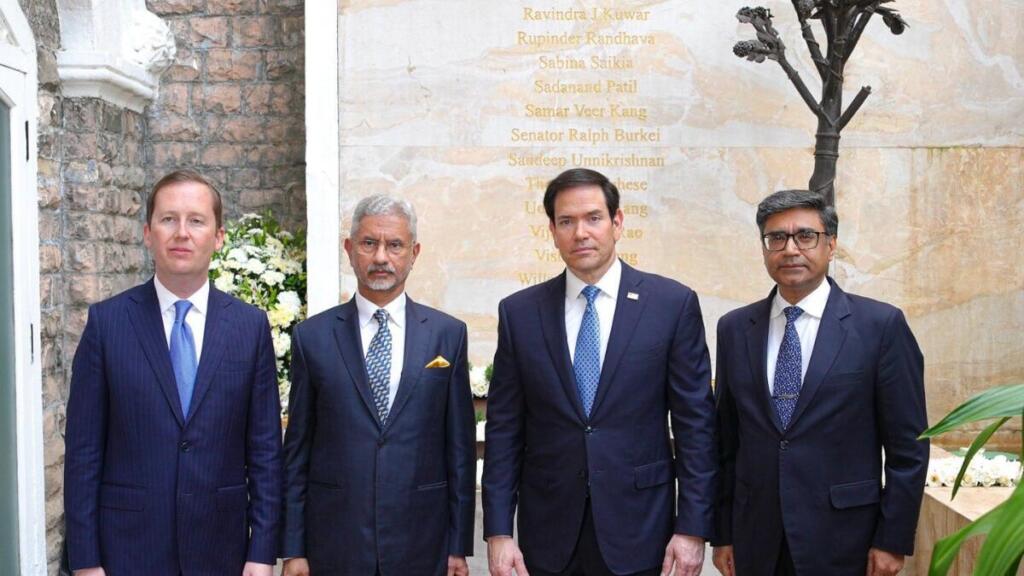
US Secretary of State Marco Rubio has arrived in Mumbai for the second leg of a trip that has already produced a diplomatic row before a single handshake. He is in India from October 17 to 22, with Mumbai and Jamnagar on the itinerary after a stop in Samarkand. His bilateral with External Affairs Minister S. Jaishankar is set for today, to be followed by the American mission’s celebration of the 250th anniversary of US independence, with Jaishankar as guest of honour.
The question hanging over the visit is not on the agenda: who gets to announce what India’s foreign minister will do.
The announcement
US Ambassador Sergio Gor told the Bloomberg New Economy Forum in Delhi that Rubio would meet Indian government officials in Mumbai. He added that “we expect that minister Dr S Jaishankar will be there,” along with officials who would travel up from Delhi to see the Secretary of State.
India’s own foreign ministry had said nothing. Congress’s Jairam Ramesh asked why the MEA was silent and since when announcing the minister’s meetings had been outsourced to someone other than its official spokesperson. Only after that did the ministry act: the MEA confirmed on Friday that Jaishankar would hold talks with Rubio on October 20.
The order of events is the story. Washington stated the schedule first, and Delhi confirmed it after being pushed.
Skipping Delhi
The setting sharpens the optics. Reporting by The Wire says this is the first time a US secretary of state has visited India without planned meetings in New Delhi. Rubio’s itinerary instead includes Jamnagar, where he will meet “senior government officials” at the base of the Ambani family’s business interests. The visit follows Elon Musk calling Mukesh Ambani the “real boss of India” last week.
For critics, that adds up to a visit organised around American commercial and energy priorities, with the government’s ministers coming to him. Jamnagar is home to Reliance’s refining complex, which can process around 1.4 million barrels of crude a day, and the State Department says the talks will cover enhanced energy cooperation and meetings with business leaders.
The Congress charge
The opposition has not been subtle. Rahul Gandhi said Rubio had “summoned his employee to Mumbai” and told Modi his MEA officials were confused. Pawan Khera went further, claiming Rubio was skipping Delhi and had summoned Jaishankar, a move the two called a “new low.” Ramesh tied the episode to an older grievance: India learned from Rubio himself, on the evening of May 10, 2025, that Operation Sindoor had been halted.
“Summoned” is the opposition’s word, and no official account describes it that way. But the complaint underneath it is harder to dismiss. A partnership of equals does not usually have one side’s ambassador narrating the other side’s minister’s calendar.
A pattern, not a slip
Gor has made a habit of fronting the relationship in public. When Rubio landed in Kolkata in May, Gor posted that trade, technology, defence and the Quad were among the items to “discuss and advance.” After the Modi meeting, he posted that Rubio had extended Trump’s invitation for Modi to visit the White House.
Ambassadors are paid to publicise their government’s business. But the more Gor speaks for both capitals, the more the relationship looks scripted from Washington, and the less room New Delhi has to set its own tempo, which matters when India is bargaining.
What’s on the table
The timing is not accidental. Rubio’s visit came days after the October 18 deadline under the Graham Act, which provides penalties on countries buying Russian energy. The two sides are trying to deepen economic ties despite disagreements over tariffs and Russian oil. The bilateral trade deal also remains unfinished. Jaishankar has said the two sides have reached “landing points” in the negotiation.
In talks where energy sourcing is one of Washington’s main asks, protocol is part of the negotiation. Who speaks first, who travels, and who sets the venue all signal who holds the leverage.
The government’s answer
The MEA’s response was dismissive. Spokesperson Randhir Jaiswal said India has been hosting foreign dignitaries outside Delhi for about a decade. The ministry also noted that Jaishankar was hosting the UAE’s foreign minister in Mumbai the same days, which suggests the city is being used as a diplomatic venue in its own right. And Gor’s words were an expectation about his own delegation’s plans, not an instruction, and the substance proved accurate.
Congress, for its part, has political reasons to inflate the story. Whether this was a slip at a conference or part of a pattern is what the next few days of readouts will test: who briefs first, what is said about Russian crude, and whether the trade deal’s “landing points” turn into an announcement.