
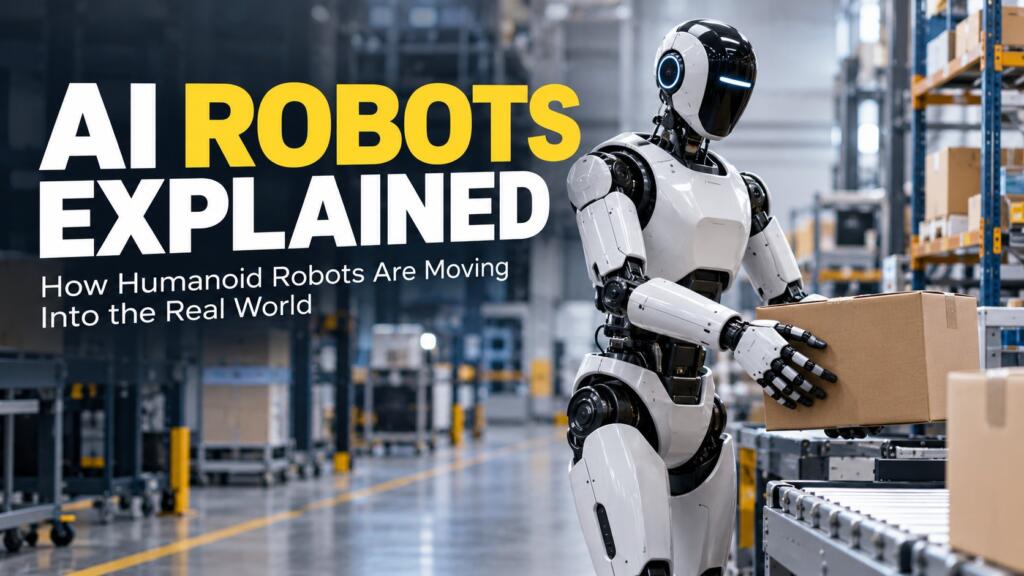
Yes, but mostly in early commercial and industrial settings rather than homes. Modern humanoid robots combine human-compatible bodies with AI for perception, instruction following, planning and movement. Their strongest use cases are in structured environments such as factories, warehouses and logistics centers. A convincing demo, however, is not the same as sustained operation on a production floor.
Key Takeaways
- Humanoid robots are designed for spaces and tools built around people, but the human form is not always the best engineering choice.
- Advances in vision-language-action models, simulation, sensors and computing are expanding what robots can handle.
- BMW, GXO and Hyundai provide useful examples of humanoids moving from research toward industrial work.
- Commercial value depends on reliability, safety, uptime, integration and task economics.
- Near-term adoption is more likely to focus on narrow, repeatable jobs than general-purpose robot workers.
What Is an AI Humanoid Robot?
An AI humanoid robot is a machine whose body resembles key parts of the human form, usually with a torso, two arms and legs or another mobile base. The design can help it operate in environments built for people.
AI may help the robot perceive objects, interpret instructions, plan actions and adapt when conditions change. This is often called physical or embodied AI because software must act through a machine in a world of weight, friction and uncertainty.
“AI-powered” does not imply human-level intelligence or complete autonomy. Traditional industrial robots also remain better suited to many fixed, high-speed jobs. Humanoids become interesting where mobility and flexible manipulation may let one machine work across several human-designed tasks.
Why Are Humanoid Robots Advancing So Quickly Now?
Three trends are reinforcing one another.
1. Better AI Models
Newer robotics systems connect visual observations, language instructions and robot state to actions, action plans or policies. Vision-language-action models, or VLAs, can help interpret what a robot sees and what it has been asked to do. Those decisions are then executed through the robot’s control stack.
2. More Training Data and Simulation
Robots need data about movement, contact, force and object interaction. Developers collect it through human demonstrations, teleoperation, synthetic data and simulation. Simulation lets robots practice large numbers of attempts without repeatedly risking real equipment.
3. Improved Hardware
Better actuators, cameras, force sensors, batteries and onboard processors have made mobile manipulation more practical. Hardware still has to survive long shifts and repeated contact, so commercial readiness cannot be judged from software capability alone.
How Does a Humanoid AI Robot Actually Work?
A useful model is Sense → Understand → Plan → Act → Correct.
- Sense: Cameras, depth sensors, joint encoders and force sensors collect information about the environment and the robot’s own position.
- Understand and Plan: AI identifies objects, interprets instructions and selects a sequence of actions. “Move this container onto that conveyor” may require decisions about where to walk, how to grip and where to place the load.
- Act: Control software converts the plan into coordinated joint, hand and whole-body movement while maintaining balance.
- Correct: Sensor feedback lets the robot compare results with expectations and adjust if an object slips or lands out of position. This feedback loop matters because physical errors can damage equipment or create safety risks.
Where Are Humanoid Robots Already Moving Into the Real World?
Manufacturing: BMW and Figure
BMW provides a well-documented example of sustained humanoid work. According to BMW Group, Figure 02 worked at its Spartanburg plant for roughly ten months in 2025, moving more than 90,000 components over about 1,250 operating hours while supporting production of more than 30,000 BMW X3 vehicles.
Its task was narrow: retrieving and positioning sheet-metal parts for welding. That makes the case useful as evidence of repeatable industrial work, not open-ended factory autonomy.
Figure AI said Figure 03 returned to BMW in June 2026 to demonstrate a more complex logistics and parts-sequencing workflow. The company described it as the first demonstration of Figure 03 performing that logistics workflow at BMW, not a sustained production deployment comparable with Figure 02.
The growing commercial interest in humanoid robotics has also created market interest around companies developing these systems. Readers following robotics-related instruments can, for example, trade UNITREE USDT futures, while keeping the trading product separate from the operational progress of humanoid robots themselves.
Warehousing and Logistics: Agility Robotics Digit
GXO and Agility Robotics moved from proof-of-concept testing to a multi-year commercial deployment of Digit in warehouse operations. Agility Robotics later reported that Digit had moved more than 100,000 totes at GXO’s Flowery Branch facility.
The significance is not that Digit can do every warehouse job. It is that a humanoid is being used for a defined, repetitive workflow where throughput can be measured over time.
Automotive Training: Boston Dynamics Atlas
Boston Dynamics unveiled the product version of electric Atlas in January 2026 and said deployments were scheduled for Hyundai and Google DeepMind.
On September 21, 2026, it opened the Robotics Metaplant Application Center at Hyundai Motor Group Metaplant America in Georgia. Atlas robots are training there on manufacturing workflows including logistics preparation and automotive-parts sequencing. The center is a training and application-development environment, not evidence of sustained production deployment across Hyundai factories.
When Does a Humanoid Make Sense?
The main advantage of the humanoid form is compatibility with existing infrastructure. Doors, shelves, tools and workstations are already designed around human reach and movement. A capable humanoid may therefore fit into a workflow without requiring the facility to be rebuilt around a specialized machine.
But purpose-built automation can still be faster, cheaper or easier to maintain.
| Task or environment | Likely better fit |
| Fixed, high-speed welding | Industrial robot arm |
| Repetitive pallet movement | AMR or forklift automation |
| Inspection across large facilities | Wheeled or quadruped robot |
| Multiple manipulation tasks in human-designed spaces | Potential humanoid use case |
The relevant question is whether a humanoid improves total workflow economics or flexibility compared with simpler automation.
What Is Still Holding Humanoid Robots Back?
Reliability and Uptime
Industrial equipment must repeat tasks for long periods. Frequent resets, recalibration or human intervention can quickly erase the value of flexibility.
Dexterity and Generalization
Robots still struggle when objects, layouts or conditions differ from training. Handling many different shapes and grips remains difficult.
Safety
Humanoids may work near people while carrying loads and generating substantial force. Deployment requires physical safeguards, workflow design, monitoring and fail-safe behavior. BMW said its Figure 02 pilot informed measures including additional barriers and improved factory connectivity.
Cost and Maintenance
Purchase or lease price is only part of the bill. Charging, maintenance, integration, supervision, spare parts and downtime all affect whether a deployment makes economic sense.
How to Tell a Real Deployment From a Demo
Ask five questions:
- Is the robot completing a useful task or only a staged demonstration?
- How long has it operated in the real environment?
- How often does a person need to intervene?
- What throughput, uptime or task-volume data has been disclosed?
- Does the humanoid offer an advantage over cheaper existing automation?
These questions help distinguish a laboratory demonstration, customer pilot, recurring production operation and commercial deployment. Each is a meaningful milestone, but they represent different levels of maturity.
What Comes Next for Humanoid AI Robots?
Near-term adoption is most likely in manufacturing, warehousing, logistics and other structured workplaces. Useful signals of progress include longer autonomous operation, better handling of varied objects, faster task training, lower maintenance costs and stronger performance across changing environments.
Homes are harder because they contain unpredictable layouts, objects and human activity. A more useful benchmark than predicting mass worker replacement is whether humanoids can perform a growing range of tasks safely, repeatedly and at a cost that makes deployment worthwhile.
Conclusion
Humanoid robots are moving from research toward real industrial use, but the transition is gradual. AI is improving perception and planning, while better hardware turns those capabilities into physical action. The key test is whether robots can deliver useful work safely, repeatedly and economically.