
The defence ministry on Thursday signed contracts worth about ₹4,106 crore for two indigenous systems: GSAT-7C, a dedicated communication satellite for the Indian Air Force (IAF), and Varunastra heavyweight torpedoes for the Navy.
The ₹2,563-crore satellite contract went to state-run New Space India Limited, Bengaluru. The ₹1,543-crore torpedo order went to Bharat Dynamics Limited (BDL), Hyderabad. Both were signed in New Delhi in the presence of Additional Secretary and Director General (Acquisition) A. Anbarasu.
What GSAT-7C will do
GSAT-7C is meant to give the IAF a secure link that works beyond line of sight, meaning aircraft, ground stations and units can stay connected even when radio horizons or terrain would otherwise cut them off. The ministry says it will improve the “secure, resilient and seamless” communications of IAF assets.
The project was first cleared by the Defence Acquisition Council in November 2021 at ₹2,236 crore. That approval covered the satellite and ground hubs for real-time connectivity of software-defined radios, which are radios whose functions are set by software and can be updated or encrypted more flexibly than older hardware. The latest release does not say whether the new contract covers those ground hubs or the launch, and it gives no launch date.
It joins an existing family. ISRO launched GSAT-7A on Dec. 19, 2018 for the IAF and Army, after the Navy’s GSAT-7 earlier. GSAT-7C is a satellite dedicated to secure software-defined-radio links, unlike the broader communication roles of its predecessors. In practice, that means the air force gets a communications backbone it controls rather than one shared across services.
What Varunastra does
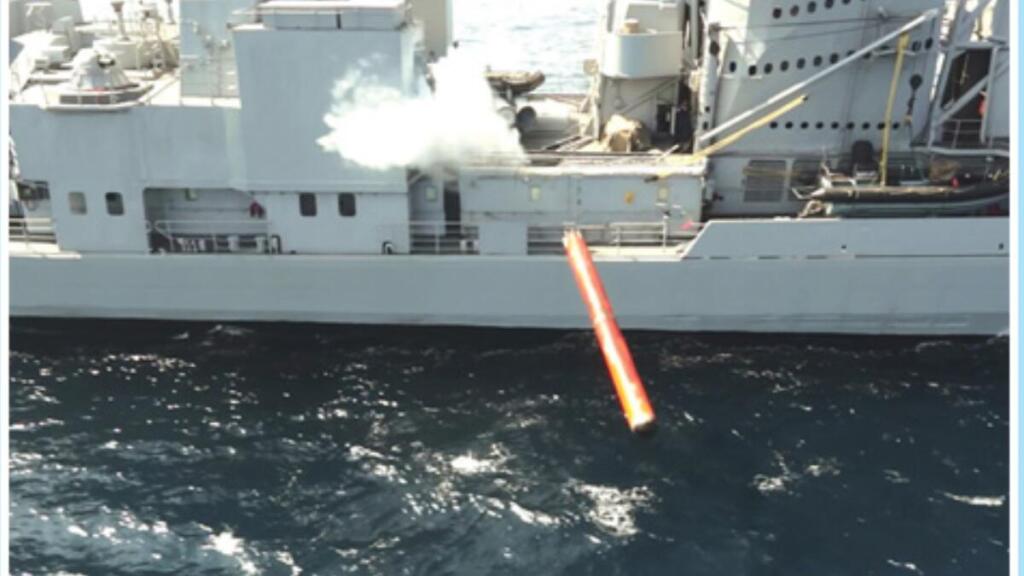
Varunastra is a ship-launched, electrically propelled heavyweight torpedo designed to hunt submarines. It was developed by the Naval Science and Technological Laboratory (NSTL) in Visakhapatnam, a DRDO lab, and is manufactured by BDL.
It is 533 mm in diameter and nearly 7.8 metres long. BDL lists an operating depth of 8 to 600 metres and speeds of up to 40 knots, and a combat version weighing about 1,850 kg. Publicly cited figures put its range at around 40 km with a roughly 250-kg warhead. The ministry says it can engage enemy submarines at long ranges, helped by advanced manoeuvring.
The torpedo homes in on targets acoustically and uses autonomous guidance algorithms and countermeasure-resistance features. This lets it track quiet submarines in shallow and deep water without a human steering it. It has an indigenous content of over 95%.
The Navy first received Varunastra from NSTL in 2016, and BDL has been producing it since. It is meant to arm ships that carry heavyweight torpedoes, including destroyers, frigates and anti-submarine corvettes.
The ministry framed both contracts as steps towards self-reliance under ‘Aatmanirbhar Bharat’ and ‘Make in India’. The satellite reduces dependence on shared or commercial links for sensitive military traffic, while Varunastra strengthens anti-submarine warfare at a time when more submarines are operating in the Indian Ocean.