
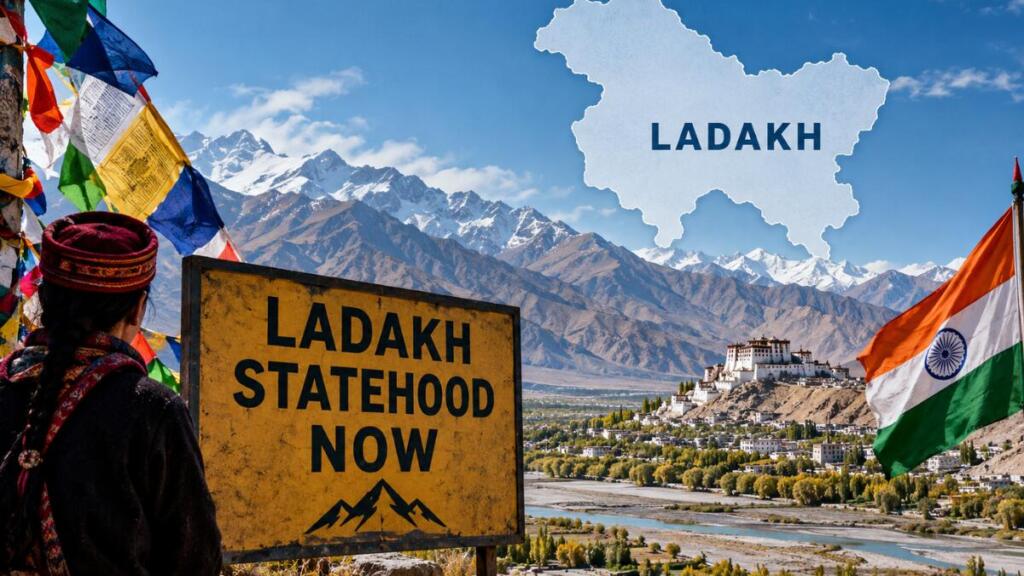
For nearly five years, “statehood for Ladakh” has been the rallying cry echoing through Leh and Kargil’s streets, hunger strikes and Jantar Mantar protests. That demand now appears to be losing its edge — not because the movement has faded, but because its leaders have recalibrated what they’re actually asking Delhi for.
According to The New Indian Express, the two groups spearheading Ladakh’s political movement — the Leh Apex Body (LAB) and the Kargil Democratic Alliance (KDA) — have quietly dialled down their long-standing push for full statehood. In its place, they’re now pressing for something narrower but arguably more attainable: a fully elected legislature, complete with their own MLAs and a Chief Minister, functioning within Ladakh’s existing status as a Union Territory.
The shift isn’t just a change in wording. It marks a departure from years of insisting that only full statehood — undoing the region’s 2019 split from Jammu and Kashmir — could safeguard Ladakh’s land, jobs and ecology. LAB chairman Chering Dorjey Lakruk was blunt about the change, telling reporters, as cited by Kashmir Observer, that the groups have “abandoned the demand for statehood” to instead concentrate on winning genuine self-governance inside the UT framework.
What They’re Asking For Now
The revised ask, as it stands, has three key components:
- An elected Legislative Assembly for Ladakh
- Directly elected MLAs and a Chief Minister to head the government
- Control over police and law and order
That last point has proven to be the real sticking point. Ladakh’s representatives argue that an elected government without command over policing would be self-rule in name only — a concern that has kept this particular issue unresolved through multiple rounds of talks with the Centre.
Why the Retreat From Statehood?
The climbdown doesn’t come out of nowhere. Delhi has been signalling for months that full statehood, and an accompanying Sixth Schedule status that grants autonomy to tribal areas, was off the table. Earlier this year, the Ministry of Home Affairs reportedly raised concerns about the financial viability of a Ladakh state, questioning where the resources for an independent government would come from — even as LAB leaders countered that the region could simply be granted the special-category status it enjoyed as part of the erstwhile state of Jammu and Kashmir.
With that door effectively closed, the pivot toward an elected UT government looks like a pragmatic recalibration — asking for a workable structure within the boundaries Delhi has signalled it’s willing to negotiate on, rather than continuing to press for a bigger structural change that hasn’t gained traction.
Talks between the Centre and the Ladakh groups are set to resume in the first week of October, with the question of policing powers likely to dominate the agenda once again. Until that’s settled, the shape of any final arrangement — and how much genuine autonomy it hands Ladakh’s residents — remains an open question.