
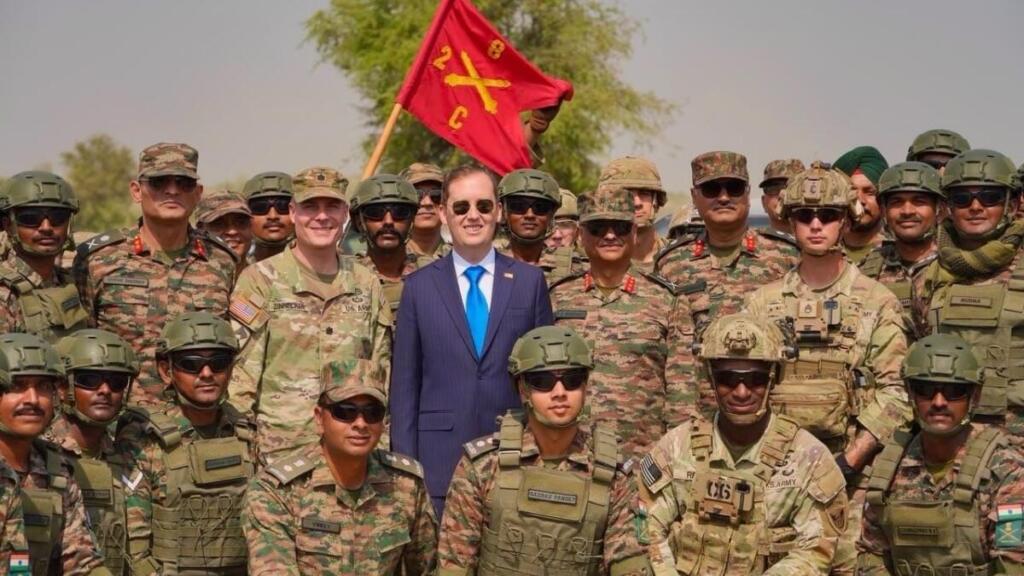
US Ambassador to India Sergio Gor visited the Mahajan Field Firing Range (MFFR) in Rajasthan on Thursday, September 24, where Indian and American troops are conducting joint drills under Exercise Yudh Abhyas 2026, and used the occasion to underline the strength of the two countries’ defence relationship.
Gor posted on X that it was impressive to see US and Indian forces training together at the Mahajan Field Firing Range, adding that the exercise reflects the strength of the two nations’ defence partnership — citing trust, readiness, interoperability, and shared purpose — and that he was proud of what the US Army and the Indian Army (referenced via its handle, @adgpi) are achieving together.
This followed an earlier post the same day in which Gor said he had just touched down at Mahajan Field Firing Range in Rajasthan for Yudh Abhyas 2026, describing it as India’s largest bilateral defence exercise with any nation, and said he was looking forward to seeing US and Indian troops train side by side.
What Exercise Yudh Abhyas 2026 involves
Now in its 22nd edition, Yudh Abhyas began on September 15 and is being conducted simultaneously at two locations: the Auli Foreign Training Node in Uttarakhand and the Mahajan Field Firing Range in Rajasthan. Around 600 personnel from each side are taking part. The exercise opened with Major General Amaresh Gunjan, General Officer Commanding of the Indian Army’s 14 Infantry Division, and Colonel Benjamin Jackman, Commander of the US Army’s 1st Infantry Brigade Combat Team, 11th Airborne Division, addressing the participating contingents.
The drills are focused on strengthening joint military capability for Integrated Battle Groups operating in mountainous and semi-mountainous terrain, with a particular emphasis on infantry operations, alongside broader goals of improving interoperability, exchanging best operational practices, and refining joint planning and execution.
At the Mahajan Field Firing Range specifically, troops have conducted joint firing and Observation Post training using a range of weapons systems, including the M777 Ultra-Light Howitzer, the Dhanush artillery gun, and the Pinaka multi-barrel rocket launcher, alongside L70 air-defence guns and M-LIDS counter-drone systems. Observation Post teams from both armies trained together on landmark indication, target identification, engagement procedures, transmission of fire orders, and fire correction — with a key focus on interoperability in the planning, coordination and execution of fires. Gor had earlier posted footage of soldiers from both sides exchanging knowledge on weapons, equipment, and unmanned systems as the exercise progressed.
Yudh Abhyas has grown into one of the most closely watched fixtures on the India-US defence calendar, and Gor’s back-to-back posts through the exercise — from its launch on September 15 to his ground visit on September 24 — reflect how actively the current US ambassador has been using the exercise to publicly signal the depth of the bilateral military relationship, even as broader India-US ties navigate friction on the trade and tariff front.