
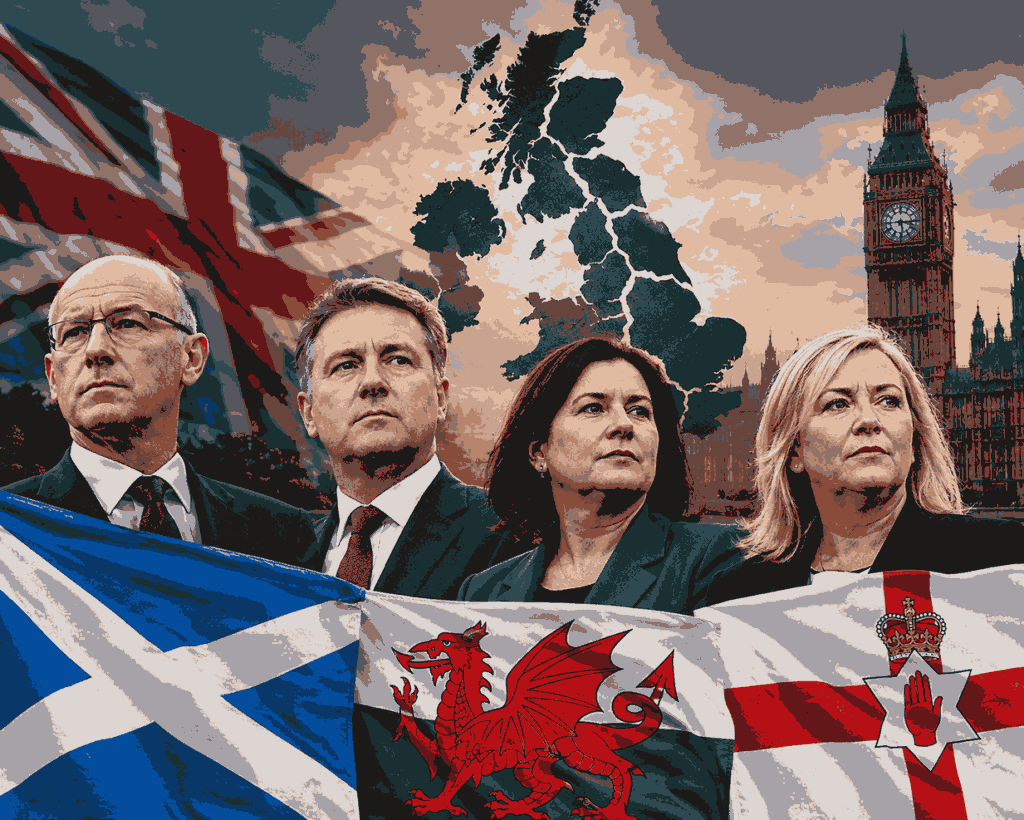
The possibility of a Break-Up of the United Kingdom has returned to the centre of political debate after the leaders of Scotland, Wales and Northern Ireland moved towards a joint declaration asserting their right to determine their constitutional futures. The unprecedented gathering in Cardiff brings together leaders of political movements that have long demanded greater autonomy or independence from Westminster, creating a fresh challenge for the UK government.
The meeting involves Scottish First Minister John Swinney, Welsh First Minister Rhun ap Iowerth and Northern Ireland First Minister Michelle O’Neill. Sinn Féin president Mary Lou McDonald is also expected to participate. The leaders are associated with the Scottish National Party, Plaid Cymru and Sinn Féin respectively, parties that have different political priorities but share a desire for greater national self-determination.
The proposed declaration is expected to cover constitutional self-determination as well as cooperation on the economy, energy, European relations and international affairs. The parties are also expected to sign a memorandum of understanding aimed at coordinating their positions on constitutional change. Such coordination could give the independence movements greater political visibility and strengthen their argument that Westminster should recognise the right of the devolved nations to determine their own futures.
For Scotland, the question of independence remains one of the most contentious issues in British politics. Scotland rejected independence in the 2014 referendum, but the issue did not disappear. The UK’s subsequent departure from the European Union intensified the debate because Scotland had voted strongly to remain in the EU. The latest initiative therefore represents another stage in a long-running political dispute rather than an entirely new movement.
Swinney has argued that the political situation has changed significantly, pointing to the fact that pro-independence parties now lead governments in Scotland, Wales and Northern Ireland. He has criticised Westminster’s approach and suggested that the existing constitutional arrangement may no longer be sustainable. His comments have contributed to renewed speculation about a possible Break-Up of the United Kingdom.
The response from Prime Minister Andy Burnham has been considerably more cautious. Burnham has indicated that another Scottish independence referendum could be considered if there were a clear consensus in favour of one, but he has rejected the idea of authorising another vote without stronger evidence of public support. He has also argued that there is currently no clear indication that a majority in Northern Ireland wants to leave the United Kingdom.
Wales brings another dimension to the dispute. Plaid Cymru emerged as the largest party in the Welsh Senedd following the May elections, allowing Rhun ap Iowerth to become First Minister. While Welsh nationalism has traditionally focused heavily on expanded devolution rather than immediate independence, the new political alignment has given the debate fresh momentum. Plaid Cymru is also seeking greater control over Welsh revenues and resources, including income associated with the Crown Estate and offshore energy development.
Northern Ireland’s position is different again because its constitutional future is closely linked to the question of Irish reunification. Sinn Féin has long supported a united Ireland, while Northern Ireland’s constitutional status remains governed by the principle that any change must reflect the democratic wishes of its people. The involvement of Sinn Féin’s leadership therefore gives the Cardiff initiative an additional international and constitutional dimension.
The possibility of a Break-Up is nevertheless far from inevitable. A joint political declaration does not itself create a legal mechanism for independence, and any attempt to alter the UK’s constitutional structure would involve complicated political, legal and economic negotiations. Questions surrounding borders, public finances, defence, trade, currency, international treaties and membership of organisations such as the European Union would all have to be addressed.
The emerging alliance could, however, place considerable pressure on Westminster. If Scotland, Wales and Northern Ireland continue to coordinate their demands, the British government may increasingly face calls not only for individual constitutional settlements but for a broader reassessment of the UK’s system of devolution.
For supporters of the Union, the development represents a serious warning that the country’s constitutional settlement cannot be taken for granted. For nationalists, it is an opportunity to demonstrate that demands for self-determination extend beyond Scotland and form part of a wider debate about how power should be distributed across the United Kingdom.
The immediate question is whether the Cardiff initiative develops into a sustained campaign capable of forcing Westminster to make significant concessions. The Break-Up of the UK is not an accomplished fact, but the political forces advocating constitutional change are becoming increasingly coordinated.
The coming months could therefore prove crucial. If public support for independence or expanded autonomy grows, Westminster may find it increasingly difficult to contain the debate. Conversely, if voters remain unconvinced by the case for constitutional separation, the initiative could ultimately strengthen arguments for reform within the existing Union rather than its dissolution.
For now, the Break-Up remains a possibility rather than a certainty. But the fact that leaders from three constituent nations are openly coordinating around self-determination marks a significant moment in Britain’s modern constitutional history.