
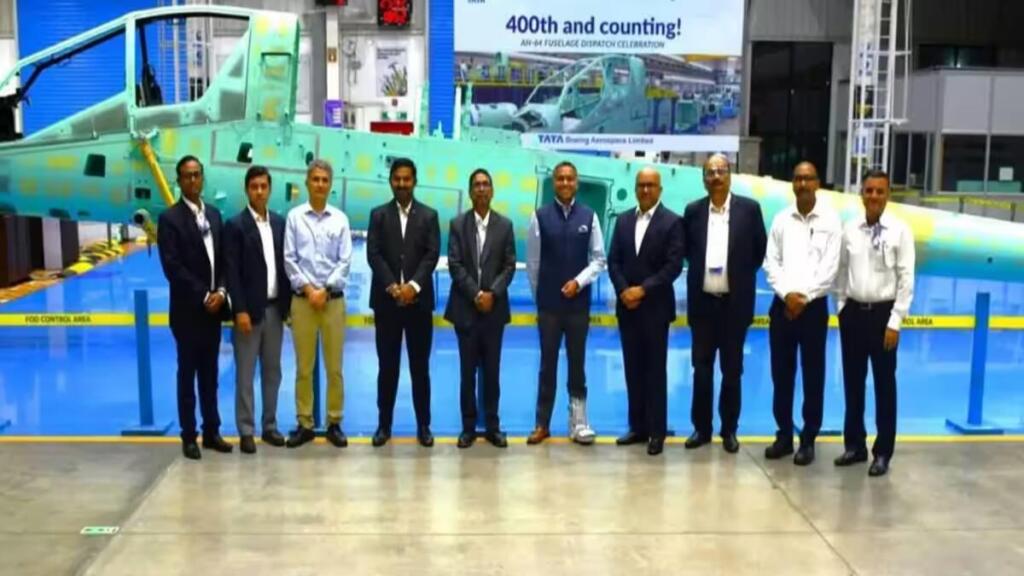
Tata Boeing Aerospace Limited (TBAL), the joint venture between Boeing and Tata Advanced Systems Limited (TASL), has rolled out its 400th fuselage for the AH-64E Apache attack helicopter from its 52,000 sq. m. aerospace manufacturing facility in Hyderabad.
With approximately 1,300 Apache aircraft currently in operation across 19 countries, the milestone highlights India’s growing role in supporting one of the world’s most iconic rotorcraft platforms. The fuselages are built in India and integrated into final Apache aircraft supplied to customers worldwide, including the U.S., as well as closer to home — six Apaches were delivered to the Indian Army in 2025, and the Indian Air Force currently operates a fleet of 22 AH-64E Apaches.
About the Plant
TBAL was established in 2016 and employs more than 750 engineers and technicians who rely on advanced robotics, automation, and aerospace manufacturing technologies to produce fuselage aerostructures for the Apache helicopter. Industry observers say the achievement underscores both the maturity of India’s aerospace ecosystem and its integration into global defence supply chains.
A Wider Push
The Apache milestone comes alongside a separate, earlier-stage development: Tata Advanced Systems has signed an MoU with the Raytheon–Lockheed Martin Javelin Joint Venture to explore co-producing the Javelin anti-tank guided missile in India. That effort is still at the planning stage, unlike Apache fuselage production, which is already up and running in Hyderabad.
If the Javelin plan advances, one report notes both parties plan to explore setting up a dedicated final assembly and integration facility in India, alongside component manufacturing capabilities, to serve future production demands — with sub-assembly kits made at Lockheed Martin’s Alabama facility and guidance electronics from Raytheon’s Arizona facility shipped to India for final assembly.
Together, the two programs point to Hyderabad’s emergence as an important hub for the production of complex aerospace structures for global programmes, and part of a broader push to deepen India’s role in international defence manufacturing.