
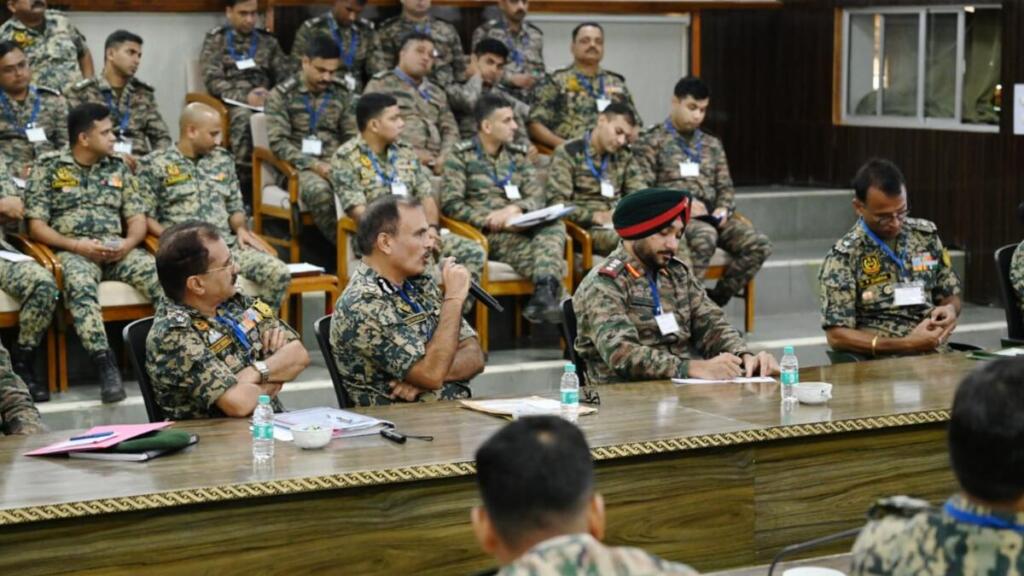
Officers of the Indian Army and the Border Security Force (BSF) held a joint coordination session in Bhuj, Gujarat, to review operational synergy along the Rann and Creek sector of Kutch, according to a statement from the Defence PRO, Gujarat. The meeting was conducted under the aegis of the Konark Corps.
Titled “Rann & Creek Sentinels – Synergy in Action,” the brainstorming session brought together the Army’s 75 (Independent) Infantry Brigade — known as the Bald Eagle Brigade — and BSF Gujarat Frontier officials to discuss joint response mechanisms, logistics coordination, and emerging challenges along the border.
“One Frontier. One Resolve,” the Defence PRO’s post read, underscoring what officials described as a unified commitment to securing India’s western frontiers.
Why the Rann and Creek Sector Matters
The Kutch region — spanning the Rann of Kutch and the marshy Sir Creek area bordering Pakistan — has long posed distinct security challenges due to its difficult terrain of salt marshes, tidal creeks and shifting waterways. The area is patrolled jointly by the Army and BSF, given its vulnerability to cross-border infiltration, smuggling, and incursions by Pakistani fishing vessels.
The Home Ministry has previously sanctioned the construction of permanent concrete bunkers in the Sir Creek and “Harami Nalla” marshy areas to strengthen surveillance, following repeated incidents involving Pakistani fishermen and seized contraband. The BSF also conducts periodic exercises such as “Ops Alert” along this stretch, spanning from Sir Creek to the Rann of Kutch and into Rajasthan’s Barmer district, combining border domination patrols with public outreach efforts.
The Units Involved
The Bald Eagle Brigade operates under XII Corps (also known as Konark Corps or the Desert Corps), which is responsible for defending India’s western borders across the desert and marshland stretching from Jaisalmer in Rajasthan to Kutch in Gujarat. The Konark Corps drew national attention earlier this year when Army Chief General Upendra Dwivedi commended its troops for coordinated operations with the Indian Air Force and BSF during Operation Sindoor, India’s military standoff with Pakistan.
Coordination between the Army and BSF in this sector is a recurring feature of border management, given the overlapping operational responsibilities in creek and coastal areas — from routine joint patrols to emergency response, as seen in past incidents where BSF patrol boats have rescued Army personnel from drowning in the region’s treacherous creek waters.
The Bigger Picture
Thursday’s meeting appears to be part of routine institutional engagement between the two forces rather than a response to any specific incident, reflecting the ongoing emphasis on inter-agency coordination along one of India’s most geographically complex border stretches. Such exercises are typically aimed at streamlining communication, standardizing joint response protocols, and ensuring logistical readiness in a terrain where quick, coordinated action is often critical.