
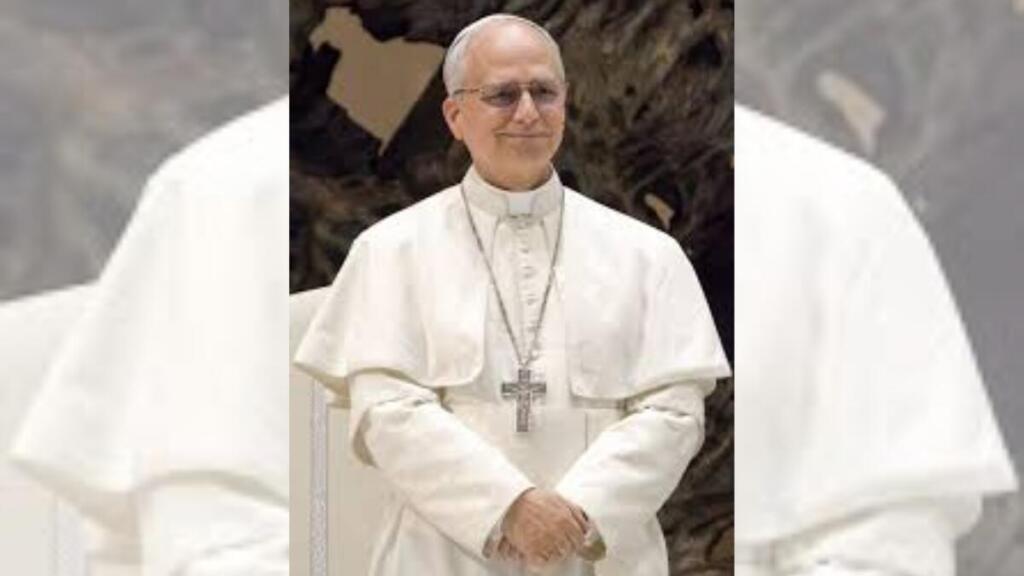
Pope Leo said on Monday that concerns about artificial intelligence destroying the world are not “fake news,” directly challenging US President Donald Trump’s recent dismissal of such fears. “I do think that the concerns raised by many of the experts, specialists in AI, should be taken seriously,” the pontiff told reporters aboard the papal flight back to Rome, following a four-day trip to France. “I don’t think that that is fake news, as some have said.”
Trump had told the UN General Assembly last week that he believed fears about AI’s dangers to humanity were a “hoax.” Leo, the first American pope, pointed directly at that claim without naming Trump outright. “He’s the same one, however, that says there should be no limits placed and no government regulation,” Leo said.
A broader target: tech CEOs too
Leo also took aim at technology leaders who argue AI should face no guardrails. He noted that he had read that Nvidia chief executive Jensen Huang had spoken of ways to insert safeguards into certain AI models, a comment that sat awkwardly next to Huang’s own statement to CBS News this month that he agreed with Trump that AI safety concerns were overblown.
Leo urged “dialogue, study, investigation, to find ways to make sure that AI does not get to a point where it could destroy humanity.” He struck a note of cautious urgency rather than alarm. “I think that there are enough people seriously interested in that… but we have to keep working,” he said. “We can’t just sit back and pretend nothing’s going to happen.”
Why the timing matters
Leo has warned about the dangers of AI throughout his 16-month papacy, making it a recurring theme of his public statements. His remarks land a day before Trump is due to meet technology executives, including from Nvidia, Meta and OpenAI, at the White House to discuss AI policy, a meeting expected to weigh the balance between innovation and regulation, with US officials warning that heavy-handed rules could cost America the AI race against China.
Pope Leo’s intervention this week has revived a long-running dispute among scientists, technologists and now a pope and a sitting American president: is the fear that artificial intelligence could destroy humanity a serious risk to plan for, or an exaggerated story that distracts from AI’s real, more immediate harms? There is no settled answer, but there is a clear map of where the disagreement lies.
The case for taking it seriously
Pope Leo’s framing echoes a view held by a significant number of AI researchers themselves, including some who helped build the current generation of systems. Their central worry is not that today’s chatbots will spontaneously turn hostile, but that AI capabilities are advancing faster than the tools to understand, predict or control them, and that a sufficiently capable, poorly aligned system could cause catastrophic harm, whether by accident, through misuse, or through a loss of human oversight over decisions made at machine speed. Proponents of this view tend to argue for building caution into development now, before systems become powerful enough for mistakes to be irreversible, rather than waiting for clear evidence of danger to emerge first.
The case for scepticism
Trump’s “hoax” framing, and Jensen Huang’s view that safety fears are overblown, represent the opposite pole. This camp argues that doomsday scenarios are speculative, drawn more from science fiction than from how these systems actually function, and that dwelling on existential risk distracts from AI’s real, present-day harms: job displacement, misinformation, surveillance and bias, as well as the economic opportunity AI represents. On this view, heavy regulation aimed at speculative future risks could slow innovation and hand a strategic advantage to rival powers, a concern that has featured prominently in US policy debates about competition with China.
Where the two sides actually differ
The gap between these camps is often less about the underlying science than about time horizons and burden of proof. Few serious AI researchers dispute that increasingly capable systems raise new risks; the disagreement is over how soon those risks could become severe, how much current safety research has already reduced them, and whether the right response is caution now or course correction once problems appear. Huang’s own acknowledgement that guardrails could be built into AI models, a point Leo specifically highlighted, suggests the distance between “it’s a hoax” and “it’s a serious concern” may be narrower in practice than the public rhetoric between Rome and Washington implies.
The debate now moves from the papal flight to the Oval Office. Trump is scheduled to meet the chief executives of Nvidia, Meta and OpenAI at the White House on Tuesday to discuss AI policy, a meeting billed as a search for balance between innovation and oversight. Leo’s remarks, delivered a day earlier and travelling fast online, have already reframed that meeting’s opening question: not whether AI needs guardrails, but how much, how soon, and who gets to decide.