
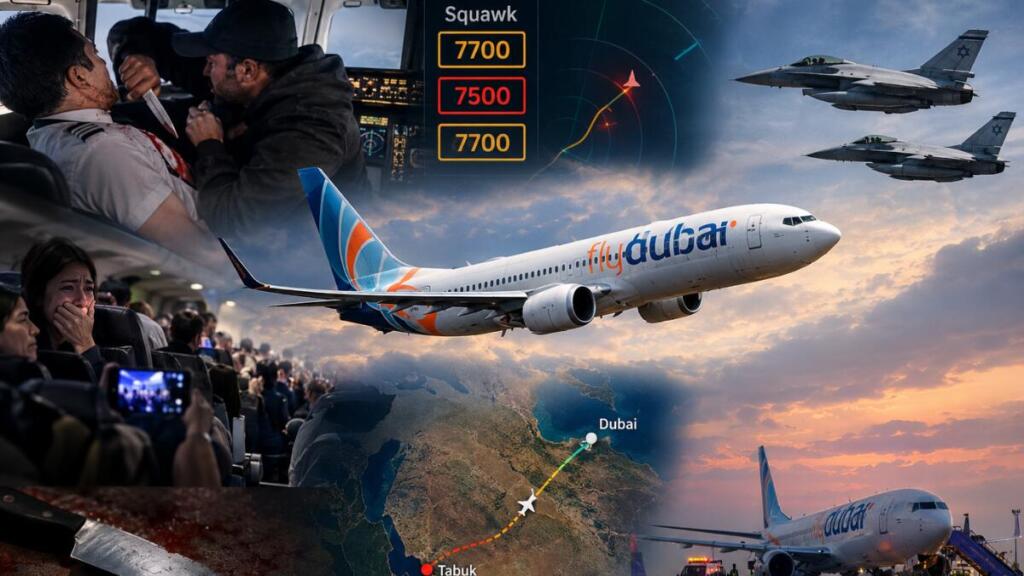
For a few terrifying minutes on Wednesday, a passenger jet flying from Dubai to Tel Aviv appeared to be facing the emergency aviation authorities fear most. A pilot had reportedly been stabbed, the aircraft suddenly lost thousands of feet, a hijack-related code appeared on radar, and Israeli fighter jets were scrambled.
Israeli officials later said they suspected the Omani co-pilot may have tried to seize control of the aircraft in a possible terror attack. The investigation is ongoing, and it is too early to say what the intent was. But the sequence of events raises a chilling question: how close did the world come to another 9/11-style disaster?
What happened
Flydubai Flight FZ1073 left Dubai for Ben Gurion Airport with around 180 people on board, most of them Israelis, according to media reports. The Boeing 737 MAX was cruising normally when something went badly wrong in the cockpit.
Flight-tracking data showed a rapid descent. Reuters reported that the aircraft lost nearly 14,000 feet in less than 30 seconds.
The transponder codes
The aircraft first transmitted Squawk 7700, the international code for a general emergency. A few minutes later it transmitted 7500, which signals unlawful interference and is commonly associated with hijackings. It then returned to 7700 as it headed towards Tabuk in northwestern Saudi Arabia.
What happened inside the cockpit is still being pieced together. Early reports described a violent confrontation between the pilots. Israeli officials later told Reuters they suspected an attempted terror attack in which the co-pilot stabbed the captain.
Flydubai has been far more cautious. It says only that the flight experienced an “incident,” landed safely in Tabuk, and that all passengers were safe and accounted for. Saudi investigators have not publicly established a motive.
Inside the cabin
Passengers described screams, blood and confusion. Videos circulated afterwards showing an injured person and crew members restraining a suspect. One passenger, his face apparently bloodied, recorded a video calling the event a hijacking and saying those on board had overpowered the attacker. That reflects what passengers believed at the time, not an official finding on motive.
Passengers step in
According to Israeli media, passengers did not stay in their seats. The Times of Israel reported that Israeli passengers rushed towards the cockpit and helped subdue the suspect. Whatever investigators conclude about motive, that intervention appears to have helped bring the immediate threat under control.
There was also a stroke of luck. Israeli reports said other pilots were travelling on the aircraft and helped after the confrontation. Accounts of who took control, and when, are inconsistent and should be treated with caution until the investigation concludes.
What is confirmed is that the aircraft stabilised, diverted to Saudi Arabia and landed safely at Tabuk. Both pilots were taken to hospital with injuries.
In Israel, the incident triggered a major security response. With a sudden altitude loss, an unlawful-interference signal and uncertainty over who controlled the cockpit, officials had to prepare for the worst.
Was another 9/11 really possible?
There is currently no established evidence that the alleged attacker meant to fly the aircraft into a building or use it as the hijackers did on September 11, 2001. Early accounts even differed on whether this was a hijacking attempt, a fight between pilots or some other cockpit emergency. Calling it a confirmed 9/11-style plot would go beyond the evidence.
But the fear was not imaginary, and Israeli officials are treating it as a possible attempted terror attack.
The passengers’ reaction has drawn particular attention in Israel, where conscription gives many people military or security training. However, nothing has been verified about the backgrounds of those who intervened, and it would be wrong to assume they were trained soldiers.
Questions that remain
Civilians should not ordinarily try to intervene in an aviation emergency, and cabin crew instructions remain critical. But FZ1073 appears to have been an exceptional case, in which those aboard believed the aircraft itself was in danger. Their response may have changed the outcome.
Investigators must now establish how a knife allegedly got into the cockpit, what triggered the confrontation, what the co-pilot intended, who ultimately regained control, and whether there were warning signs before take-off. Saudi authorities, Flydubai and other governments involved will have to reconstruct those minutes carefully.
For now, the key facts are simple. An aircraft carrying around 180 people suffered a violent cockpit emergency at cruising altitude and landed safely, with all passengers accounted for. The courage of those on board may be part of the reason this story ended on a runway in Saudi Arabia rather than as another date remembered for tragedy.