
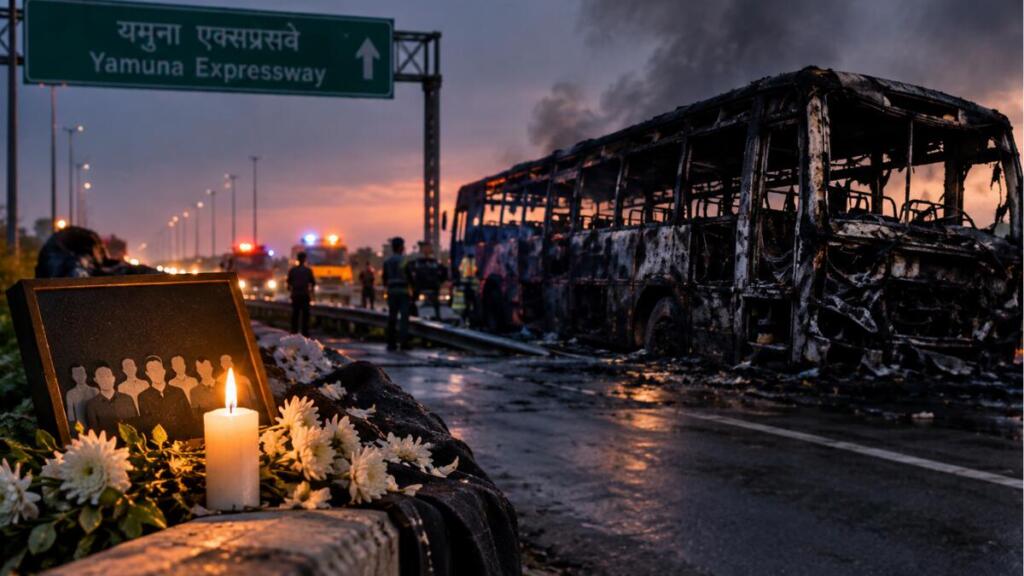
Nine passengers were charred to death late Wednesday night when a private sleeper bus caught fire on the Yamuna Expressway near Jewar in Greater Noida. The tragedy has drawn condolences from the President, the Prime Minister and the Home Minister. But behind the official grief lies an uncomfortable question that India’s road safety establishment keeps failing to answer: how many more people have to die on this one stretch of highway before something actually changes?
The bus, traveling from Delhi’s Kashmiri Gate to Mahoba, caught fire around 11:30 pm near the 33-kilometre mark of the expressway. According to the FIR, passengers first noticed a burning smell coming from the driver’s cabin. When they alerted the driver, he reportedly dismissed their concerns and refused to stop, allegedly telling them, “Die if you want to, but we won’t stop the bus.” The driver and conductor allegedly continued smoking inside the cabin as the smell persisted. Flames erupted soon after near the driver’s seat, and by the time the bus finally stopped, smoke had filled the cabin and the fire had spread beyond control.
Passengers broke windows to escape. Some jumped out; others could not. It took five fire tenders roughly an hour to douse the blaze. Nine of the roughly 35 passengers aboard were burned to death. The driver and conductor fled the scene and were later arrested. Investigators believe a spark or short circuit in the bus’s air-conditioning system triggered the fire.
Perhaps the most damning detail to emerge: the bus had 19 pending challans for fitness and other violations, with fines of ₹1.75 lakh outstanding against its owners. In other words, this was a vehicle already flagged, repeatedly, as unfit — and it was still on the road, still carrying paying passengers, on one of India’s busiest and most dangerous highways.
A Highway With a Body Count
This is not an isolated horror. The Yamuna Expressway — a 165-kilometre, six-lane corridor linking Delhi, Greater Noida and Agra — has developed a grim reputation over its 14-year existence. By 2019, officials estimated close to 900 people had died on the road since it opened in 2012. That year alone, a bus traveling from Delhi to Lucknow skidded off the highway near Agra and plunged into a drainage gap between two flyovers, killing 29 people after the driver apparently fell asleep at the wheel.
The pattern has repeated with numbing regularity since: five killed and 16 injured in a bus-truck collision near Aligarh; five charred to death after a bus tyre burst and a car slammed into it near Mathura; six killed and 19 injured in twin accidents in a single morning; a school bus crash that left a driver dead and over 20 students injured. Each incident produced its own round of condolences, its own promised inquiry. Few produced lasting change.
The Uncomfortable Questions
The Wednesday night fire raises questions that go well beyond one negligent driver:
Why was a bus with 19 pending violations still operating? Fitness challans exist precisely to pull dangerous vehicles off the road. If a vehicle can accumulate nearly 20 violations and continue running commercial routes carrying dozens of sleeping passengers, the enforcement mechanism isn’t failing occasionally — it’s failing structurally. Someone, somewhere in the chain of transport authorities, allowed this bus to keep driving.
Why do private sleeper buses keep catching fire? Electrical faults, particularly in retrofitted air-conditioning systems, have been implicated in multiple bus fire tragedies across India in recent years. Sleeper buses pack passengers into enclosed berths with limited emergency exits — a design that turns a small electrical fault into a death trap when a fire spreads. Yet regulatory scrutiny of these vehicles’ electrical systems and emergency egress remains inconsistent at best.
Why does driver accountability only arrive after the deaths, not before? The FIR alleges the driver was warned repeatedly and chose to keep driving rather than risk delay — prioritizing schedule over lives. That is a failure of individual judgment, certainly. But it’s also a symptom of a transport culture where drivers and operators face little real-time consequence for cutting corners, and enormous financial pressure to keep vehicles moving regardless of warning signs.
Why hasn’t this specific highway prompted a systemic safety overhaul? Nearly a thousand deaths and counting on a single expressway is not a statistic that should exist in a country whose government has invested heavily in showcasing highway infrastructure as a marker of national progress. Speed, road design, lack of median barriers in certain stretches, inconsistent enforcement of night-driving rules for commercial vehicles, and patchy emergency response times have all been cited in past inquiries — yet a comprehensive, enforced fix has not materialized.
The Compensation Reflex
The government’s response followed a now-familiar script: ex-gratia payments of ₹2 lakh from the PM’s relief fund for each deceased, ₹50,000 for the injured, statements of grief from the highest offices in the country. These gestures matter to grieving families, but they also risk becoming a substitute for the harder, less visible work of prevention — auditing vehicle fitness records, enforcing challans with actual vehicle seizures, mandating fire-safety retrofits for sleeper buses, and holding transport departments accountable when a chronically flagged vehicle is still ferrying 35 sleeping passengers down a highway at midnight.
India’s roads kill more than 150,000 people a year, more than almost any other country on earth. The Yamuna Expressway is not an outlier within that system — it is a microcosm of it: modern infrastructure, poor enforcement, and a citizenry left to hope that the bus they board, the driver behind the wheel, and the vehicle’s paperwork are all what they’re supposed to be. For nine families this week, that hope proved fatal. Until India moves from condolence to consequence — from ex-gratia payments to enforced accountability — this expressway, and countless others like it, will keep adding names to an already staggering toll.