
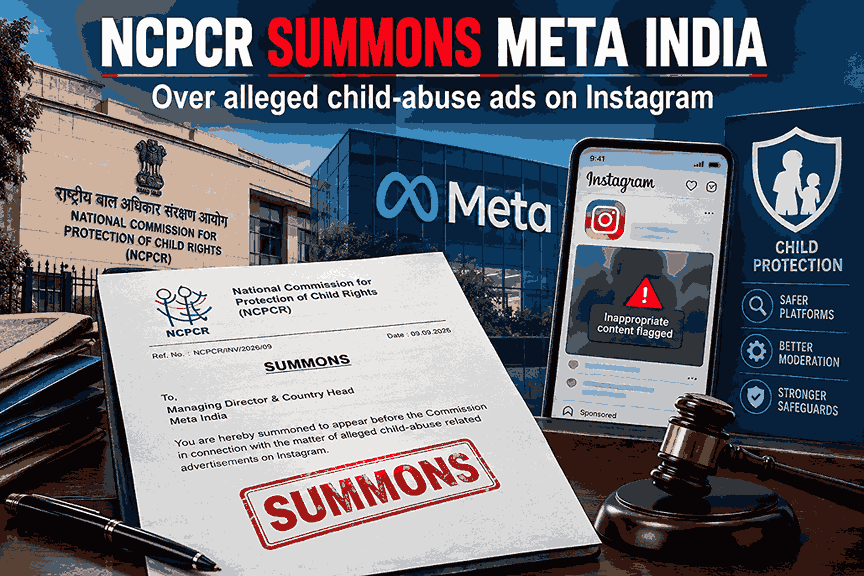
The National Commission for Protection of Child Rights (NCPCR) has summoned senior officials of Meta India over serious allegations that advertisements on Instagram promoted or facilitated access to child sexual exploitation and abuse material. The development has triggered fresh concerns about the responsibility of major social media platforms in preventing harmful and illegal content from reaching users, particularly when such material involves the exploitation of children.
According to reports, the NCPCR has called upon the Managing Director and country head of the company as part of an inquiry into the alleged advertisements. The child rights body is seeking answers over how such promotional content allegedly appeared on Instagram and what action was taken after the issue came to light.
The matter gained momentum following reports and investigations that raised questions about advertisements allegedly directing users towards channels or platforms where child sexual abuse material could be accessed. Some of the advertisements reportedly used disturbing search terms and appeared to facilitate access to illegal content through external links.
The controversy has placed Meta India under intense scrutiny, with the NCPCR deciding to examine the facts surrounding the allegations. The commission had reportedly taken cognisance of media reports earlier and sought an explanation from Meta Platforms regarding the alleged appearance of such advertisements on its social media platform.
The company is understood to have submitted a response to the commission following the initial communication. However, the NCPCR has now moved ahead with a formal inquiry and summoned top officials to appear before it. The inquiry is expected to focus on the alleged advertisements, the platform’s content moderation mechanisms and the safeguards in place to prevent the promotion of material involving the sexual exploitation of children.
The summons comes at a time when governments and child protection agencies across the world are increasingly raising concerns about the misuse of digital platforms. Social media companies have repeatedly faced questions over whether their automated moderation systems are capable of detecting harmful content quickly enough, particularly when paid advertisements are involved.
In this case, the key question is how advertisements allegedly linked to such material were able to appear on Instagram in the first place. Paid advertisements generally undergo some form of review, making the allegations particularly serious and raising concerns about possible gaps in automated and human moderation systems.
Officials from Meta India are expected to provide clarification to the NCPCR regarding the allegations and the measures adopted by the company after being alerted to the issue. The commission’s intervention reflects the gravity with which Indian authorities are viewing any potential online activity connected to child sexual exploitation and abuse.
The Ministry of Electronics and Information Technology had also reportedly taken note of the issue and directed action against advertisements and content promoting or facilitating access to child sexual exploitation and abuse material. The government sought an explanation and emphasised the need for immediate steps to ensure that such content is removed from digital platforms.
The episode has renewed the debate over the legal and moral responsibilities of technology companies operating in India. With millions of users accessing social media platforms every day, critics argue that companies must invest more heavily in systems capable of identifying dangerous content before it spreads or is promoted through advertising networks.
For Meta India, the NCPCR inquiry represents a significant test of its child safety policies and moderation infrastructure. The company will likely face questions not only about the specific advertisements under investigation but also about the broader mechanisms used to review paid promotions and detect attempts by malicious actors to exploit the platform.
Child rights advocates have long warned that the internet has created new avenues for offenders to target children and distribute exploitative material. The rapid growth of artificial intelligence and sophisticated image manipulation tools has added another layer of complexity, making it increasingly difficult for platforms and law enforcement agencies to identify harmful content.
The NCPCR’s decision to summon Meta India also underlines a growing willingness among Indian regulatory and child protection authorities to demand greater accountability from global technology companies. As digital platforms become more deeply embedded in everyday life, authorities are increasingly insisting that online safety cannot be treated as a secondary concern.
The inquiry is expected to examine whether existing safeguards were adequate and whether the company responded swiftly enough after the alleged advertisements were identified. Meta India may also be asked to explain the processes through which advertisements are approved and the steps taken to prevent repeat violations.
The case has wider implications beyond a single company or platform. It highlights the continuing challenge faced by governments, technology firms, parents and child protection organisations in creating a safer online environment. The speed and scale at which content can spread online often make enforcement difficult, particularly when offenders use multiple platforms and constantly change their methods.
As the inquiry progresses, the focus will remain on accountability and the effectiveness of online safety mechanisms. Meta India now faces the task of addressing the concerns raised by the NCPCR while demonstrating that robust measures are in place to prevent its platforms from being misused for activities involving the exploitation of children.
The outcome of the inquiry could have important consequences for how social media companies approach child safety, advertising oversight and content moderation in India. Whether Meta India can satisfactorily address the questions raised by the country’s child rights body will now be closely watched as authorities continue their investigation into one of the most serious allegations facing a major digital platform.