
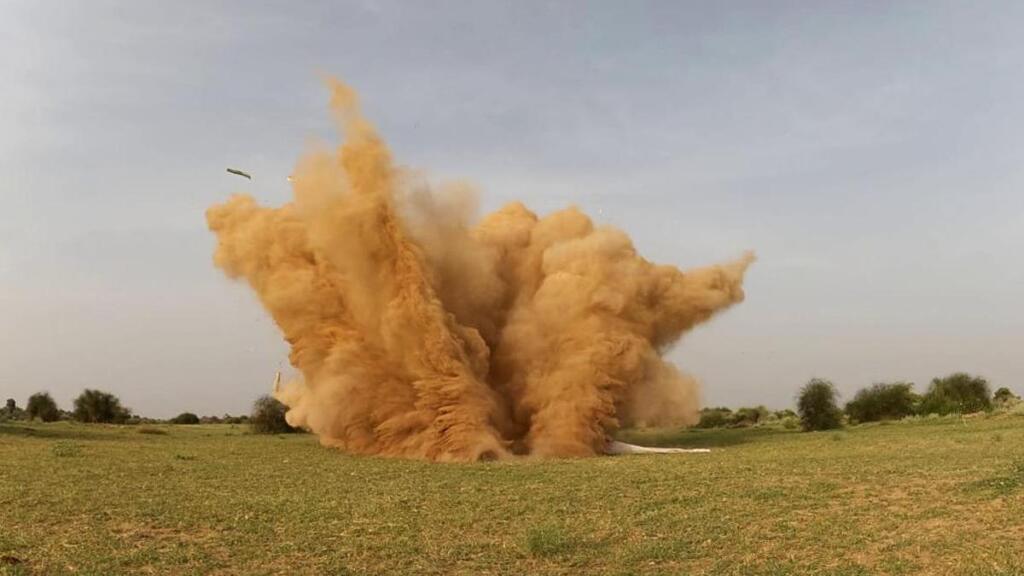
The Indian Air Force has carried out a successful drop trial of the Khagantak-243, a home-grown Long Range Glide Bomb (LRGB), marking a notable step forward for both the IAF and India’s domestic defence manufacturing base.
The weapon was developed by Nagpur-based startup JSR Dynamics in partnership with Bharat Electronics Limited (BEL), under a Development-cum-Production Partner arrangement — a collaboration model that underscores the growing role of public-private partnerships in India’s weapons programs. The two firms’ roles are complementary: JSR Dynamics supplies the airframe and control systems, while BEL contributes the electronics and guidance subsystems. Their partnership dates back to a collaboration and marketing agreement signed between BEL and the Nagpur-based JSR Dynamics, aimed at jointly developing glide bombs and related precision-strike systems for both domestic and export markets.
About the weapon
The Khagantak-243 falls in the roughly 300 kg class, measuring up to about 4 metres in length with a diameter near 290 mm, and is built around a cylindrical body with swivel-type mid-body glide wings and five aft control surfaces. It carries a Mk-81 general-purpose blast-fragmentation warhead containing 125 kg of explosive fill, and is rated for a glide range beyond 140 km when released from an altitude of around 12,000 metres.
The design leans heavily on resilience and precision: it uses jamming-resistant satellite navigation to keep functioning in GPS-denied environments, is rated to operate across a wide temperature range from -40°C to +70°C, and is built to the MIL-STD-1760 standard for aircraft-weapon interfacing. Development of the system took over a decade, and it was initially planned for testing aboard the IAF’s Su-30MKI fleet, with future trials possible on other platforms such as the MiG-29K.
Why it matters
The Khagantak family — which also includes a longer-range 306 variant with an operational range of about 175 km along with updated guidance and control surfaces — is being positioned as a homegrown alternative to imported stand-off weapons in the same class as France’s Hammer or Israel’s Spice glide bombs, an area where India has traditionally leaned on imports. Officials and industry observers have flagged the program as a milestone in the “Make in India” push for defence self-reliance, and specifically as an early example of a fully private-sector-developed glide bomb entering IAF service.