
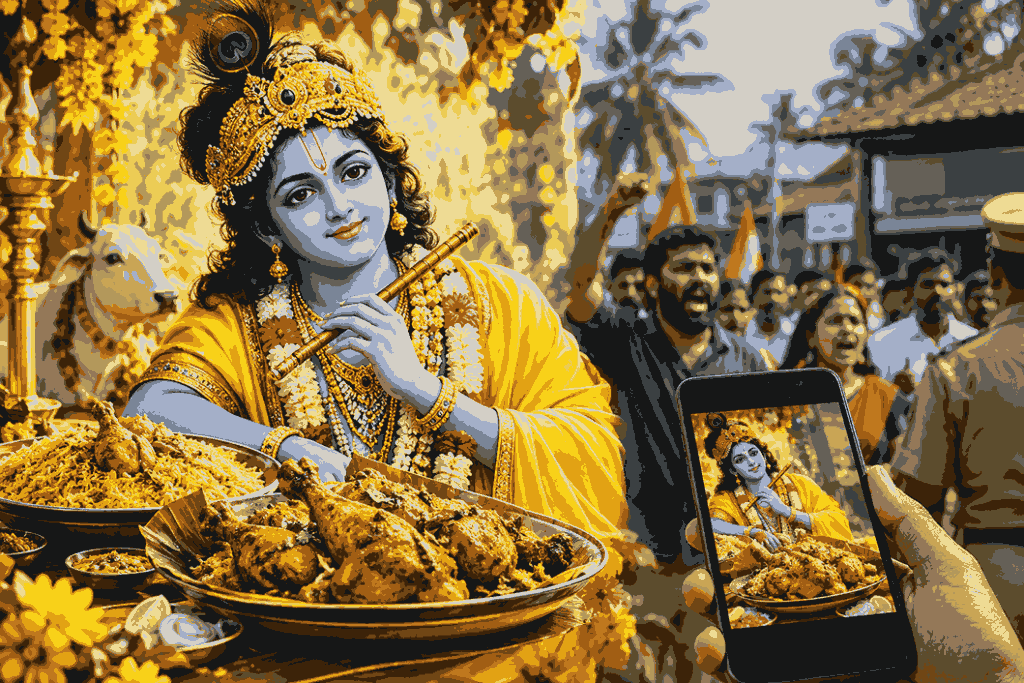
A controversy in Kerala has brought the sensitive question of religious imagery in commercial advertising into sharp focus after restaurant promotions featuring Lord Krishna alongside chicken and other non-vegetarian dishes surfaced online. The visuals, circulated around Lord Vishnu, triggered strong reactions from sections of the Hindu community, who argued that using revered deities to promote meat products during Hindu Festivals crossed a line of cultural and religious sensitivity.
The controversy began in Cherthala, Alappuzha, where Mehr Mandi & Grills reportedly circulated a Vishnu-themed promotional poster depicting Lord Krishna alongside a platter containing chicken. The advertisement quickly spread across social media, prompting criticism and protests. For many devotees, the issue was not about food preferences alone but about the manner in which a sacred religious figure was placed next to a commercial food product.
The restaurant later issued an apology, stating that the controversial design had been outsourced and attributing the incident to a designer’s mistake. The owners said they regretted causing offence and insisted that there was no intention to hurt religious sentiments. However, the explanation did little to calm the controversy, with critics arguing that businesses remain responsible for material published under their name.
The debate gained further momentum after similar promotional images reportedly emerged from other establishments in Kerala. In some of these advertisements, Lord Krishna was shown alongside dishes such as mandhi, biryani and fried meat. The appearance of multiple examples transformed what initially looked like an isolated advertising controversy into a broader discussion about cultural awareness and commercial exploitation of Hindu Festivals.
The legal dimension also emerged quickly. Police registered a case in connection with the Cherthala advertisement under provisions of the Bharatiya Nyaya Sanhita concerning acts allegedly intended to provoke communal disturbance. One of the individuals associated with the restaurant was arrested as the investigation progressed. Reports also indicated that protests were organised by Hindu organisations, with demonstrators demanding action against those responsible for the advertisements.
The incident has also highlighted the diversity of food traditions within Kerala itself. While some communities and regions may include non-vegetarian dishes in festive meals, religious customs surrounding specific deities and occasions can differ considerably. Vishu, in particular, carries deep devotional significance, and many devotees associate offerings to Lord Krishna with fruits, sweets, vegetables and other traditional items. That distinction has become central to the argument surrounding the advertisements.
At the heart of the dispute is therefore a larger question: how far should advertising go when using religious symbols? Businesses routinely draw on festivals, deities and cultural traditions to establish an emotional connection with consumers. But Hindu Festivals are not merely marketing opportunities for millions of devotees. They are occasions tied to family traditions, worship, community identity and personal faith.
The controversy also demonstrates how quickly a poorly judged advertisement can escape its original context. A poster intended for local customers can now reach millions within hours through social media. Once an image becomes viral, an explanation issued later may struggle to undo the initial impact. In this case, the restaurant’s apology was accompanied by continuing criticism from people who believed that greater scrutiny should have been applied before the advertisement was published.
Another important aspect is the distinction between criticism of a particular advertisement and hostility towards an entire community. The controversy should not be used to generalise about Kerala’s religious communities or food habits. The concern expressed by critics is specifically about the use of a Hindu deity in commercial material promoting non-vegetarian food. Keeping that distinction clear is essential if a cultural dispute is not to become a wider communal confrontation.
The episode is likely to remain part of the continuing debate over representation, religious sensitivity and the responsibilities of businesses operating in a diverse society. Hindu Festivals carry enormous cultural and emotional significance, and advertisers seeking to use their imagery must recognise that religious symbols cannot always be treated like ordinary commercial graphics.
Ultimately, the controversy offers a straightforward lesson for brands: cultural awareness matters. Creative freedom and commercial promotion do not exist in a vacuum, particularly when they involve revered religious figures. Hindu Festivals bring communities together through traditions that have been passed from one generation to another. Treating those traditions with care is not simply a matter of avoiding controversy; it is also a basic exercise in respecting the audience a business hopes to serve.