
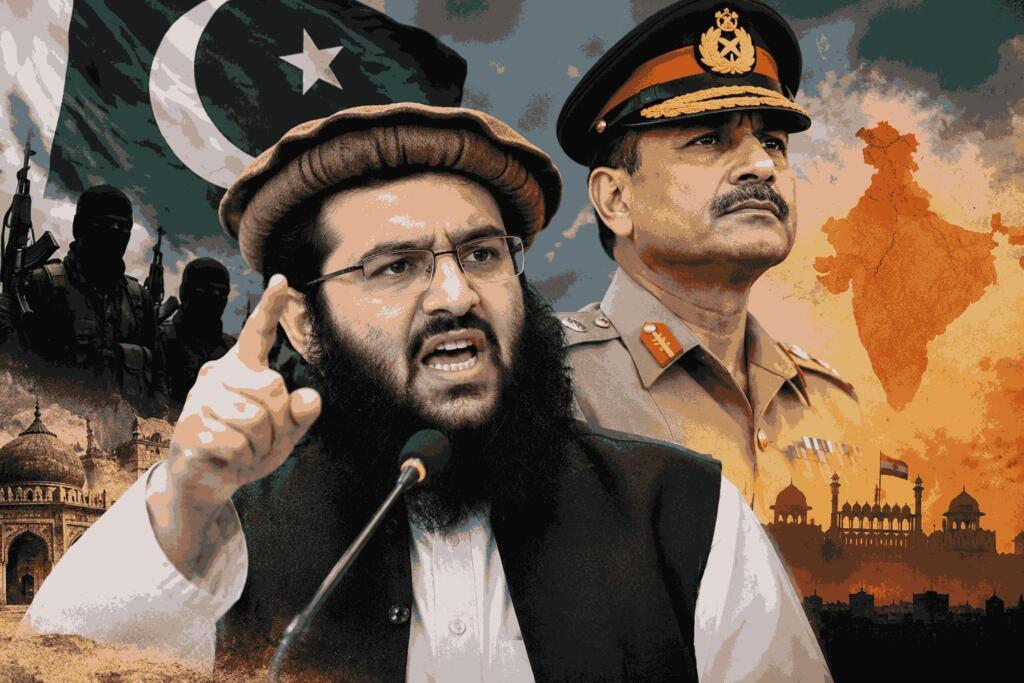
Hafiz Talha Saeed, son of Lashkar-e-Taiba founder and 26/11 Mumbai terror attack mastermind Hafiz Muhammad Saeed, has once again delivered a provocative anti-India speech in Pakistan, declaring that his supporters would continue what he described as “jihad” and invoking a disputed historical narrative about Muslim rule in the Indian subcontinent.
Speaking at a gathering reportedly held in Sheikhupura, Pakistan, Hafiz Talha Saeed sought to present his extremist rhetoric as part of a continuing ideological struggle. According to reports, he told the gathering that those committed to jihad would continue their campaign for as long as they remained alive and possessed the strength to do so. His remarks were accompanied by direct references to India and an attempt to portray contemporary political realities through a highly selective interpretation of history.
Hafiz Talha Saeed also questioned the legitimacy of India’s present political leadership by referring to the period of Muslim rule in the subcontinent. He reportedly asked why “anti-Pakistan” rulers in Delhi speak about the region today and invoked the claim that Muslims had ruled the subcontinent for 500 years. The remarks appeared designed to frame present-day India through the lens of medieval political power, rather than recognising the sovereignty of the modern Indian republic.
The historical argument used in the speech has little relevance to the constitutional and political realities of contemporary South Asia. Modern India is a sovereign democratic republic whose political legitimacy does not derive from the identity of medieval rulers. By invoking past empires to challenge the present-day status of Delhi, the rhetoric instead reflects an attempt to revive territorial and religious grievances for political mobilisation.
Hafiz Talha Saeed further praised Pakistan Army chief Field Marshal Asim Munir, describing his appointment in religiously approving terms and crediting him with reviving concepts such as faith, piety and jihad. The praise is particularly significant because Munir occupies one of Pakistan’s most powerful military positions, while Saeed’s remarks openly connect military leadership with an Islamist ideological vocabulary.
The speech also reportedly referred favourably to the so-called Makkah Pact involving Pakistan, Saudi Arabia and Türkiye. Hafiz Talha Saeed attempted to place the contemporary relationship between these countries within a broader religious and historical narrative, including references to the Ottoman period and the protection of Islam’s holy sites. His comments thus moved beyond direct hostility towards India and sought to situate Pakistan’s geopolitical ambitions within a larger religious framework.
Hafiz Talha Saeed’s background makes the latest remarks particularly significant. He is the son of Hafiz Muhammad Saeed, the founder of Lashkar-e-Taiba, an organisation designated as a terrorist group by the United Nations. Indian authorities have also designated Talha Saeed as an individual terrorist under the Unlawful Activities (Prevention) Act. The United States designated him as a terrorist in 2012, according to reports.
The latest episode also underscores the continuing influence of militant rhetoric in Pakistan’s discourse surrounding India. Rather than focusing solely on contemporary political disagreements, the speech attempted to combine religion, historical grievance, territorial claims and military symbolism. Such messaging can reinforce an adversarial atmosphere even when it does not translate immediately into a specific operational threat.
For India, statements of this nature are unlikely to be treated simply as political rhetoric because of the speaker’s association with a proscribed terrorist organisation and his family’s history within the Pakistan-based jihadist ecosystem. The memory of the 26/11 Mumbai attacks, which killed civilians and security personnel, continues to shape Indian concerns about Lashkar-e-Taiba and its networks.
Hafiz Talha Saeed’s latest comments therefore represent more than another inflammatory speech. They demonstrate how extremist narratives continue to draw upon selective historical memories to justify hostility towards India, while simultaneously seeking legitimacy through praise of powerful institutions in Pakistan. His declaration that the alleged struggle would continue indefinitely offers a stark reminder that the ideological infrastructure behind India-focused militancy remains a serious security concern.