

The scoreline does not always reflect the quality of a team’s performance. A team can win despite creating very few chances, while another may lose after producing several clear-cut opportunities. The analysis available at Footballtips-hub.com makes it possible to examine expected goals (xG) and compare actual performance with the probabilities implied by betting odds. This can help bettors identify value bets without relying solely on recent results.
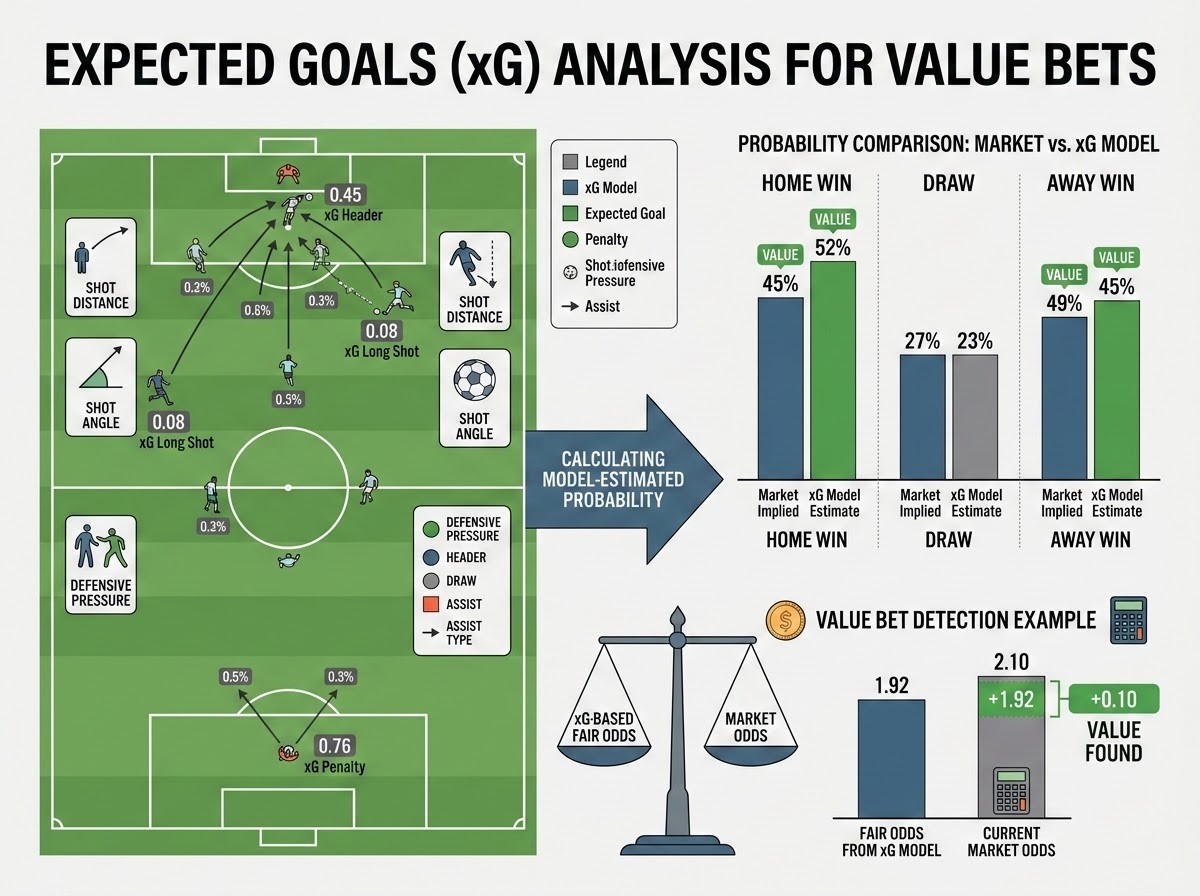
Illustrative diagram and data visualization of expected goals (xG) in football, featuring a football pitch with analytical overlays, shot trajectories toward the goal labeled with probability percentages, and statistical charts illustrating value-bet analysis.

What xG Reveals About a Match
Expected goals estimates the probability that a shot will result in a goal based on its distance from the goal, angle, type of assist, and other variables. For example, a chance valued at 0.30 xG would be expected to result in a goal approximately three times out of ten across similar attempts within the model being used.
The combined value of a team’s chances indicates how much attacking threat it generated. If a club wins 2–0 despite producing only 0.6 xG while allowing 1.7 xG, the result may have been better than the underlying performance. This context makes the xG data football predictions Footballtips-hub.com useful for assessing team form without being misled by a short run of results.
How to Use Expected Goals to Find Value
To understand how to use expected goals for value bets, the first step is to calculate the implied probability of the betting odds. Divide one by the decimal odds: odds of 2.00 represent an implied probability of approximately 50%, before the bookmaker’s margin is taken into account.
You can then create your own estimate by considering:
- xG generated and conceded across several matches
- Home and away performance
- The quality of previous opponents
- Starting XI lineups, injuries, and suspensions
- Tactical style and the recent fixture schedule
- Home advantage and conditions at the venue
If your analysis gives a team a 55% chance of winning, its fair odds would be approximately 1.82. If the market offers odds of 2.05, there may be theoretical value. However, finding value odds using xG statistics does not guarantee success in any individual match. The aim is to make potentially profitable decisions over a large sample of bets.
Suitable Markets for an xG Strategy
An expected goals betting strategy can be applied to markets such as over 2.5 goals. Instead of simply counting previous results, bettors should examine the quality of the chances created, the teams’ attacking tempo, and the xG they concede. Two teams with several recent high-scoring results will not necessarily produce another open match.
Asian handicap markets may also reveal opportunities. A favourite that dominates possession but creates mainly low-quality shots may not have a large enough advantage to cover a demanding handicap line. Footballtips-hub.com football analytics should therefore be used alongside team news, confirmed lineups, and changes in the betting odds.
Limitations and Responsible Bankroll Management
xG cannot account perfectly for every tactical detail or predict extraordinary moments of individual skill. Different data providers may also assign different values to the same chance. It is therefore advisable to use large samples, compare multiple sources, and keep a record of every prediction.
Bankroll management is just as important as the analytical model. Bettors should set a fixed budget, keep stakes small, and avoid trying to recover losses by increasing the amount wagered. Data can support more informed decisions, but no analytical tool can eliminate uncertainty.


Conclusion
Expected goals allow bettors to look beyond the final score and assess how scoring opportunities were created. When combined with betting odds, recent form, team lineups, and home advantage, xG provides a useful foundation for developing match predictions and identifying potential value bets.
The objective is not to predict every score correctly, but to recognise when the odds offered may be higher than the estimated probability suggests—and always to act with discipline.