
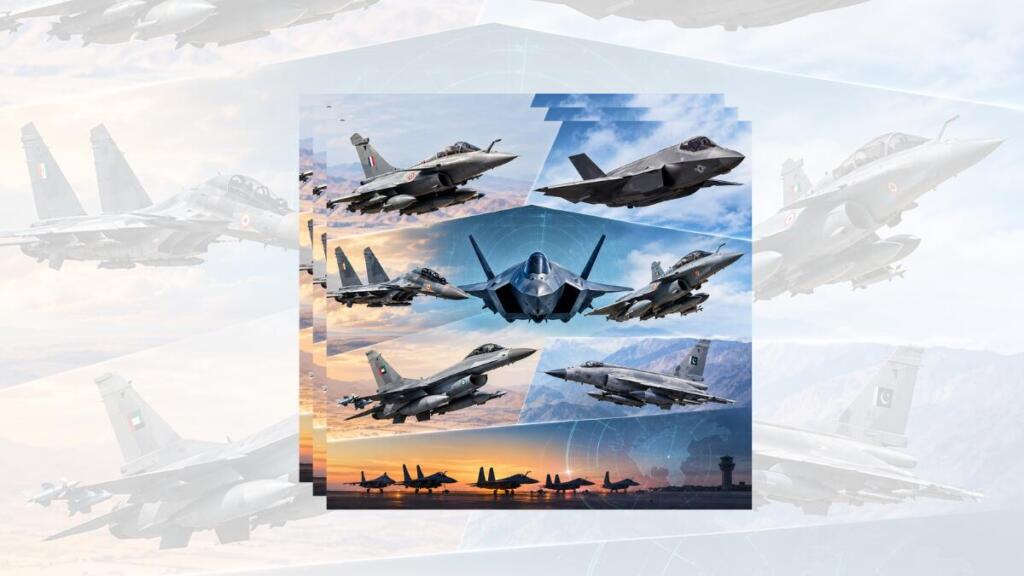
The fleet assembled at Jodhpur for Exercise Tarang Shakti 2026 is one of the more instructive samples of modern air power to land in India. The United States is deploying two to three F-35 fifth-generation fighters, France is bringing Rafales, and the UAE is fielding F-16s, while the IAF flies its own Rafales, Su-30MKIs and Tejas. A few hundred kilometres across the border, the Pakistan Air Force relies mainly on the Chinese-built J-10CE and JF-17 Thunder, and China fields a much wider mix, including stealth types. The comparison is inexact, since the exercise is a training event and not a combat test. But it shows where the real gaps and overlaps lie.
Tarang Shakti is a multilateral training exercise built around interoperability and shared learning among air forces, and it is not aimed at any particular country.
The fourth-generation core: Rafale, J-10C and JF-17
The most watched pairing in South Asia is the Rafale against the J-10C. Both are canard-delta designs with active electronically scanned array (AESA) radars, and both are marketed as capable multirole fighters. The differences are in the details. The Rafale is a twin-engine aircraft, which gives it redundancy, whereas the J-10C lacks twin-engine redundancy but offsets that with lighter weight, lower cost and a missile said to rival the Meteor. Price matters here. The Rafale is often put at more than $100 million a unit, which is why, in the words of one analysis, a country can field two or three J-10Cs for the price of one Rafale.
The missile contest is the centre of the debate. The Rafale carries the Meteor, a ramjet-powered weapon. Its advantage is that it keeps its energy through flight, unlike the PL-15, though both are credited with ranges around 200 km. The PL-15 is China’s answer, and its reported maximum range varies by source between 200 and 300 km, with a two-way datalink for mid-course updates. Those range numbers are largely claims and should be treated with caution. What is not in dispute is that the missile is central to Pakistan’s calculus, since the PAF is the first export customer and has integrated it on the J-10C and is equipping it on the JF-17 Block III.
That last point matters for the JF-17. It is the cheaper, lighter workhorse, but the Block III variant replaces the mechanically scanned radar of earlier models with an AESA set, and shares the same long-range missile as the J-10C. In practical terms, the gap between Pakistan’s two main types has narrowed on paper, even if the J-10C remains the more capable airframe. What separates the Rafale from both is less any single number than the whole package, including its electronic warfare suite and sensor fusion, which observers commonly rate as the strongest in the class. That is a judgement drawn largely from open commentary, not from tested data.
The UAE’s F-16s are a reminder that Tarang Shakti is also a diplomatic showcase. The type is the aircraft the J-10C and JF-17 were, in part, built to substitute for, and one commentator noted that the J-10C offers comparable agility and a longer-reaching missile, with AESA radar as standard, and none of the US end-use restrictions that bind F-16 operators. That last point is a strategic one. It explains why the Chinese types appeal to buyers who want freedom of use, and it is a reason Pakistan turned to Beijing for its front line.
The F-35: where the comparison changes category
The F-35 is not really comparable to the J-10C or JF-17 at all, and that is the point. It is a fifth-generation aircraft, built around low observability, sensor fusion and networked operation, and it belongs to a different class. Its appearance at Jodhpur is its first in an Indian military exercise, and India has no operational fifth-generation fighter of its own.
That makes the exercise valuable for training in one specific way. IAF crews can see how a stealth aircraft is detected, or not detected, by their own radars and sensors, and how it operates within a mixed package. The lesson is most useful for the threat that is coming next. In May 2026, the PAF signed an “initial collaborative agreement” to acquire China’s J-35 stealth fighter. Reports point to an initial order of up to 40, with first deliveries expected in late 2026 or early 2027, though no official contract has been announced and the timeline remains fluid. A related report describes a wider package that includes KJ-500 airborne early warning aircraft and HQ-19 air defence systems.
If that arrives, the realistic peer for the F-35 in this region is the J-35A, not the J-10C. Reported unit costs also differ sharply, with the J-35A said to cost about $50 million, a fraction of the F-35’s price. Those figures are unconfirmed, as is much else about the programme, and a signed agreement is not the same as a combat-ready fleet.
What it means for India
The IAF’s present strength is a large fleet of fourth-generation and fourth-plus aircraft. That includes around 36 Rafales, with more on order, and over 260 Su-30MKIs, while the Advanced Medium Combat Aircraft programme targets induction no earlier than 2034-35. Against Pakistan’s current types, that fleet is competitive, and Meteor-armed Rafales, upgraded Su-30s and airborne early warning support give it depth. The real strategic question is the interval before India has its own stealth capability.
Exercises like Tarang Shakti do not close that gap, but they let pilots and planners study the threat they are most likely to face, and refine tactics and sensors against it.