
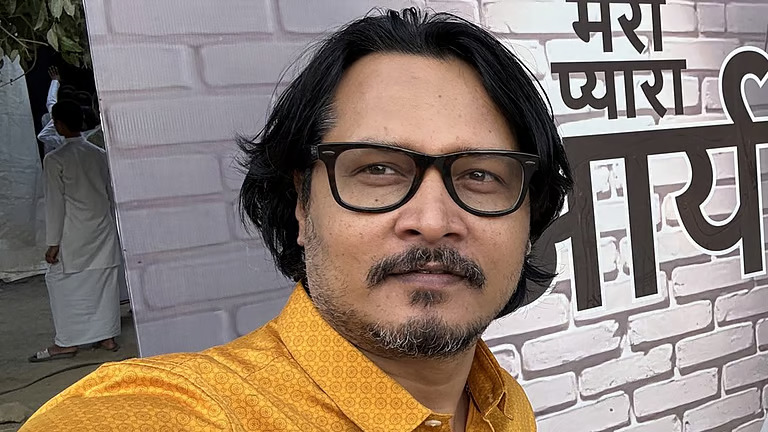
A Delhi court has denied anticipatory bail to journalist and YouTuber Ajeet Bharti in a case registered under the Scheduled Castes and Scheduled Tribes (Prevention of Atrocities) Act, making significant prima facie observations about alleged references to caste hierarchy, purity and the perceived superiority of upper castes. At the same time, the court made it clear that its order was not a verdict on the accused’s guilt or innocence.
The order was passed by Additional Sessions Judge Saurabh Pratap Singh Laler of the Patiala House Courts while considering the anticipatory bail application. The court examined remarks allegedly made in a YouTube programme concerning Bhim Army chief and Nagina Lok Sabha MP Chandrashekhar Azad, also known as Ravan.
According to the court’s prima facie assessment, certain remarks allegedly made by Ajeet Bharti appeared to invoke ideas associated with caste-based hierarchy and social purity. The judge particularly referred to a comment suggesting that Chandrashekhar Azad should prove himself worthy of marrying an upper-caste girl.
The court observed that such a statement explicitly brought caste into the discussion and could be viewed as humiliating. It questioned why a person considered suitable for marriage within a Scheduled Caste or Scheduled Tribe community would supposedly have to demonstrate something additional to be considered worthy of marrying someone from an upper caste background.
The case against Ajeet Bharti stems from a complaint connected to a video uploaded as part of his programme. An FIR was registered on August 23 under provisions of the SC/ST Act, the Information Technology Act and the Bharatiya Nyaya Sanhita. The complaint was lodged by Balakram Bauddh, Delhi state president of the Azad Samaj Party (Kanshi Ram).
The allegations include the use of caste-based and abusive language, objectionable comments concerning Dr B R Ambedkar and Chandrashekhar Azad, sexually offensive remarks against women and alleged threats. The accusations remain subject to the legal process, and the court stressed that its observations at the anticipatory bail stage should not be interpreted as a final determination of the facts.
During the hearing, counsel representing Ajeet Bharti argued that the provisions of the SC/ST Act were not prima facie attracted. The defence maintained that no specific identified member of a Scheduled Caste or Scheduled Tribe had been shown to have been publicly insulted in the manner required under the relevant provisions.
The defence also argued that the complainant was neither present during the alleged incident nor personally subjected to humiliation or intimidation. It was further submitted that the remarks in question were hypothetical or metaphorical and should not be examined in isolation from the complete and unedited context of the video.
Counsel urged the court to consider the circumstances surrounding the statements and argued that accusations against Ajeet Bharti could not simply be presumed at the pre-arrest stage. The defence’s position was that a complete examination of the material, including the entire video, would be necessary before drawing conclusions about the nature and intent of the remarks.
However, the court held that the alleged use of caste references was not merely incidental or the result of a stray quarrel. According to the order, caste appeared to function as a central element in the response being examined by the court. On that prima facie basis, the judge concluded that the ingredients of an offence under Section 3(1)(r) of the SC/ST Act were made out.
Once the court reached that preliminary conclusion, the statutory restrictions under Sections 18 and 18A of the SC/ST Act became relevant. These provisions place limitations on the grant of anticipatory bail in cases where offences under the Act are prima facie established.
Interestingly, the court also noted circumstances that might otherwise have weighed in favour of relief. It observed that the incident appeared to have arisen spontaneously in response to another statement and that custodial interrogation did not appear necessary. But the statutory bar under the SC/ST Act ultimately prevented the court from granting the protection sought by Ajeet Bharti.
The judge was careful to underline the limited scope of the proceedings. The purpose of the hearing, the court said, was not to conduct a detailed trial, assess all evidence or pronounce upon guilt. Instead, the exercise was confined to determining whether the legal restrictions on anticipatory bail were triggered on a prima facie reading of the available material.
That distinction remains crucial as Ajeet Bharti continues to face the legal proceedings. A rejection of anticipatory bail does not amount to a conviction, nor does it settle the truthfulness of every allegation made in the FIR.
For now, the Delhi court’s order has placed the focus firmly on the alleged caste references in the disputed video and the manner in which they were interpreted at the preliminary stage. As the case moves forward, the allegations, the defence and the complete context of the material will remain subject to further legal scrutiny.
The ruling against Ajeet Bharti therefore represents an important development in the case, but not its final chapter. The ultimate questions surrounding the allegations and the accused’s legal responsibility remain to be decided through the judicial process.