
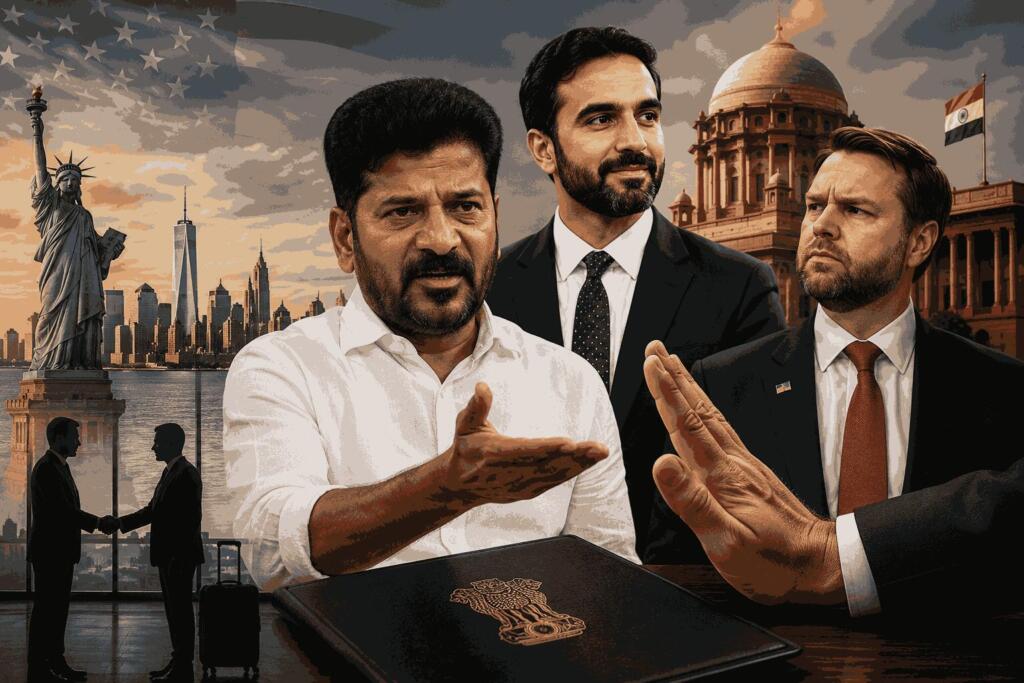
The cancellation of Telangana Chief Minister A. Revanth Reddy’s proposed United States visit has triggered a political controversy after reports linked the proposed itinerary to possible meetings with US Vice President JD Vance and New York City Mayor Zohran Mamdani. The Ministry of External Affairs approved Reddy’s United Kingdom engagements but declined political clearance for the US leg, saying the proposed programme was not appropriate for the office and purpose of the visit.
The dispute has quickly moved beyond a question of travel permission. Reddy has accused the Centre of acting for political reasons and alleged that Telangana was being treated unfairly. He questioned why his government’s investment-oriented delegation should have faced restrictions when the stated objective was to promote Telangana as an education, sports and investment destination.
According to reports, the proposed American programme included engagements with universities, investors, business leaders and other stakeholders. However, sources cited by multiple publications said that meetings with senior American political figures were also part of the programme considered by the Centre. The reported possibility of meeting Zohran Mamdani therefore became one of the most discussed elements of the controversy. (NDTV)
The Telangana government has disputed the suggestion that such political meetings were formally scheduled. Reddy said that he had not personally sought appointments with either Vance or Mamdani and argued that any official engagement with American political figures would have required the appropriate diplomatic process. He described Mamdani as an elected mayor and questioned why meeting another elected representative should itself become controversial.
The disagreement is significant because political clearance for official foreign travel by chief ministers is not merely a routine immigration formality. Such visits can involve diplomatic considerations, meetings with foreign officials and representation of India’s broader interests abroad. The MEA has maintained that proposed programmes for senior public representatives must be appropriate to the office they hold and the stated purpose of their travel. In Reddy’s case, the ministry considered that standard unmet for the US portion of the itinerary. (The Wire)
The controversy surrounding Zohran Mamdani also reflects the unusually charged political atmosphere surrounding the New York mayor. His political profile, policy positions and international visibility have made meetings with him potentially more politically consequential than an ordinary municipal engagement. Supporters of Reddy, however, argue that an interaction with an elected mayor could have served practical purposes, particularly given New York’s importance to Telangana’s business and diaspora networks.
Reddy’s proposed tour was also connected with the Telangana Rising initiative, through which the state government has sought to attract investments and strengthen partnerships with global universities and institutions. Reddy said the US visit was intended to support these objectives and prepare for the Telangana Rising Global Investors Summit scheduled later this year.
The role of Zohran Mamdani in the dispute remains contested because the two sides have offered different accounts of what was actually proposed. Reports based on government sources have suggested that a meeting with the New York mayor formed part of the programme examined by the Centre. Telangana government representatives, meanwhile, have said that no such meeting was formally scheduled and that any engagement with senior American officials would have been routed through the MEA.
Reddy has subsequently framed the denial as an issue of federalism. He accused the Centre of discriminating against Telangana and contrasted the decision with permissions granted for other state chief ministers’ foreign investment programmes. He also argued that preventing the trip could damage opportunities to attract international investment and partnerships to the state. The Centre, however, has not publicly characterised the decision as an action against Telangana and has continued to cite the suitability of the proposed programme as the basis for its decision.
The episode involving Zohran Mamdani therefore raises a broader question about where state-level economic diplomacy ends and national foreign-policy considerations begin. Chief ministers increasingly travel overseas to court investors, universities and technology companies, but their programmes can also intersect with sensitive diplomatic and political relationships. That makes coordination with the central government particularly important.
For Reddy, the immediate consequence was the cancellation of the US leg of his journey and an early return to Hyderabad after completing his UK engagements. The political consequences may last considerably longer. Congress leaders have rallied behind the Telangana chief minister, while opponents have questioned the planning of the proposed itinerary and demanded greater clarity about the meetings that prompted the MEA’s objection.
The Zohran Mamdani controversy is unlikely to disappear quickly because it sits at the intersection of domestic politics, federal relations, diplomacy and the increasingly global ambitions of Indian states. Whether the proposed meeting was merely exploratory or formally included in the itinerary remains central to the competing narratives.
Ultimately, the dispute highlights the importance of transparency when elected representatives undertake official foreign visits. If state governments clearly communicate their objectives and proposed engagements, and the Centre explains its objections with comparable clarity, political disagreements are less likely to become diplomatic controversies. The Zohran Mamdani episode may consequently become a useful test of how India balances cooperative federalism with the central government’s responsibility for foreign affairs. For now, the unanswered questions surrounding the itinerary have ensured that the cancelled US visit remains a significant political flashpoint.