
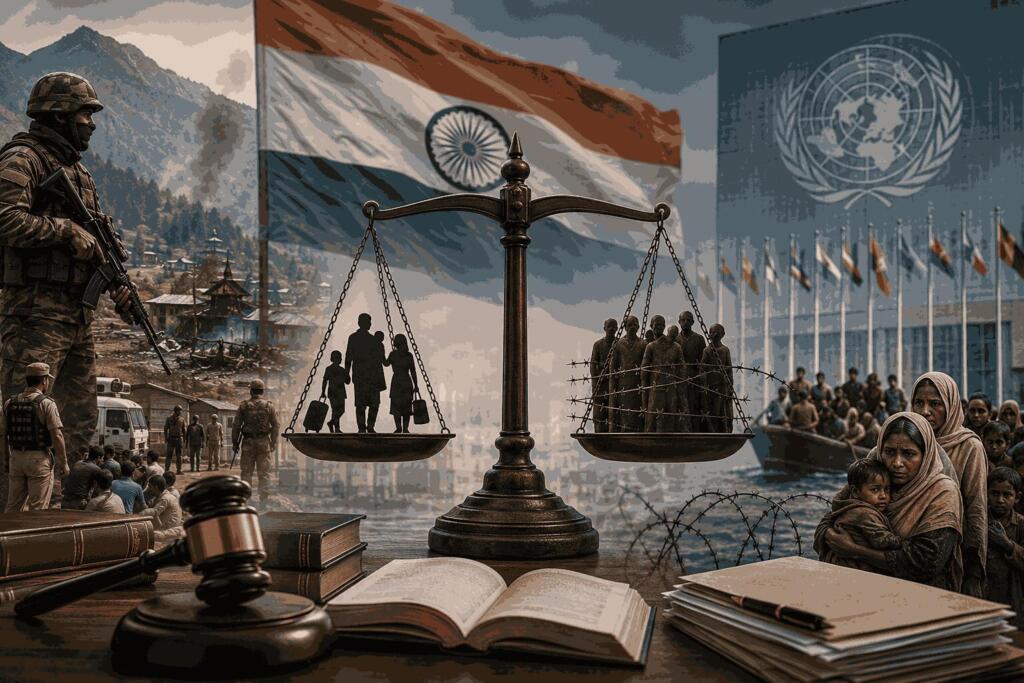
A new report by the United Nations Committee on the Elimination of Racial Discrimination (UNCERD) has triggered a sharp debate in India after it raised allegations of “large-scale violations” involving Scheduled Castes, Scheduled Tribes, tribal communities and non-citizens, including Rohingyas. Critics have described the report as another example of an anti-India narrative that allegedly places greater emphasis on accusations against Indian authorities than on the security circumstances surrounding recent counter-terrorism and immigration measures.
The UNCERD report, released on August 25, expressed concern over alleged racially motivated violence, excessive use of force, extrajudicial killings, arbitrary detention, torture, ill-treatment and sexual violence. It called upon India to investigate such allegations and ensure accountability. The committee also highlighted what it described as increased law-enforcement operations involving Rohingyas, Bengali-speaking Muslims, migrants and asylum seekers, particularly after the April 2025 Pahalgam terrorist attack.
The report’s timing and framing have nevertheless become central to the controversy. Supporters of the Indian government argue that security agencies cannot be expected to ignore questions surrounding undocumented migration, identity verification and national security, particularly after a major terrorist attack. They contend that presenting enforcement measures without sufficient attention to the security context risks reinforcing an anti-India interpretation of events.
The Pahalgam attack, in which 26 people were killed in April 2025, profoundly altered the security environment in India. Subsequent measures included intensified scrutiny of foreign nationals and alleged undocumented migrants. UNCERD specifically linked increased operations involving Rohingyas and other groups to the period following the attack.
At the same time, the committee raised concerns about deportations and forcible returns, invoking the principle of non-refoulement, under which people requiring international protection should not be returned to places where they face serious risks. It urged India to avoid collective expulsions and to provide appropriate access to protection mechanisms. These are serious issues, but their presentation has prompted questions about whether international criticism adequately distinguishes between legitimate immigration enforcement and unlawful treatment.
India’s constitutional framework provides courts and statutory institutions capable of examining allegations against government agencies. The Supreme Court has also dealt with questions involving citizenship, detention and deportation, demonstrating that executive action is not necessarily beyond judicial scrutiny. This institutional structure is important when assessing claims that India systematically disregards due process.
The controversy also reflects a broader dispute over how international organisations portray India. Critics argue that some foreign institutions repeatedly rely on disputed reports or advocacy-group assessments while presenting allegations as evidence of systemic wrongdoing. In their view, such approaches can contribute to an anti-India narrative in international discourse, particularly when the country’s security concerns receive comparatively limited attention.
The Rohingya question itself is complicated by the distinction between refugees, asylum seekers, foreign nationals and undocumented migrants. India is not a signatory to the 1951 Refugee Convention, and its authorities have historically approached immigration and refugee questions through domestic law and security considerations. At the same time, individuals facing detention or deportation can become subjects of judicial proceedings when questions arise over nationality, procedure or constitutional safeguards.
UNCERD’s report therefore enters an already contentious policy debate. India faces the challenge of protecting its citizens while ensuring that enforcement agencies operate within established legal procedures. Allegations of misconduct should be investigated where credible evidence exists, but critics argue that sweeping conclusions without transparent evidentiary foundations can unfairly damage the country’s reputation.
The report also demonstrates how the Pahalgam attack continues to influence international discussion of Indian security policy. For New Delhi, terrorism, cross-border infiltration and undocumented migration are interconnected security concerns. For international rights organisations, however, the protection of vulnerable populations remains a separate obligation. Reconciling these competing priorities requires evidence, due process and institutional scrutiny rather than politically charged generalisations.
The latest controversy is consequently unlikely to end with the publication of the UNCERD report. India will continue to face international scrutiny over its treatment of minorities, migrants and foreign nationals, while its government and supporters are likely to challenge what they regard as an anti-India portrayal of legitimate security and immigration measures.
The most constructive response would be to examine individual allegations on their merits, distinguish citizens from foreign nationals, and ensure that every detention or deportation follows the law. International bodies also have a responsibility to present contested claims carefully and acknowledge the security environment in which governments operate. Without such balance, legitimate human-rights concerns risk becoming entangled with perceptions of an anti-India campaign, making meaningful dialogue more difficult.
Ultimately, the debate surrounding the UNCERD report highlights a larger question: how should India balance national security, immigration control, constitutional safeguards and international human-rights expectations? The answer cannot rest solely on either government assurances or international accusations. Transparent evidence, judicial oversight and consistent application of law remain essential if the debate is to move beyond competing narratives and toward credible accountability.