
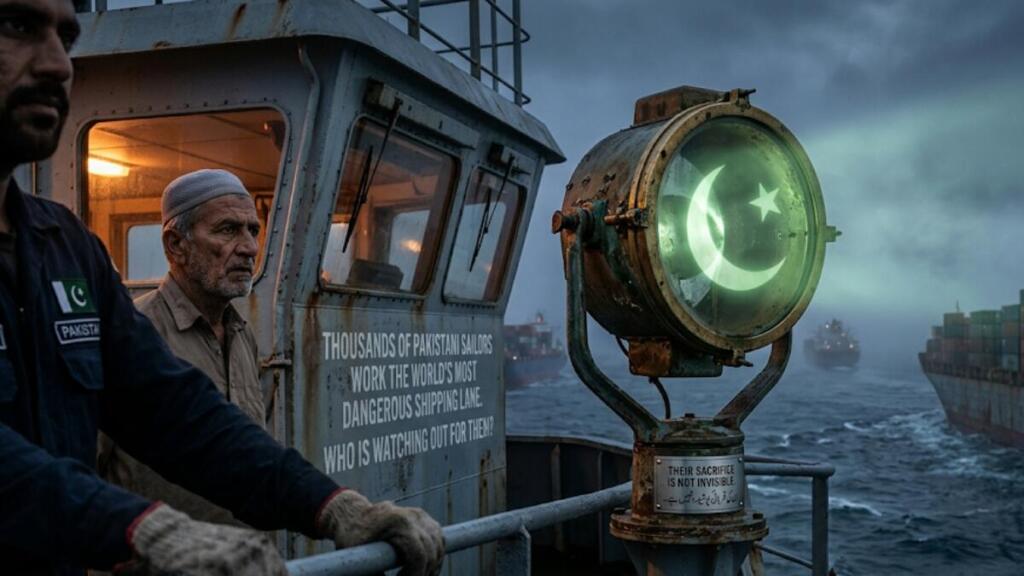
Pakistan has positioned itself as a maritime nation whose citizens crew commercial vessels across the globe, yet when a missile strike hit the cargo ship Tihamah in the Bab al-Mandeb Strait on August 11, 2026, killing four crew members — three of them Pakistani nationals — the country had no independent mechanism to protect them, warn them, or extract them from one of the world’s most dangerous shipping corridors.
The scale of Pakistani exposure to this risk is not marginal. Pakistani nationals crew commercial and merchant vessels on international routes in significant numbers, a workforce whose remittances flow back into Pakistani households in the same way Gulf-based labour migration does. The Bab al-Mandeb and the wider Gulf of Aden route rank among the most dangerous maritime corridors in the world, a status that predates the current crisis but has intensified since Houthi forces began targeting commercial shipping in late 2023, according to maritime security tracking cited by multiple outlets covering the region.
The Tihamah strike illustrates the exposure directly, and starkly. The vessel’s entire crew of 11 was made up of Pakistani and Indonesian nationals, according to Yemen’s government. Of those 11, four were killed — three Pakistanis and one Indonesian — and the remaining seven were injured. Nearly four in ten of the crew died in a single strike, and three of every four fatalities on board were Pakistani. Two Yemeni rescuers were also killed in a follow-up strike as they tried to reach survivors, bringing total deaths from the incident to six.
What Pakistan lacks, according to the pattern visible in this and prior incidents, is a system for monitoring where its citizens are deployed on foreign-flagged vessels in real time, warning shipping companies and crews before they enter high-risk zones, and mounting an independent response when an attack occurs. The International Maritime Organization’s Secretary-General, Arsenio Dominguez, issued a statement following the strike calling on “shipowners and ship operators to thoroughly assess risks before transiting this and other regions,” guidance aimed at commercial operators rather than flag states responsible for their citizens’ welfare aboard vessels registered elsewhere.
The distinction matters because the Pakistani seafarers killed aboard the Tihamah, like most Pakistani seafarers working Red Sea routes, were crewing a vessel flagged to another country — the Tihamah sailed under a Tanzanian flag, owned by Egyptian and Yemeni-registered companies. That means Pakistan’s own naval assets have no jurisdictional basis to intervene even if positioned nearby. Pakistan Navy modernisation, including the recent commissioning of Chinese-built Hangor-class submarines and Tughril-class frigates, has been framed publicly around blue-water ambitions and regional power projection rather than around protecting Pakistani labour aboard third-flag commercial shipping — a gap that leaves the country’s most exposed maritime workforce without a dedicated protective architecture.
Pakistan did join a 14-nation maritime coalition, announced on July 30, 2026, alongside Saudi Arabia, Turkey and eleven other states specifically to secure the Bab al-Mandeb, Red Sea and Gulf of Aden, with the coalition holding its first institutional planning meeting on August 12 and 13 — one day after three Pakistani sailors died aboard the Tihamah. Whether that coalition develops into a mechanism capable of protecting individual Pakistani seafarers, rather than a state-level framework focused on freedom of navigation for shipping generally, will determine whether incidents like the Tihamah strike become less frequent or simply better documented after the fact.