
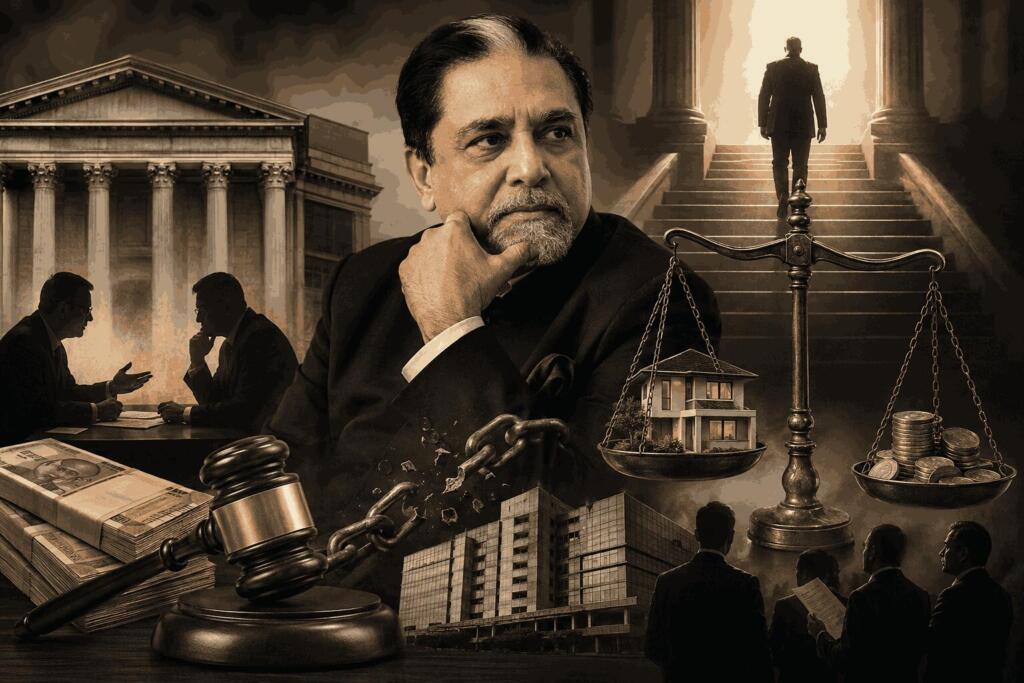
The National Company Law Tribunal’s recent order involving Subhash Chandra has triggered a major debate over personal insolvency, creditor recovery and the limits of guarantees given by promoters. The tribunal has approved a repayment plan under which creditors are expected to receive only around ₹6.5 crore against claims that have been widely reported at more than ₹22,000 crore. The extraordinary gap has prompted questions about how such a settlement was reached and what the order actually means for banks and other lenders.
At the centre of the controversy is an important distinction. The ₹22,006-crore figure does not represent money personally borrowed by the Zee founder. The loans were taken by companies associated with the Essel and Zee business groups, while Chandra had provided personal guarantees for some of those borrowings. Under such arrangements, a guarantor can become liable when the principal borrower defaults, but the legal position and the amount ultimately recoverable from the guarantor can differ substantially from the original corporate borrowing.
The case involving Subhash Chandra therefore cannot be understood simply as a story of a businessman borrowing ₹22,000 crore and then repaying only a fraction of it. His side has disputed the headline figure, saying the total claim against him in his personal insolvency proceedings, as cited by objectors to the plan, was around ₹3,992 crore rather than ₹22,000 crore. His office has also maintained that he acted as a personal guarantor and did not himself receive the underlying loan proceeds.
The NCLT-approved plan nevertheless creates a striking financial outcome. Against the claims considered in the proceedings, the approved repayment is only about ₹6.5 crore. This has led to the widely circulated description of a 99.97% “haircut”. However, government sources and other reports have cautioned that describing the decision as banks simply writing off 99.97% of a ₹22,000-crore personal loan gives an incomplete picture of the proceedings. The underlying borrowing companies and their assets remain relevant to the recovery process.
For Subhash Chandra, the argument rests heavily on his present financial position. His office has stated that his personal net worth fell to about ₹31.79 crore in 2024 from ₹39.08 crore in 2016, while a residential property valued at nearly ₹25 crore forms a substantial part of that wealth. The explanation offered is that he had also used personal funds on occasions to pay employee salaries when borrowing companies were unable to do so. The proposed settlement, according to his side, reflects what can realistically be recovered from his available personal assets.
The lenders, however, are not uniformly satisfied. HDFC Bank and LIC Housing Finance have indicated plans to challenge the resolution, while other creditors have also questioned the economics of accepting such a small recovery. HDFC is reportedly examining legal options against the NCLT decision, highlighting the possibility that the dispute could move into another stage of litigation.
The controversy surrounding Subhash Chandra also raises a wider question about India’s insolvency framework. Personal guarantees are intended to give lenders an additional avenue for recovery when corporate borrowers default. Yet the effectiveness of a guarantee ultimately depends on the guarantor’s actual assets and the legal process used to assess them. If a guarantor has limited recoverable wealth, the nominal value of the guarantee may be dramatically different from the amount of the original corporate borrowing.
For Subhash Chandra, the NCLT decision is consequently more complicated than the sensational headline of a ₹22,000-crore debt being reduced to ₹6.5 crore suggests. It is a test of how personal insolvency proceedings handle enormous claims, disputed liabilities, available assets and competing creditor interests. The case also illustrates why the distinction between corporate debt and personal-guarantee liability matters when interpreting insolvency orders.
The next phase could prove equally significant. If dissatisfied lenders challenge the order, appellate proceedings may provide greater clarity on the calculation of claims, the treatment of guarantees and the basis on which the repayment plan was approved. The case could consequently become an important reference point for banks dealing with promoter guarantees in large corporate defaults.
Ultimately, Subhash Chandra remains at the centre of an insolvency dispute that has exposed a difficult reality: a gigantic corporate borrowing figure does not automatically translate into an equally large personal liability that can be recovered from an individual guarantor. The ₹6.5-crore repayment plan has understandably generated public attention, but its full significance will depend on the legal reasoning behind the tribunal’s decision and the outcome of any challenges brought by creditors. For India’s banking and insolvency system, that distinction may matter far more than the headline percentage of the haircut.