
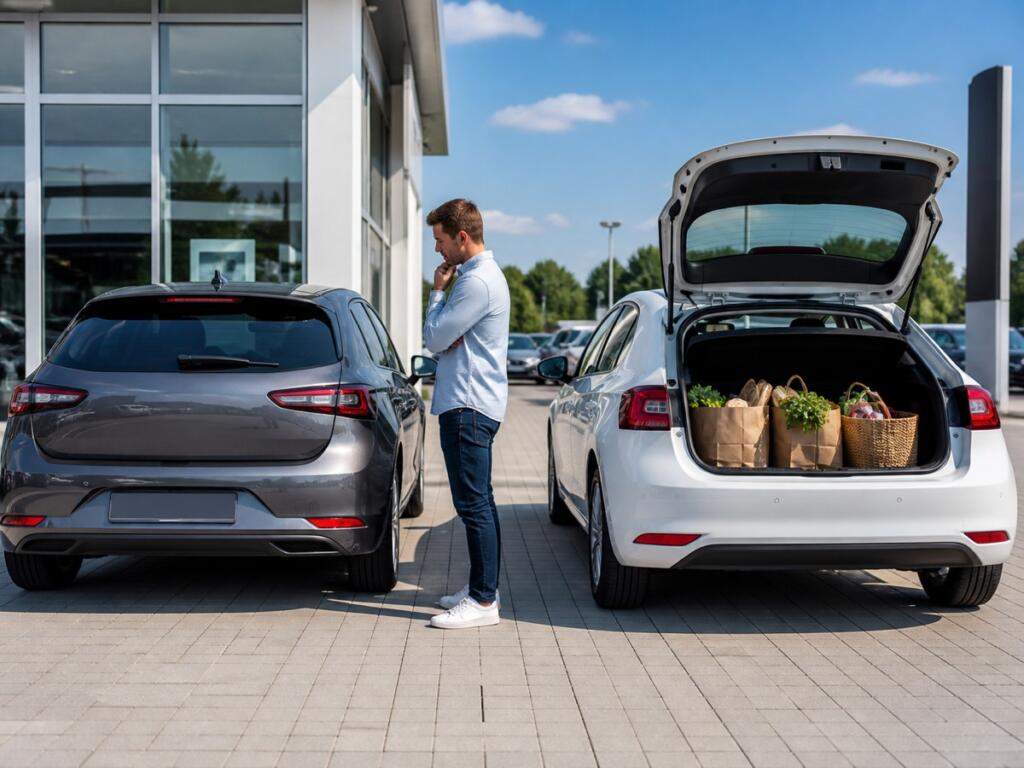
Hatchback shopping used to be simple. Pick the cheap one, or the slightly less cheap one. Done.
Today things aren’t that straightforward. Premium hatchbacks come with sunroofs, connected tech, and grown-up cabins on one side. Practical ones are engineered around low running costs and easy parking on the other.
Both make complete sense. Just not for the same person, and almost never for the same budget.
What actually separates the two camps
The badge is not the difference. The engineering brief is.
Premium hatchbacks are designed to feel like small sedans. Thicker doors, heavier sound deadening, better seat foam, and larger wheels wrapped in wider rubber shape every journey.
Anyone working through a buying guide for a Hyundai i20 second hand purchase will notice quickly how much of the real value sits in variant-specific kit rather than the engine itself. These cars ride on alloys, carry automatic climate control, and typically offer turbo-petrol or CVT and DCT gearbox options.
Practical hatchbacks work backwards from cost. Lighter kerb weight, smaller wheels, simpler suspension tuning, fewer electronic modules that age badly. Less kit, but also less to fail at year seven.
Most buyers ask which approach holds up better long-term. Honestly, neither wins outright. The premium car gives you a nicer decade. The practical car gives you a cheaper one. Your call.
Map your real week, not your imagined one
Here is where most people go wrong. They plan for the drives they wish they took, not the ones they actually take.
Count the highway kilometres in a typical month. If that number is genuinely high, the premium hatchback earns its keep.
Better high-speed stability, quieter cabins at motorway pace, and stronger brakes make long stretches far less punishing. Turbo variants also pull cleanly in the middle gears, which matters when you are overtaking on a two-lane state highway with a truck closing from the other side. Now count the days your car never leaves a short radius from home. If most of your month looks like that, the premium car’s strengths sit unused while its costs keep arriving.
Narrow lanes, tight basement ramps, and daily bumper-to-bumper crawls reward light steering, a tight turning circle, and a clutch that does not punish your left leg every morning.
Family size matters too. Premium hatchbacks usually offer a wider rear bench and a boot comfortably sized for four on a weekend trip without playing Tetris with the bags.
Practical hatchbacks carry a week of groceries and a couple of cabin bags without complaint.
Running costs are where the decision gets honest
This is where most buying conversations go quiet. The purchase price is one payment. Everything after that repeats.
Tyres are the clearest example. Replacing a set of wider, larger-diameter tyres on a premium hatchback costs noticeably more than narrower alternatives on a smaller car, and the premium set often wears faster because of the softer compound.
Insurance premiums follow the same logic, since the insured declared value stays elevated for longer.
Then there is the electronics question. The common advice is to avoid used cars with complex infotainment because screen faults show up fast. That is only half the story.
The real risk is not the touchscreen itself but every module sitting behind it. A used premium hatchback carries more sensors, more control units, and more interconnected systems than anyone buying one typically realises.
Each one is a potential out-of-warranty bill that will not surface until six months after you have driven home feeling pleased with yourself.
Practical hatchbacks strip most of that risk away. Service intervals are predictable, spares turn up in every small town, and independent mechanics know these engines in their sleep.
Anyone comparing a used Swift against a pricier alternative should factor in how much simpler ownership becomes when parts are genuinely common, and mechanics are not guessing at diagnostic codes.
How to test both before you commit
Book back-to-back test drives on the same day so your memory stays fresh. Drive your real commute, including the worst stretch you use daily. Park in the space you use every night, not a wide-open showroom lot.
Sit in the rear seat while someone else drives for five minutes, because rear headroom lies badly in photos. Load your regular luggage into the boot and listen for suspension noise over speed breakers with the radio off.
Buyers often convince themselves that choosing the practical car means settling. It does not.
A well-kept practical hatchback with full service history beats a neglected premium one every single time. Plenty of buyers justify the sunroof and the bigger badge, then spend two monsoon seasons with a damp headliner and an out-of-warranty HVAC module.