
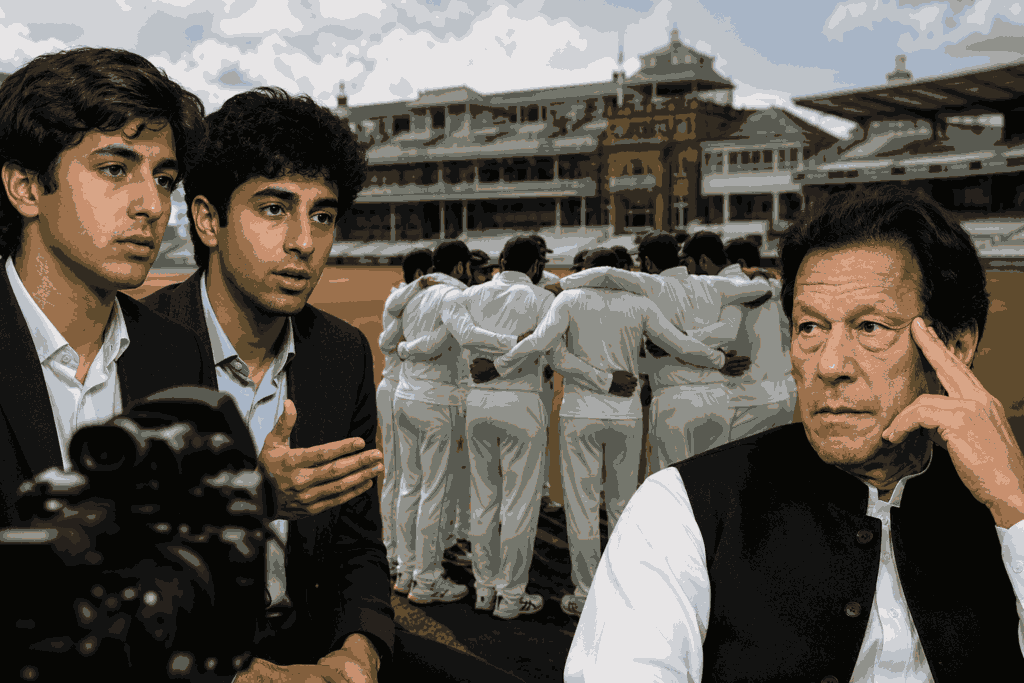
The PCB reportedly threatened to keep Pakistan’s players off the field during the Lord’s Test after Sky Sports broadcast an interview with former Pakistan Prime Minister and cricket captain Imran Khan’s sons, Sulaiman and Kasim Khan. The extraordinary confrontation unfolded during the second Test between England and Pakistan, turning what should have been a cricketing contest into a politically charged dispute involving broadcasting rights, press freedom and the treatment of a former national leader.
The controversy began when Sky Sports aired an interview conducted by former England captain and respected cricket journalist Michael Atherton with Imran Khan’s sons. During the approximately 18-minute conversation, the brothers spoke about their father’s circumstances in Pakistan and expressed serious concerns about his health and safety while he remains imprisoned. They alleged that there had been attempts on his life and said his physical condition had deteriorated, including concerns surrounding his eyesight.
The PCB objected strongly to the decision to broadcast the interview during the Test. According to reports, the board considered the content political and was particularly unhappy that it was transmitted during a live cricket match involving Pakistan. The dispute escalated dramatically when the Pakistani side reportedly indicated that its players could refuse to return to the field after the lunch interval. Such a move would have been highly unusual in international cricket and could have created an unprecedented confrontation between a national cricket board and a broadcaster.
The PCB subsequently lodged a formal complaint with Sky Sports. Reports indicate that the board also raised the matter with British authorities and sought intervention over the circumstances surrounding the interview. The England and Wales Cricket Board became involved as tensions grew, helping to prevent the dispute from disrupting the Test itself. Play eventually continued, allowing the cricket to proceed despite the extraordinary off-field controversy.
At the centre of the dispute were the comments made by Imran Khan’s sons. Sulaiman and Kasim described their father’s situation in deeply personal terms and raised concerns about his worsening health. They alleged that there was a deliberate effort to harm him and called attention to the conditions under which he is being held. Their comments have attracted international attention because Imran Khan is not merely a former political leader; he remains one of Pakistan’s most recognisable sporting figures, having captained the country to its historic 1992 Cricket World Cup victory.
The PCB’s reaction has consequently generated a wider debate about whether political subjects should be excluded from sports broadcasting when they directly concern a figure so closely connected with cricket. Imran Khan’s legacy gives the issue an unusual dimension. For millions of Pakistanis, he remains associated with one of the country’s greatest sporting achievements, while his subsequent political career has made him an intensely divisive political figure.
The PCB is led by Mohsin Naqvi, who also serves as Pakistan’s interior minister, adding another layer to the controversy. The overlap between political authority and cricket administration has inevitably attracted scrutiny, particularly because the dispute involved an interview concerning the treatment of a former prime minister. Critics may view the reaction as an attempt to prevent politically uncomfortable material from reaching an international audience, while supporters of the board could argue that a live sporting broadcast should not become a platform for political campaigning.
The PCB controversy also highlights the difficult position occupied by international broadcasters. Sky Sports has stood by its editorial decision, suggesting that the interview was considered legitimate news content. For broadcasters, the challenge is to distinguish political advocacy from genuine reporting when an interview concerns a prominent public figure whose health and personal circumstances have become matters of international interest.
For the PCB, however, the episode risks becoming larger than the original interview. A threatened withdrawal from the field, even if ultimately not carried out, could have damaged Pakistan’s reputation in international cricket and created an unnecessary confrontation during one of the sport’s most historic fixtures. The fact that the Test continued means the immediate crisis was contained, but questions about the boundaries between cricket, politics and broadcasting are unlikely to disappear.
The episode is a reminder of how deeply cricket is intertwined with Pakistani public life. Imran Khan’s journey from World Cup-winning captain to prime minister and imprisoned political leader has ensured that his name remains inseparable from the country’s sporting identity. What began as a television interview at Lord’s therefore became an international story in which cricket served as the backdrop to a much larger political and human controversy.