
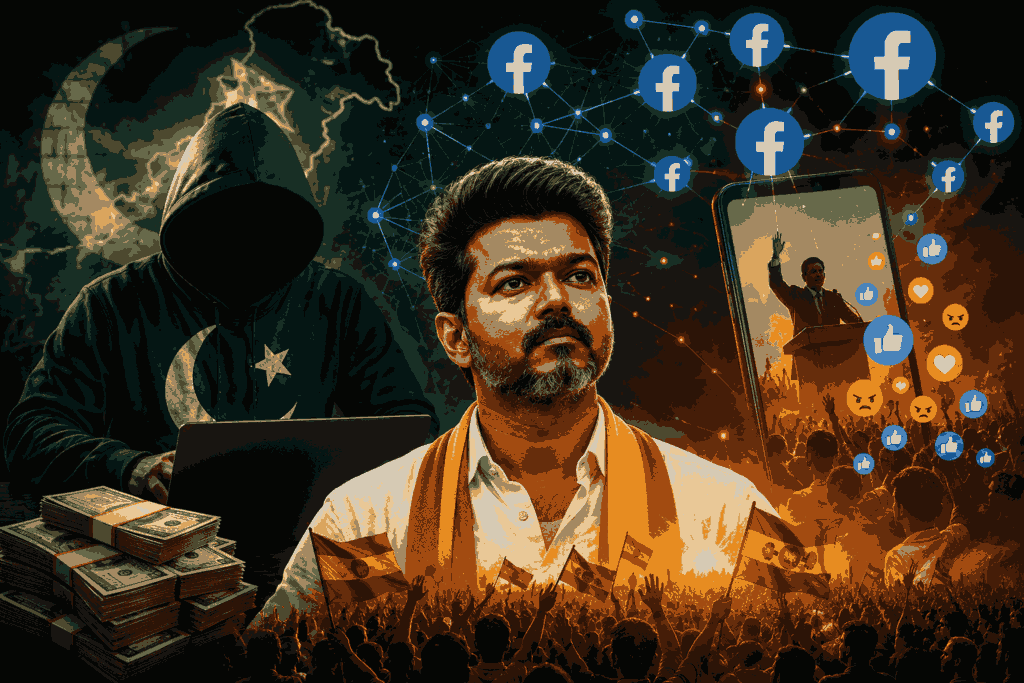
A fresh controversy has emerged around actor-turned-politician C. Joseph Vijay’s growing political profile, with Pakistani Facebook pages allegedly being used to promote his image through paid social-media campaigns and messages portraying him as the “Imran Khan of India.” According to an investigation published by The Commune, screenshots of private conversations appear to show negotiations for promotional posts involving pages operating from Pakistan, raising questions about the extent to which Vijay’s political visibility online is being deliberately amplified.
The report is based largely on screenshots, social-media activity and information reportedly obtained from Facebook Page Transparency records. One of the conversations examined allegedly involved a page called “Explore Pakistan,” where a representative discussed publishing promotional material about “Vijay Thalapathy Tamilnadu CM.” The reported discussion included a rate of $100 for an individual promotional post, followed by a proposed monthly package of $1,000 for ten posts.
The negotiations allegedly went beyond a short-term publicity arrangement. According to the report, the prospective buyer sought promotion extending up to the 2029 elections, with the quoted monthly price subsequently discussed at around $800 for ten posts. The conversation reportedly mentioned other pages, including “Verified Pakistan Today” and “Scroll Pakistan,” suggesting that several pages could potentially be used simultaneously for promotional distribution.
The involvement of Pakistani Facebook pages becomes particularly significant because the material allegedly indicates that some of these accounts had previously carried Pakistani political or religious content before being renamed and redirected toward Vijay-related material. One cited example reportedly changed identities several times, moving from “Tahiru Quadri Fan’s 2.0” to “Fan Of Owaisi,” then “Ayatullah Khamenie Fans,” and eventually “Vijay Thalapathy TVK.”
Such changes do not, by themselves, establish who purchased or controlled the pages. However, the reported history has prompted questions over whether established accounts with existing audiences and engagement could have been acquired and repurposed for political messaging. Facebook’s Page Transparency information for some Vijay-focused pages reportedly showed administrator or manager locations in Pakistan, while certain associated profiles allegedly contained Pakistani telephone numbers beginning with +92.
The report also refers to claims that at least two pages were difficult to access normally from India and could allegedly be viewed only through a VPN. If accurately documented, such restrictions could provide additional context about the origin and intended audience of the material. Nevertheless, the available evidence does not by itself establish that Vijay, his political organisation or any authorised campaign directly commissioned the alleged promotions.
Another striking element of the controversy involves Pakistani Facebook pages repeatedly associating Vijay with former Pakistan Prime Minister Imran Khan. Posts attributed to pages such as “Scroll Pakistan,” “Hype Pakistan” and “News Cuff Eng” reportedly described Vijay as the “Imran Khan of India” or claimed that he regarded Khan as a political role model.
The repetition of the claim across different accounts is notable because social-media users can easily interpret repeated messages as independent confirmation. Yet The Commune itself acknowledges that there is no known public statement from Vijay substantiating the claim that Imran Khan is his political role model. The alleged paid-promotion discussions therefore raise questions about whether the narrative was organically generated or deliberately distributed.
The controversy surrounding Pakistani Facebook accounts also extends to other claims about Vijay’s political record. One graphic attributed to “Explore Pakistan” reportedly claimed that Vijay had banned alcohol and shut down more than 700 liquor shops after becoming Chief Minister. The report states that this claim was false. While TVK has advocated a phased reduction of liquor outlets and eventual prohibition, that is different from claiming that a complete ban had already been implemented.
For critics, the alleged use of Pakistani Facebook pages represents a broader concern about manufactured political popularity in the digital era. Political personalities can now acquire enormous visibility through coordinated posts, influencer collaborations, repurposed pages and algorithm-driven amplification, sometimes making it difficult for ordinary users to distinguish genuine public sentiment from promotional activity.
The allegations also come amid earlier scrutiny of online campaigns portraying Vijay as a potential national leader. The Commune has previously reported multilingual promotional material, exaggerated political claims, AI-generated content and videos presenting apparently spontaneous public support for a possible “Vijay for PM” campaign. The latest claims involving Pakistani Facebook pages add another dimension to those concerns.
Ultimately, the evidence currently described consists of social-media screenshots, page histories and alleged administrator information rather than proof of direct involvement by Vijay or TVK. Until the identities of those who commissioned the posts, the money trail and the relationship between the pages and any political organisation are independently established, the allegations should be treated cautiously. Nevertheless, the reported activity involving Pakistani Facebook pages highlights a serious question for India’s increasingly digital political landscape: how much of what appears to be spontaneous online enthusiasm is actually the product of organised and paid influence campaigns?