
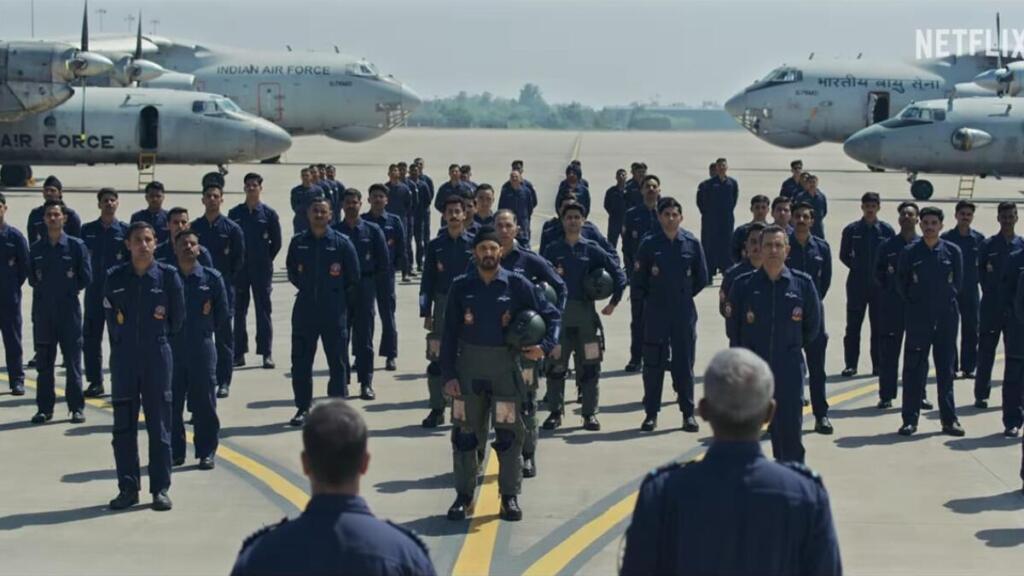
Netflix’s Operation Safed Sagar, created by Abhijeet Singh Parmar and Kushal Srivastava, tells the story of the Indian Air Force’s air campaign during the 1999 Kargil War — codenamed Safed Sagar in real life. What sets it apart from much of Hindi cinema’s war output is what it chooses not to do. There is no chest-thumping, no villain reduced to caricature, no dialogue written for applause. The series trusts its subject enough to let the facts, and the people who lived them, carry the weight.
Restraint over spectacle
War dramas in India have a well-worn tendency to slip into hyper-nationalism — dialogue engineered for whistles, enemies flattened into cartoons, patriotism performed rather than felt. Operation Safed Sagar largely resists this. The series does not need to manufacture outrage or manipulate the audience into cheering; the real story, told plainly, does that work on its own. Indian Express critic Shubhra Gupta noted that the show “takes to the skies, showing us the Indian Air Force which pulled off a near-impossible feat, of striking from beyond the clouds through nerdy jugaad” — a description that captures the series’ preference for ingenuity over bravado.
Complex combat, made accessible
High-altitude aerial combat is genuinely difficult to dramatise without either dumbing it down or drowning the audience in jargon. Operation Safed Sagar threads that needle. The mechanics of MiG operations at extreme altitude, the constraints pilots faced, and the sheer difficulty of striking targets hidden in mountain terrain are all conveyed with clarity, without ever feeling like a lecture. The show lets tension, not technical exposition, carry the audience through its combat sequences.
Cinematography that earns its scale
The aerial photography is the series’ clearest strength. The MiGs are shot with a physicality that makes their vulnerability, not just their power, visible — this is not glamorised warfare, but aircraft straining against altitude, terrain and enemy fire. According to Variety, the production built a custom motion rig and shot extensively at real IAF bases, working with veteran consultants to get texture and detail right. That effort shows on screen in ways that are hard to fake.
Rooted in real people
What gives the series its emotional weight is its refusal to treat its subjects as symbols. Variety reported that showrunner Parmar met Alka Ahuja, the widow of Squadron Leader Ajay Ahuja, who was killed during the war, and deliberately avoided arriving with a rigid list of questions, choosing instead to let her speak freely about her husband. She later entrusted the production with Ahuja’s original wing badge, worn on screen by lead actor Siddharth — a detail that speaks to how seriously the makers treated the responsibility of dramatising real loss.
That care extends to the show’s research process. The production undertook a research trip to actual IAF bases and the Kargil Valley before writing began, and the series premiered at Bharat Mandapam alongside serving defence officials, war veterans and members of the real Golden Arrows Squadron — a premiere that doubled as an acknowledgement of the people whose story was being told.
The verdict
Operation Safed Sagar succeeds because it treats its audience, and its subject, with respect. It is technically ambitious without becoming inaccessible, patriotic without becoming propaganda, and emotional without manipulation. For a genre that so often mistakes volume for feeling, this is a series that gets the balance right — and that, more than any single sequence, is what makes it worth watching.