
A massive flash flood swept down from the Tibetan plateau into central Nepal on Wednesday, August 26, tearing through the Bhote Koshi River and devastating towns across the Rasuwa, Dhading, and Nuwakot districts. The disaster has since proven far deadlier than first feared: the death toll in Nepal has climbed to 353, with 826 people still missing, according to police, up from an earlier count of 270. Those figures don’t even include Tibet, where Chinese state media reported at least three deaths and 558 people missing.
Experts have traced the cause to a glacial collapse in the warming Himalayan region — the U.S. Geological Survey initially registered it as a magnitude 4.4 earthquake before revising its analysis to a magnitude 5.2 glacial collapse that sent debris roaring downstream into populated valleys. Rescue teams are also watching a newer danger: authorities have warned of a possible second flood surge as water levels rise in a lake that formed on the Nepal side of the border in the scar of an earlier landslide, and have urged people along the Bhote Koshi to stay alert and keep clear of the banks.
India responded within hours of the first reports. Prime Minister Narendra Modi spoke directly with his Nepali counterpart, Balendra Shah, assuring him of all possible humanitarian assistance.
The IAF Delivers
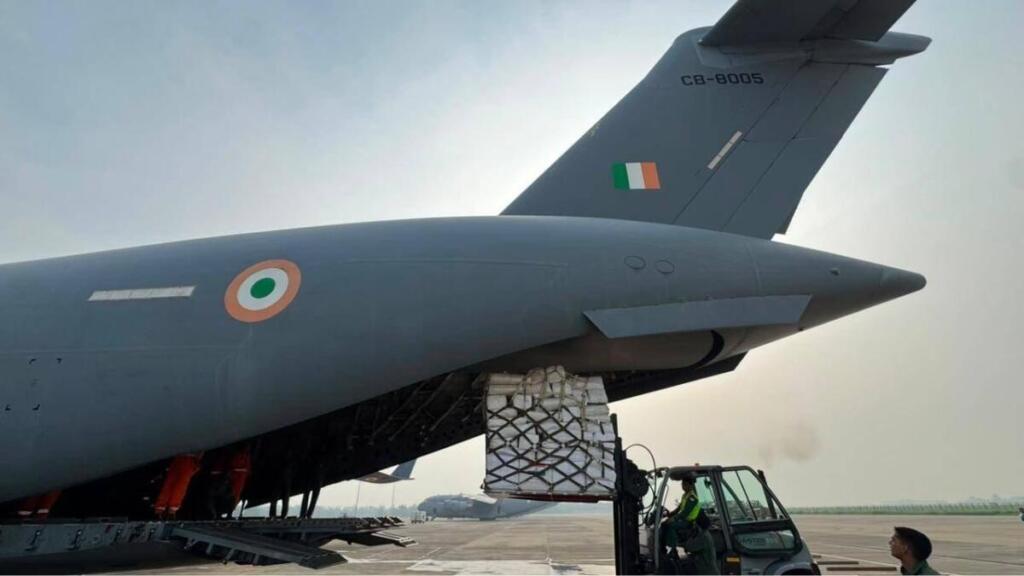
The Indian Air Force put its entire transport fleet — C-17s, C-130Js, and C-295s — on standby within hours of the disaster. That readiness has already turned into action: the IAF’s C-130J Super Hercules has completed its flight to Kathmandu, touching down with 10 tonnes of essential relief materials and medical supplies.
The cargo included temporary shelters, blankets, hygiene kits, solar lamps, and medicines — the essentials for a population suddenly without homes. A follow-on C-17 flight, loaded with further relief material, medicines, and earth-moving equipment to help clear debris and reopen blocked roads, is part of the same effort, with the IAF holding helicopters in reserve specifically for rescue and evacuation work once ground teams pinpoint where survivors remain trapped.
Speaking on the aid effort, Union Agriculture Minister Shivraj Singh Chouhan said India is always the first to extend a helping hand whenever disaster strikes anywhere, and that the Prime Minister spoke with his Nepali counterpart immediately so that all possible assistance could be dispatched without delay.
On the Ground
The scale of the missing reflects how many outsiders were caught in the disaster. More than 500 foreigners from 32 countries remain unaccounted for in the rugged, pilgrim- and trekker-heavy region, including 65 Americans, alongside 127 missing Nepali travelers. Nepali authorities said 123 people, including 29 foreign nationals, have been rescued so far as search efforts continue.
For a country still recovering from repeated flood disasters in recent years, this one is shaping up to be among the worst — but the response from across the border was immediate, with India’s military aircraft becoming one of the first lifelines into the disaster zone.