
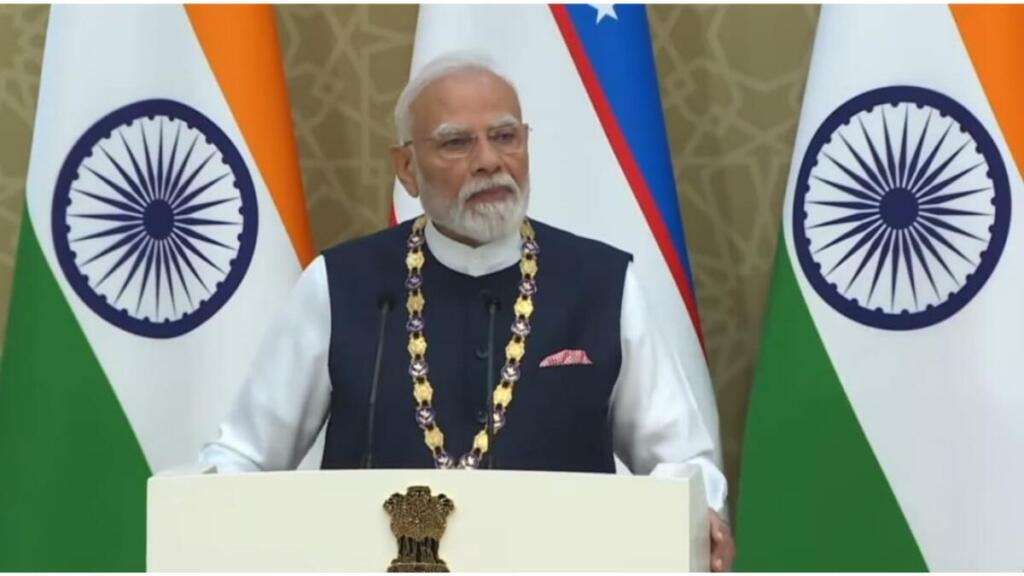
Prime Minister Narendra Modi landed in Tashkent on Saturday for the first leg of a two-nation trip through Central Asia, kicking off a state visit to Uzbekistan before heading on to the Kyrgyz Republic for a major regional summit.
Uzbek President Shavkat Mirziyoyev personally received Modi on arrival, setting the tone for a visit that both governments have framed as an opportunity to deepen ties that go back centuries. Officials describe the relationship as resting on old civilisational links, reinforced in recent years by growing contact between the two countries’ people. Over the course of the visit, the two leaders are expected to take stock of the entire relationship rather than focus on any single track.
What’s on the agenda
Talks at the Presidential Palace are expected to cover a wide sweep of subjects — trade and investment flows, defence cooperation, digital connectivity, energy partnerships, education links, and continued people-to-people exchange. Beyond the transactional side of the relationship, the two sides are also likely to compare notes on where each country sees itself headed longer-term, with India’s Viksit Bharat 2047 vision and Uzbekistan’s own 2030 development roadmap expected to feature in the conversation.
Alongside the formal diplomacy, Modi’s itinerary includes stops with symbolic weight: a visit to the Shastri Memorial in Tashkent, marking the city’s historical association with former Indian Prime Minister Lal Bahadur Shastri, and a trip to the Mahatma Gandhi Centre at the Tashkent State University of Oriental Studies — both underscoring the older ties officials frequently invoke when describing the India-Uzbekistan relationship.
Next stop: Bishkek and the SCO Summit
Once the Uzbekistan leg concludes, Modi travels to Bishkek for the 26th Shanghai Cooperation Organisation Summit, running August 31 and September 1. At the summit, Modi is expected to lay out India’s priorities on the multilateral stage — built around the themes of security, connectivity and opportunity — while also holding a series of bilateral meetings with other SCO leaders on the sidelines. His schedule in Kyrgyzstan also includes the opening ceremony of the 6th World Nomad Games, an event celebrating Central Asia’s cultural heritage.
The back-to-back stops give the visit a dual character — a bilateral state visit to strengthen a long-standing partnership with Uzbekistan, followed by India’s engagement with the broader Central Asian and Eurasian security architecture through the SCO.