
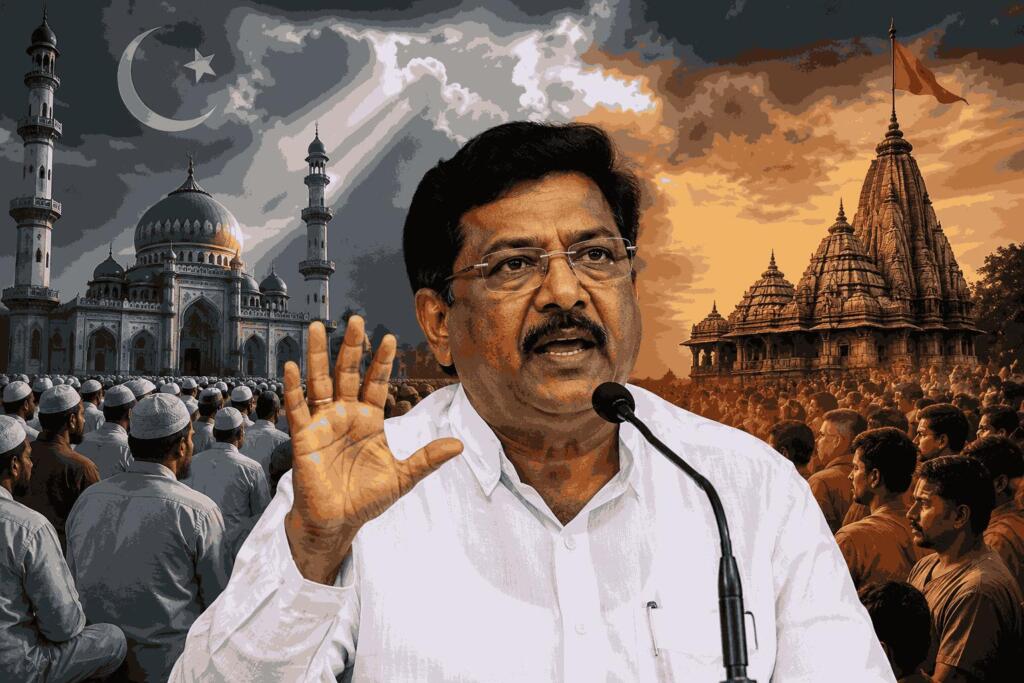
The Karnataka Congress government is facing fresh political controversy after Higher Education Minister Basavaraj Rayareddy described Islam as “superior to all other religions” while addressing a gathering in Kuknoor, Koppal district. His remarks, made during a Muslim community mass-wedding programme, have triggered sharp criticism from the BJP and revived a wider debate over religious neutrality in political discourse. The controversy comes days after Congress leader Rahul Gandhi’s remarks targeting the Manusmriti and its treatment of women.
Rayareddy, who recently became part of Deputy Chief Minister D.K. Shivakumar’s Cabinet, spoke at length about Islam and said he regarded it as a great religion founded on humanity. According to reports, he said that misconceptions about Islam existed in society and argued that people should understand the religion before forming opinions about it. He also expressed a personal desire to undertake the Haj pilgrimage to Mecca, saying that he could not do so because only Muslims are permitted to undertake the pilgrimage.
The minister went further by saying that Islam was superior to other religions because, in his view, it begins with humanity. He also stated that he was willing to study the Quran and suggested that the religious text could be read by anyone, rather than being restricted exclusively to Muslims. His comments quickly circulated online, drawing attention because they came from a serving minister responsible for a major portfolio in the state government.
The Karnataka Congress has now been placed under pressure to clarify whether Rayareddy’s comments represent his personal views or reflect a broader position within the ruling party. The BJP has seized on the remarks to accuse the government of pursuing what it describes as minority appeasement, while questioning why the Chief Minister has not publicly rebuked the minister.
Karnataka BJP president R. Ashoka criticised the statement and questioned Chief Minister D.K. Shivakumar’s silence. Ashoka argued that Rayareddy’s comparison amounted to an insult to Sanatan Dharma and demanded that the minister withdraw his remarks and apologise. He further said that if Rayareddy refused to do so, the Chief Minister should consider removing him from the Cabinet.
The controversy has acquired an additional political dimension because it follows Rahul Gandhi’s recent comments on the Manusmriti. Speaking at a student outreach programme in Pune on August 22, Gandhi criticised patriarchal ideas and argued that women should have complete ownership over their own lives. He also accused the BJP and RSS of retaining what he described as a Manusmriti mindset. His remarks prompted a counterattack from BJP leaders, who accused him of selectively targeting Hindu traditions.
Against that backdrop, the Karnataka Congress is confronting an uncomfortable juxtaposition: while a senior national Congress leader is publicly criticising an ancient Hindu text, a state minister from the same party is facing criticism for explicitly praising one religion over others. Whether the two issues are directly connected is a matter of political interpretation, but opponents are already using the contrast to attack Congress’s approach to religion.
Rayareddy, however, did not present his entire speech as an argument against other faiths. He also urged people not to become religious fanatics or casteists and said that merely visiting a mosque or temple did not automatically make a person virtuous. Instead, he called for people to adopt positive principles from different religions and live peacefully with one another.
Minister Yathindra Siddaramaiah, who was also present at the programme, spoke about the socio-economic condition of Muslims and stressed the importance of improving their welfare. He appealed for communal harmony and argued that religion should not be exploited for political conflict. His remarks attempted to frame the event around social development and peaceful coexistence rather than religious competition.
For the Karnataka Congress, the episode presents another test of how it handles politically sensitive statements by members of its government. In a state where questions of religion, caste, welfare and identity frequently intersect with electoral politics, statements comparing the relative merits of religions can quickly become larger political flashpoints.
The episode also demonstrates how religious remarks by elected representatives can have consequences beyond the immediate gathering where they are delivered. A statement intended to praise humanity, faith or inter-community understanding can be interpreted very differently once it enters the political arena. For the Karnataka Congress, the immediate challenge will be to explain whether Rayareddy’s comments were simply a personal expression of faith and admiration or whether the party believes such comparisons are appropriate for a constitutional office-holder.
Ultimately, the controversy is likely to continue as opposition parties demand accountability and the ruling party weighs the political fallout. Rayareddy’s subsequent emphasis on respecting good values across religions may provide context for his supporters, but his description of Islam as superior to other religions remains the central issue driving criticism. The Karnataka Congress will now have to navigate the debate carefully, particularly as competing political narratives around religion and secularism continue to shape public discourse in the state.
If you want, I can also make the headline shorter and more punchy, in the same style as your previous news articles.