
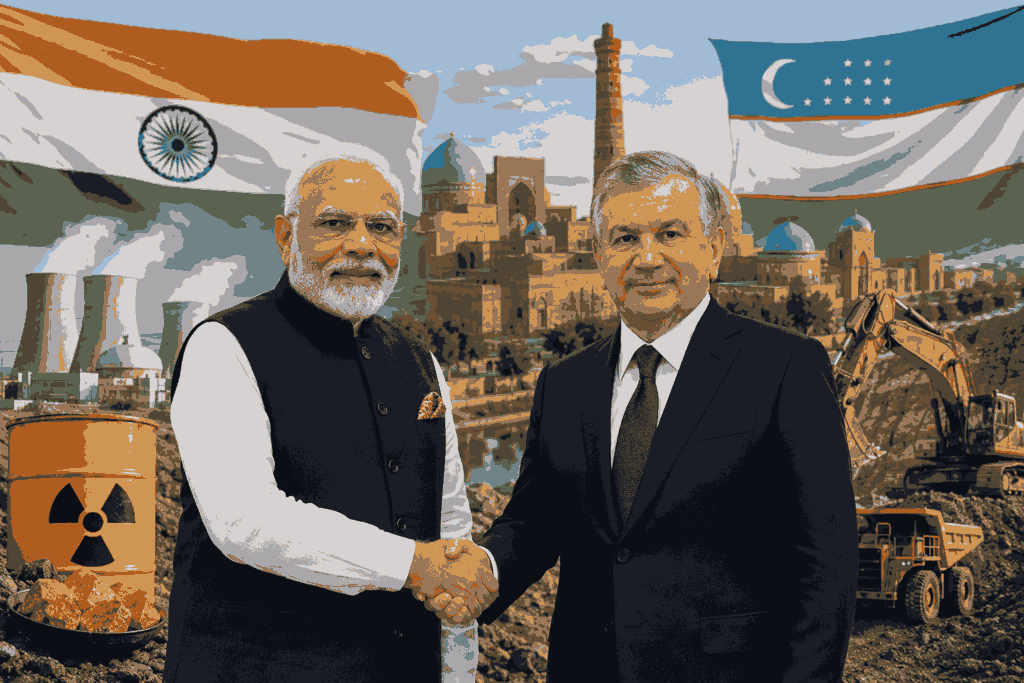
India has taken a significant step towards strengthening its energy security after Prime Minister Narendra Modi’s visit to Uzbekistan, where New Delhi and Tashkent advanced a long-term arrangement for uranium supplies while elevating their bilateral relationship to a Comprehensive Strategic Partnership. The agreement comes at a time when India is seeking reliable and diversified sources of nuclear fuel to support the expansion of its civilian nuclear power programme.
The uranium understanding emerged as one of the most consequential outcomes of Modi’s two-day state visit. During discussions with President Shavkat Mirziyoyev, both sides reviewed cooperation across energy, mining, critical minerals, defence, trade, technology, healthcare and education. The Indian Prime Minister said the two countries would establish a long-term arrangement for uranium supply, signalling a potentially important development for India’s nuclear energy ambitions.
For India, access to dependable nuclear fuel has implications that extend well beyond the energy sector. Nuclear power provides electricity without the direct carbon emissions associated with fossil-fuel generation, while uranium supplies remain strategically important for maintaining the operation and expansion of nuclear reactors. A long-term arrangement with Uzbekistan could therefore contribute to a more diversified nuclear fuel supply chain and reduce dependence on a limited number of international sources.
The development also reflects the changing nature of India’s engagement with Central Asia. Uzbekistan occupies an important geographical position in the region and has emerged as a significant partner for New Delhi in areas ranging from connectivity and trade to security and natural resources. The two countries have now agreed to deepen institutional coordination, including through a foreign-minister-led mechanism intended to provide greater direction to the expanding relationship.
The nuclear agreement was accompanied by a broader push to cooperate in geology, mining and critical minerals. The two governments agreed to explore joint projects involving geological exploration, mineral processing and the development of integrated value chains. For India, such cooperation is increasingly important as industries compete globally for resources essential to advanced manufacturing, clean energy, electronics and strategic technologies.
Trade is another major component of the new partnership. India and Uzbekistan have set an ambitious target of taking bilateral trade to $5 billion by 2030. The two sides intend to broaden the range of goods traded, reduce non-tariff barriers and encourage greater investment. Engineering products, electrical goods, automobiles and pharmaceuticals have been identified as sectors with considerable potential for expanded commercial cooperation.
The visit also produced agreements covering culture, higher education, scientific research, tourism, environmental protection, traditional medicine and mining. India announced a $1 million grant for ecological rehabilitation efforts in the Aral Sea region, while the two sides agreed to cooperate in preserving ancient Buddhist sites at Fayaz Tepa and Kara Tepa. The outcomes demonstrate that the relationship is no longer confined to conventional diplomatic and commercial engagement.
For Uzbekistan, closer ties with India provide access to one of the world’s largest and fastest-growing economies, while New Delhi gains a stronger foothold in a strategically important Central Asian market. Cooperation in digital public infrastructure is another emerging area, with the two countries moving towards enabling Indian UPI applications to make merchant payments through the Uzbek national QR system.
Defence and security cooperation are also gaining momentum. The two countries have maintained institutional exchanges and joint military activities, including the Dustlik exercise. Their leaders reaffirmed the importance of cooperation against terrorism, organised crime, cyber threats and other security challenges. Such collaboration strengthens India’s wider engagement with Central Asia at a time when regional security dynamics are becoming increasingly complex.
The diplomatic significance of the visit was underscored by the decision to elevate relations to a Comprehensive Strategic Partnership. For Uzbekistan, this represents a deepening relationship with a major Asian power; for India, it reinforces its long-term strategy of building stronger links with Central Asian states through energy, commerce, security, technology and people-to-people connections.
The uranium arrangement could ultimately prove to be one of the most strategically important elements of the visit. India’s nuclear sector requires predictable fuel supplies as the country seeks to expand low-carbon electricity generation. While the precise commercial and operational details of the long-term uranium arrangement will determine its eventual impact, the political commitment itself marks an important advance.
Prime Minister Modi’s visit has consequently produced a relationship that goes far beyond a single energy agreement. With Uzbekistan becoming a more prominent partner in nuclear fuel, critical minerals, trade, technology and regional cooperation, India is positioning itself for a deeper and more sustained presence in Central Asia. The next challenge will be turning the agreements announced in Tashkent into concrete projects, investment and reliable supply chains that deliver tangible benefits for both countries.