
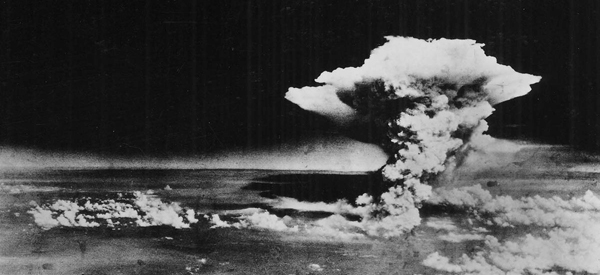
A peace bell rang at 8.15am on Thursday and about 50,000 people fell silent in Hiroshima’s Peace Memorial Park, 81 years after a US B-29 dropped a uranium bomb that left roughly 140,000 dead by the end of 1945. Nagasaki, struck three days later, marks its own anniversary on Sunday.
It was the first such anniversary in more than half a century observed in a world with no binding legal limit on the nuclear arsenals of Russia and the United States. Eighty-one years after the bomb, the last treaty restraining the superpowers has lapsed, the Doomsday Clock has never been closer to midnight, and two of the world’s live wars are being fought over nuclear weapons.
Hiroshima’s mayor, Kazumi Matsui, used his peace declaration to attack the logic of deterrence itself. “Policymakers of the world, civil society demands the immediate abolition of nuclear weapons,” he told the ceremony, attended by Prime Minister Sanae Takaichi and delegates from about 120 countries, including the United States.
The last treaty is gone
New START, which capped deployed strategic warheads between the United States and Russia at 1,550 each, expired on 5 February with no successor. President Vladimir Putin had offered in September 2025 to keep observing its ceilings for a year; Washington never formally replied. President Donald Trump said instead that he wanted a “new, improved, and modernized Treaty”, according to the Arms Control Association. Foreign Minister Sergey Lavrov told the Duma on 11 February that Russia would respect the old numbers only while the United States did.
UN Secretary-General António Guterres called the lapse “a grave moment for international peace and security”. On 27 January the Bulletin of the Atomic Scientists moved its Doomsday Clock to 85 seconds to midnight, the closest ever, naming the treaty’s collapse as a major factor.
The numbers have stopped falling
The SIPRI Yearbook 2026, published on 8 June, counted 12,187 warheads worldwide in January, of which 9,745 sat in military stockpiles. Some 4,012 were deployed on missiles and aircraft, and between 2,100 and 2,200 were on high alert, launchable in minutes. Russia and the United States hold about 86 per cent of the total.
The headline figure is still drifting down, but only because Moscow and Washington are scrapping retired Cold War stock — a trend SIPRI expects to reverse. China’s arsenal grew to about 620 warheads and is expanding faster than any other; North Korea’s estimate was raised to about 60; India’s rose to 190, against Pakistan’s 170.
Ukraine: signalling, not striking
Russia revised its nuclear doctrine in November 2024 to widen the conditions for use, and its rhetoric has continued through 2026. Analysts at Germany’s DGAP logged a missile test on 12 May and a snap strategic forces exercise on 19–21 May, each following battlefield setbacks in Ukraine.
The signalling is loud; the assessment, according to Western intelligence agencies, is unchanged. They have consistently judged the probability of use to be low, and no nuclear weapon has been detonated in war since Nagasaki. Trump’s order last October to resume testing has not yet produced an explosive test.
Iran: a war fought over the bomb
The greater danger, by most assessments, is in the Gulf. On 28 February, US and Israeli forces launched hundreds of strikes on Iran, killing Supreme Leader Ali Khamenei. Iran shut the Strait of Hormuz; Washington imposed a naval blockade in April. A memorandum of understanding collapsed and American strikes resumed in July. Trump this week said a Hormuz deal would be followed by what he called the “denuclearization of Iran”.
Meanwhile, no one can account for the material. The International Atomic Energy Agency last verified 440.9kg of uranium enriched to 60 per cent — a short technical step from weapons grade — on 13 June 2025, and reported in February that it cannot establish the stockpile’s size, composition or whereabouts. Iran’s parliament has drafted legislation to quit the Non-Proliferation Treaty. The treaty’s review conference in New York ended on 22 May without agreement, the third failure running, sunk largely by the row over Iran.
So, is this the most dangerous phase since the Cold War?
By the structural measures, arguably yes: no bilateral treaty, no verification, no inspections in Iran, a three-way competition rather than a two-way one, and open talk of testing. Non-nuclear states are hedging too. Takaichi is revising Japan’s security documents by the end of the year, with pressure from within her own coalition to soften the three non-nuclear principles, though she has ruled out NATO-style nuclear sharing.
The counter-argument is that today’s stockpiles are roughly a sixth of the Cold War peak of about 70,000, and that deterrence has held for 81 years.