
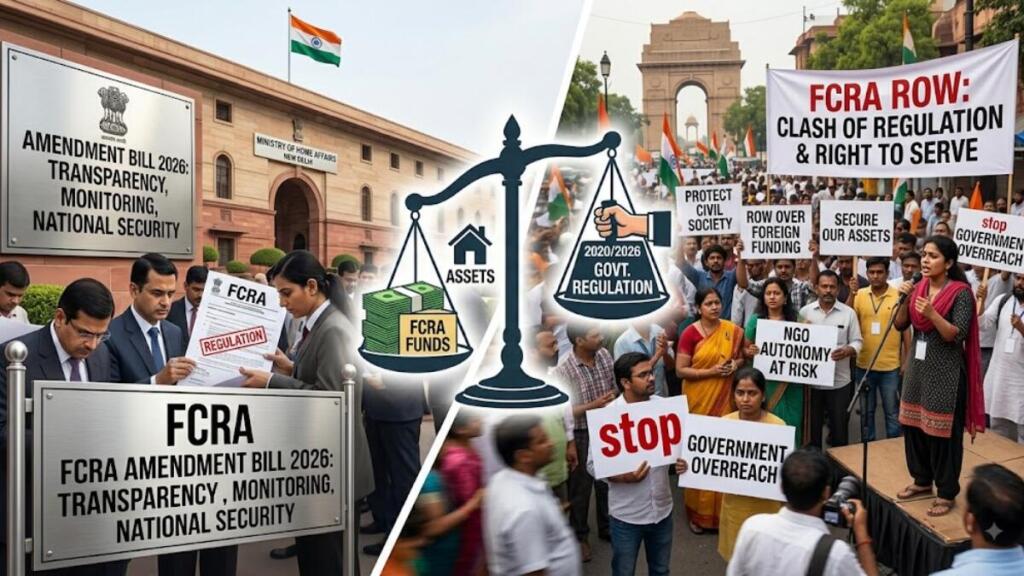
New Delhi: A bill seeking to amend India’s law on foreign funding for non-governmental organisations (NGOs) has become one of the most contentious issues before Parliament this Monsoon Session. The Foreign Contribution (Regulation) Amendment Bill, 2026, was first introduced in the Lok Sabha on March 25, but the government put it on hold after facing protests from opposition parties and several civil society groups, Business Standard reported.
The Foreign Contribution (Regulation) Act (FCRA), 2010, regulates how NGOs, trusts, societies, educational institutions and religious organisations receive and use foreign contributions. Under the law, any organisation seeking such funds must obtain registration or prior permission from the Ministry of Home Affairs. Registration is valid for five years and must be periodically renewed.
What the amendment proposes
The government says the changes are meant to strengthen oversight of foreign funding and safeguard national security. According to the bill’s Statement of Objects and Reasons, cited by Business Standard, India had 14,449 active FCRA registrations at the time it was introduced.
The amendment would give authorities sweeping new powers over the assets of NGOs whose licences are cancelled or not renewed — a significant shift, since such organisations could until now often retain assets built up over years even after losing their registration. The International Center for Not-for-Profit Law (ICNL) has noted this could have particular implications for schools, hospitals, welfare centres and research institutions that rely on foreign funding and have invested in long-term infrastructure.
Since 2010, successive governments have amended the FCRA three times, most significantly in 2020, when transfers of foreign funds between organisations were banned, administrative expenditure was capped, and funds were required to be routed through a single designated bank account. Since then, about 22,000 FCRA registrations have been cancelled, and an estimated 15,000 more had lapsed without renewal as of April this year, according to ICNL.
Why it has become controversial
The Opposition has described the bill as “draconian,” Business Standard reported, and civil society groups warn it could further shrink space for humanitarian, educational, religious and rights-based work. Their objection is less about oversight itself — which they largely accept as necessary — and more about scope: they argue the bill applies broad restrictions across the sector rather than targeting organisations genuinely at risk of misuse.
That argument has some backing from an unlikely source. ICNL has pointed out that the Financial Action Task Force’s 2024 evaluation had recommended a more targeted, risk-based approach to regulating foreign-funded organisations, alongside greater consultation with the non-profit sector — a more calibrated approach than what critics say the current bill takes.
Amended FCRA rules excluding proselytisation from foreign-funding categories have triggered a wave of appeals from Christian bodies and Mizoram’s chief minister, ahead of the bill’s Parliament debate.
An international dimension
The row has also drawn attention beyond India’s borders. A US congressman, Riley Moore, has alleged that the proposed amendments could allow the government to take over churches and religious charities, and warned that the move could affect India-US relations, according to Business Standard and Outlook India. Amnesty International has raised similar concerns more broadly, framing the changes as a threat to the wider non-profit sector rather than religious organisations specifically.
The government has pushed back on this framing. The Union minister, Kiren Rijiju, said during a visit to Kerala that any misunderstandings around the bill would be addressed, and that concerns raised by Christian missionaries would be taken into account, according to All India Radio’s news service. He said violations would invite strict action, but organisations working for the country’s welfare would not be disturbed, and accused opposition parties of spreading misinformation for political gain.
Where things stand
Parliament deferred consideration of the bill following opposition from civil society organisations, religious communities and political parties, ICNL reported. It remains pending and could return in a future session. Separately, in June, the Ministry of Home Affairs adopted a set of amended FCRA rules granting the government expanded powers to police the activities, management and leadership of NGOs receiving foreign funds — a move that drew a joint statement from civil society organisations, coordinated in part by Amnesty International, calling for its withdrawal.