
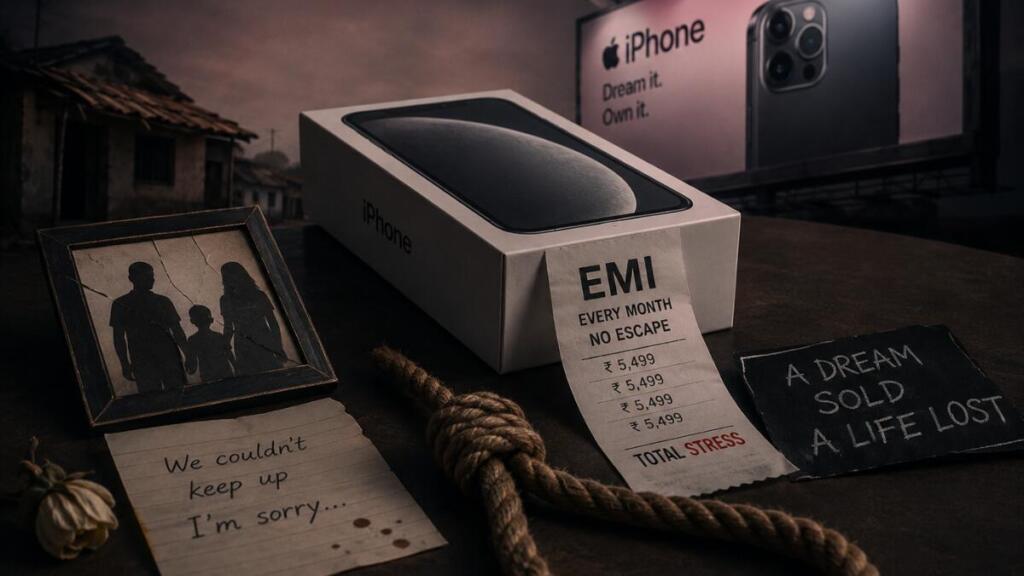
A family of three from Maharashtra’s Chhatrapati Sambhajinagar district died on Friday after a dispute over unpaid iPhone EMI installments escalated into a tragedy on a hilltop, according to police.
Eighteen-year-old Kunal Chandgude, a resident of the Zalta Phata area, had purchased an iPhone on EMI but was struggling to keep up with the payments. Police said the missed installment led to a heated argument with his father, Murlidhar Chandgude, a 48-year-old driver. Around 10 a.m., Kunal walked to the edge of Khavda Hill in the Tisgaon area and threatened to jump.
For nearly three hours, his parents, local villagers, the village sarpanch, fire brigade personnel, and Waluj MIDC police tried to talk him down. Emergency responders reportedly tried to position a safety net below the cliff, but Kunal kept shifting along the edge.
Around 1 p.m., his father climbed up and tried to pull him back from the ledge physically. Both lost their balance and fell into the gorge. His mother, Sangita Chandgude, watching from below, then jumped after them. All three died at the scene. Police have registered a case and sent the bodies for post-mortem examination; the investigation is ongoing.
The angle behind the headline
Coverage of this story has largely framed it as a “fight over a phone.” But that framing understates what’s actually being sold, and to whom.
The smartphone market and Apple’s marketing in particular have spent over a decade shifting its pitch from specifications to identity. Billboards, reels, and store windows for flagship phones rarely lead with battery life or camera sensors; they sell belonging, status, and the unspoken implication that the device you already own is quietly inadequate. This isn’t incidental — it’s a business model built on manufactured comparison, where the ad’s real product is dissatisfaction with what you have.
EMI financing is the mechanism that turns that dissatisfaction into a transaction anyone can technically say yes to. A phone priced well beyond a driver’s monthly income becomes “affordable” once it’s broken into installments — the total cost doesn’t shrink; it just becomes easier to agree to in the moment. For a teenager surrounded by classmates, influencers, and advertising where the “right” phone functions as social currency, that gap between what you have and what you’re told you should have can feel less like a preference and more like a referendum on your worth.
None of this fully explains what happened in Tisgaon; families carry pressures, histories, and pain no report can capture, and this case is still under investigation. But the pattern is not new, nor is it isolated to one household. It sits at the intersection of aspirational marketing, easy consumer debt, and financial stress in households where a single unpaid installment can become a flashpoint.