
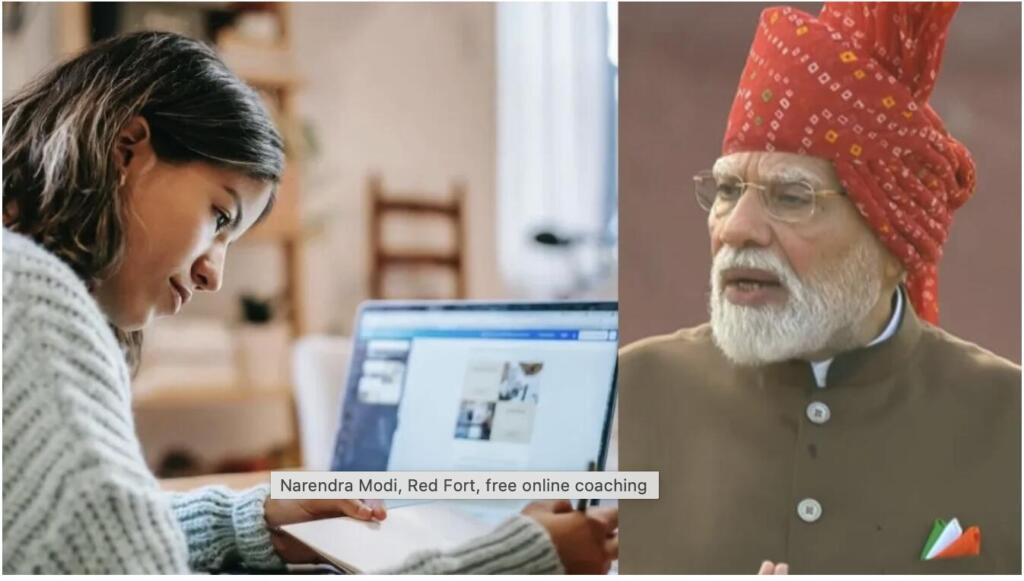
In India, cracking a government job or a major entrance examination is no longer just about studying hard and clearing a test. Around the examination system, an entire economy has emerged- coaching centres, test series, hostels, PG accommodation, online batches, YouTube classes, Telegram groups, paid mentorship and, increasingly, teachers who have built their own brands on social media. Where allegations of paper leaks and organised malpractice enter the picture, parts of this ecosystem can even begin to resemble a mafia network.
Prime Minister Narendra Modi has now touched one of the most contentious points in this system.
In his Independence Day address, the Prime Minister said that the high fees charged by coaching institutions put a heavy financial burden on poor and middle-class families. As an alternative, he announced free online coaching for various competitive examinations by bringing together the country’s best teachers and its Digital Public Infrastructure.
The message is significant. If students can access high-quality preparation without spending lakhs of rupees, the economic barrier that has grown around competitive examinations could begin to weaken.
That raises a larger question: could this become a turning point for India’s booming coaching industry?
A Coaching Economy Running Into Thousands of Crores
India’s coaching sector is no longer a small education-support business. Recent industry estimates put the market for coaching institutes at around $7.2 billion in 2025, or roughly ₹60,000 crore, with the figure projected to reach around $17.8 billion by 2034.
Another industry estimate valued India’s test-preparation market at around $11.6 billion in 2025, with an additional market opportunity of about $6.04 billion expected by 2030.
These figures should be treated with some caution because different reports use different definitions. Some count only coaching institutes, while others include test preparation, online learning and related services.
NDTV Profit reported in June 2026, citing an industry estimate, that India’s private coaching market was already worth more than ₹58,000 crore and could cross ₹1 lakh crore in the coming years. The report said the sector was serving more than seven crore students.
Kota remains the most visible example.
The Rajasthan city became synonymous with JEE and NEET preparation, but it has also become a symbol of the pressures surrounding India’s coaching culture. In 2024, the number of students in Kota reportedly fell from the usual 2–2.5 lakh to around 85,000–1 lakh. Industry stakeholders estimated that annual revenues across the coaching and hostel sectors had fallen from around ₹6,500–7,000 crore to roughly ₹3,500 crore.
The decline was not simply a market correction. Student pressure, suicides, regulatory action and the expansion of major coaching brands into other cities were among the factors cited.
When Coaching Becomes an Entire Ecosystem
There is nothing inherently wrong with coaching. Good teachers, structured preparation and additional academic guidance can make a significant difference to a student preparing for a difficult examination. The problem begins when the system creates the perception that success is almost impossible without expensive coaching.
The costs then start piling up. There is the coaching fee, followed by test series, study material, hostel or PG accommodation, online mentorship, crash courses, special batches and paid doubt-solving services.
For many families, preparing for a government job or entrance examination therefore becomes an economic race of its own.
This is the gap the government’s free digital coaching initiative is attempting to address.
The infrastructure for such a move already exists to some extent. The Education Ministry’s SATHEE platform, developed in collaboration with IIT Kanpur, offers free preparation and AI-based support for examinations including JEE, NEET, CLAT, ICAR, CUET, SSC, RRB and IBPS. The government has also introduced dedicated DTH channels and mobile applications.
In other words, the Prime Minister’s announcement is not starting from scratch. India already has the beginnings of a digital education ecosystem that can be expanded into a large-scale competitive-examination platform.
The ‘Coaching Mafia’ and the Paper Leak Problem
This brings us to the most sensitive part of the debate: paper leaks and examination malpractice.
It would be wrong to suggest that coaching institutes as a whole are responsible for paper leaks. The overwhelming majority of teachers and institutions have no connection with such crimes. But investigations into several cases have brought people associated with the coaching ecosystem under scrutiny.
The NEET-UG 2026 case is one of the most recent and serious examples.
In May 2026, the CBI arrested Prof. Shivaraj Motegaonkar, owner of RCC Coaching Institute in Latur, in connection with the alleged NEET-UG paper leak. According to the agency, searches at the institute led to the recovery of a Chemistry question bank containing exact matches with questions that appeared in the NEET examination. Investigators also alleged that leaked questions had been discussed and dictated to students attending special classes after paying for access.
The CBI subsequently arrested a physics faculty member at a coaching centre in Pune. According to the agency, he had received leaked Physics questions. The number of arrests in the case eventually reached 13.
In July 2026, the CBI filed a chargesheet against 13 accused in the NEET paper leak case. Those named included three experts associated with the National Testing Agency, middlemen and two people linked to coaching institutes.
There have been allegations involving coaching centres and people connected to them in earlier paper-leak cases as well.
The incentive is not difficult to understand. A coaching institute benefits when its students perform well because success strengthens the brand. In a more criminal version of the same ecosystem, leaked papers can become a direct source of money.
But the distinction remains important: the problem is not coaching itself. It is the informal and, in some cases, criminal networks that can grow around coaching, examinations and access to question papers.
That is why the fight over examination integrity cannot end at the examination hall. It also has to address the networks that can turn a leaked paper into a business.
The Golden Era of the Social Media ‘Sir’ ?
The face of coaching in India has changed dramatically. A coaching centre is no longer necessarily a building in Kota, Delhi or another major city. A smartphone can be a classroom. A YouTube channel can function like an institute. A Telegram group can become a study room. And a popular teacher can become a brand in his or her own right.
This transformation has also democratised education. A student in a small town or village can now watch lectures by a teacher who once would have been accessible only to students who could afford to travel to a major coaching hub.
But the same model has created a new commercial influencer ecosystem.
A free YouTube lecture can lead to a paid batch. Free current-affairs content can be followed by a premium test series. A free strategy video can lead to a paid mentorship programme. Over time, the teacher becomes an education brand.
This is where the government’s free online coaching initiative could put the greatest pressure on the existing model.
If the government brings IITs, AIIMS, top universities and experienced teachers onto a national digital platform and offers structured lectures, mock tests, previous-year papers, doubt-solving, mentorship and AI-based personalised preparation for free, a very simple question could confront students:
Why pay thousands or even lakhs of rupees for something that is available free of cost?
That could be the real test of the golden era of the social media ‘Sir’.
Private coaching is unlikely to disappear. But its ability to charge premium prices simply because students believe there is no alternative could come under pressure.
Regulation Is Already Part of the Government’s Approach
The government’s approach is not limited to free coaching. In January 2024, the Education Ministry issued Guidelines for Regulation of Coaching Centres. The framework covered areas including registration, fees, infrastructure, student safety, counselling, grievance redressal and monitoring.
The guidelines also called for greater attention to students’ mental well-being, including access to counsellors and psychologists. However, implementation depends largely on state governments and local regulatory mechanisms. That makes enforcement the real challenge.
A guideline on paper can only achieve so much. The question is whether it can be enforced on the ground.
The government is now attempting to approach the problem from two sides – regulation of private coaching on one hand and creation of a free digital alternative on the other.
Can Free Coaching Really Kill Private Coaching?
Probably not. And that may not even be the objective. A government digital platform cannot meet every student’s individual needs. Some students need a classroom environment. Others benefit from personal mentorship, discipline or the competitive atmosphere of a peer group.
Private coaching will therefore continue to have a role. What could change is its pricing power and the perception of monopoly. If a student from a poor family can access the same basic academic resources for free that another student previously paid thousands of rupees for, private coaching will have to demonstrate what additional value it provides.
The larger issue, however, goes beyond whether coaching is good or bad. India has millions of young people competing for a limited number of government jobs and seats in professional institutions. In such a system, the commercialisation of preparation is almost inevitable.
But when money begins to determine the quality of preparation available to a student, the principle of equal opportunity starts to suffer. A wealthy family can afford to keep a child in Kota for two years. A middle-class family may opt for a cheaper coaching centre closer to home. For a poor family, a smartphone and an internet connection may be all that is available.
That is where free online coaching can make a real difference.
If the government can bring together the country’s best teachers, digital infrastructure, AI-based personalised learning, multilingual content and high-quality test preparation on one accessible platform, it could do more than challenge the coaching industry.
It could make competitive examinations significantly more accessible to students who have traditionally been priced out of the preparation ecosystem. And perhaps that is the larger meaning of the Prime Minister’s announcement from the Red Fort. The real question is not whether the era of coaching is over.
It is whether the era in which money could determine how well a student was prepared is finally beginning to change.