
Prime Minister Narendra Modi on Friday extended his greetings to the nation on the occasion of Raksha Bandhan, wishing that the festival bring happiness, prosperity and success into people’s lives, and that the bond of love, affection and mutual trust it celebrates remain “forever strong and unbreakable.”
“Rakshabandhan ki bahut-bahut shubhkamnayein. Yeh pawan parv aap sabhi ke jeevan mein khushhali, samriddhi aur safalta laaye. Sneh, apnatva aur aapsi vishwas ki dor sadaiv atoot bani rahe, yahi kaamna hai,” Modi posted on X.
With that, the festival is once again being marked across the country today — sisters tying rakhis on their brothers’ wrists, brothers pledging to protect and support them in return. But where does this custom actually come from, and why has it endured for so long?
A festival with more than one origin story
Unlike festivals tied to a single scriptural event, Raksha Bandhan has grown out of several overlapping legends, each contributing a piece of what the festival means today.
The most frequently cited story comes from the Mahabharata. During a battle, Krishna cut his finger, and Draupadi tore a strip of cloth from her sari to bandage the wound. Touched by the gesture, Krishna is said to have promised to protect her in return — a vow he famously fulfilled years later when he came to her aid during her humiliation in the Kaurava court. This exchange — a piece of cloth tied in care, met with a lifelong pledge of protection — is widely seen as the symbolic root of the rakhi thread itself.
A second, older legend comes from the Bhavishya Purana and involves the god Indra. When Indra was losing a war against demons, his wife Sachi is said to have tied a sacred thread on his wrist while invoking divine protection for him. Indra went on to reclaim his kingdom, and the thread came to be associated with protection against adversity — the basis for the “raksha” (protection) in Raksha Bandhan.
A more historical, though debated, episode involves Rani Karnavati, the Rajput queen of Chittor, who is said to have sent a rakhi to the Mughal emperor Humayun in the 16th century, appealing for his protection against an invading force. Historians differ on how literally to take this account, but it endures in popular memory because it captures something the festival later came to embody: the thread as a bond of trust that could extend beyond blood relations, even across communities and political lines.
How these threads came together
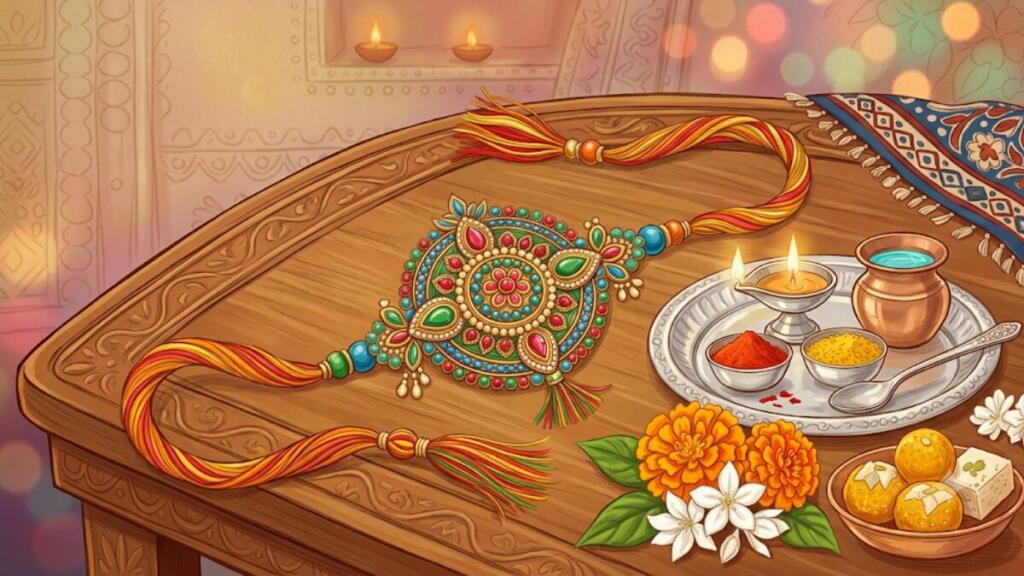
Over centuries, these mythological, devotional and historical strands fused into the ritual practiced today. On Shravana Purnima — the full moon day of the Hindu month of Shravana, which fell on August 28 this year — sisters tie a decorated thread or amulet, the rakhi, on their brothers’ wrists. They pray for the brothers’ well-being, and in return receive a gift along with a pledge of protection and care.
What began as a largely familial custom has, over time, broadened considerably. The rakhi is now tied not only by sisters to brothers but between cousins and friends, and even to soldiers, police personnel and public figures — a gesture of solidarity and goodwill rather than one confined strictly to family ties. Prime Minister Modi himself has, in previous years, been tied rakhis by schoolchildren at his residence in New Delhi, and has a long-running rakhi tradition with Qamar Mohsin Sheikh, a Pakistani-origin woman settled in Ahmedabad who has handmade him a rakhi almost every year for three decades.
What it signifies today
Government messaging around the festival — from the President’s office to the Prime Minister’s — has increasingly framed Raksha Bandhan alongside themes of women’s protection and empowerment, layering a contemporary social message onto the older idea of familial duty. At the same time, the festival’s core sentiment has stayed remarkably consistent across its many retellings: a thread tied in trust, answered with a promise of protection.
Celebrated under regional names such as Rakhi Purnima, Saluno or Silono in different parts of the country, and observed across religious lines in several communities, Raksha Bandhan remains one of the more enduring reminders in the Indian calendar that bonds of care — whether between siblings, friends or even, as legend has it, a queen and an emperor — are worth renewing, year after year.