
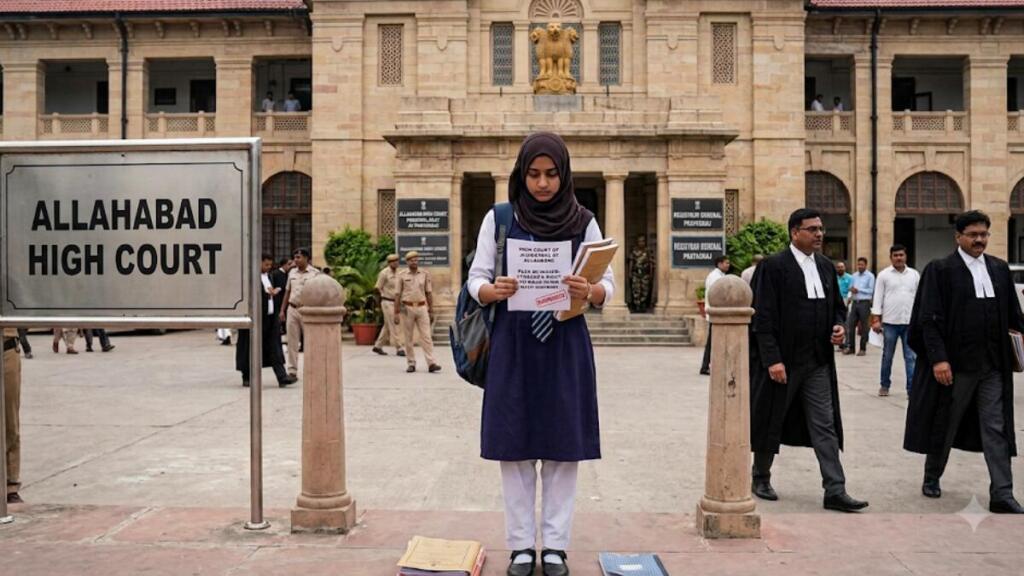
A Muslim schoolgirl’s fight to wear a headscarf alongside her school uniform has ended in defeat at the Allahabad High Court, in a ruling that leans heavily on a Karnataka precedent still awaiting final word from the Supreme Court.
In a judgment delivered on August 21, a division bench of Justice J.J. Munir and Justice Indrajeet Shukla dismissed the petition filed by a minor student of Tagore Public School in Attarsuiya, Prayagraj. The court held that no student has the right to modify a school’s prescribed dress code to suit personal preference, and that the petitioner had failed to show that wearing a hijab qualifies as an essential religious practice under Islam.
The student, identified in court papers as Sukaina Rizvi, had reportedly worn a hijab to school since Class VI without objection. The dispute came to a head when she sought admission to Class XI: the school allegedly refused to admit her while she continued to wear the headscarf, insisting that adding it to the prescribed uniform would breach its dress code. She approached the High Court seeking a direction that would let her wear the hijab alongside her uniform.
The school’s position was straightforward — its uniform policy applied uniformly to every student, was not aimed at any single community, and existed to preserve discipline and a shared institutional identity rather than to target anyone’s faith.
What the Court Said
The bench’s reasoning rested on two pillars.
First, on the constitutional question, the court found that the petitioner hadn’t produced sufficient material to establish hijab-wearing as an essential religious practice protected under Article 25. In doing so, it aligned itself with a chain of earlier rulings — from the Kerala High Court’s decision in the Fathima Thasneem case, to the Bombay High Court’s ruling in Fathema Hussain Sayed, and most significantly, the Karnataka High Court’s 2022 Full Bench verdict in Resham v. State of Karnataka, which had reached the same conclusion.
Second, on the question of institutional autonomy, the bench held that where a dress code is applied uniformly, in good faith, without discrimination, and genuinely serves discipline and institutional identity, the authority to set and enforce that code belongs to the school — not to individual students or their preferences.
Notably, the court acknowledged that the matter isn’t fully settled at the highest level. The Karnataka verdict had eventually reached the Supreme Court in the Aishat Shifa case, where a two-judge bench delivered a split verdict, sending the dispute onward for a larger bench to resolve — a bench that, as of this ruling, still hasn’t been constituted. Even so, the Allahabad court concluded it had no reason to depart from the Karnataka Full Bench’s reasoning, treating it as persuasive authority of real weight in the absence of a definitive Supreme Court ruling.
Part of a Longer Legal Thread
This verdict doesn’t arrive in isolation. It’s the latest entry in a legal debate that began in earnest with the 2022 Karnataka hijab row, when a ban on religious attire in classrooms sparked protests, a marathon court hearing, and eventually a High Court ruling that hijab-wearing isn’t essential to Islamic practice. That Karnataka ban was later upheld by the High Court but subsequently rescinded by a Congress-led state government in 2026. The Supreme Court’s subsequent split verdict left the constitutional question hanging — a gap that courts across the country, including now Allahabad’s, have had to navigate on their own, generally by treating the Karnataka reasoning as the closest thing to settled law available to them.
What Happens Next
For now, the ruling leaves school administrations firmly in the driver’s seat on uniform policy, so long as their rules are evenly applied and framed as neutral, non-discriminatory measures. For students and families who see the hijab as inseparable from their faith, the judgment adds another High Court voice to a chorus that has, so far, consistently ruled against them — pending the day the Supreme Court finally settles the question with an authoritative, binding pronouncement.
Whether this particular case moves further up the judicial ladder remains to be seen. But the underlying constitutional question — how far a student’s religious expression can extend inside a classroom governed by a uniform dress code — is clearly not going away until India’s top court speaks with one voice.