
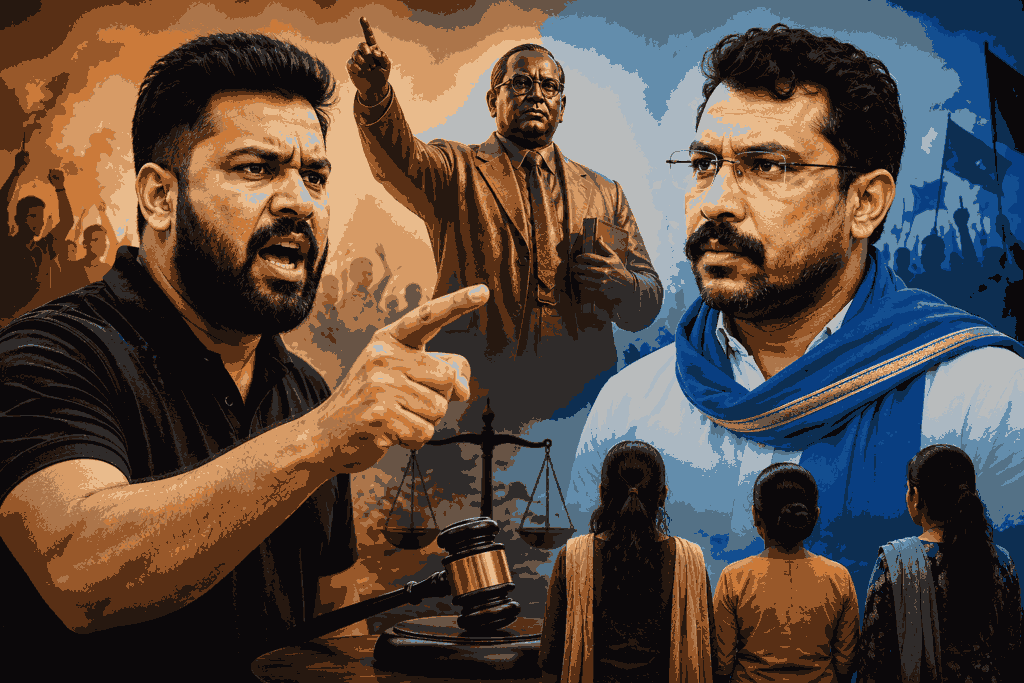
Ajeet Bharti has become the centre of a fresh political and legal controversy after an FIR was registered against the YouTuber under the Scheduled Castes and Scheduled Tribes (Prevention of Atrocities) Act and provisions of the Bharatiya Nyaya Sanhita. The complaint, filed on August 23, alleges caste-based abuse, promotion of caste hatred and sexually coloured remarks concerning Dr B.R. Ambedkar and Bhim Army chief Chandrashekhar Azad Ravan.
The dispute originated with a video concerning the ongoing debate around reservations. According to the complaint and the account published by OpIndia, a social-media user identified as “@singhden” posted a comment suggesting that Bharti should send his sister to Chandrashekhar Azad, implying that such a marriage would resolve the issue of reservations. Bharti responded angrily, referring to the commenter’s mother and sister and making several provocative remarks about Azad.
The exchange has since become much larger than an argument between two individuals. At its heart is a difficult question about the boundaries of political speech, caste identity and the use of women as symbols in ideological battles. Ajeet Bharti has argued that his response was provoked by an offensive suggestion involving his family and that he did not threaten Azad’s relatives. The original complaint, however, alleges that his remarks crossed legal boundaries.
The controversy has also revived scrutiny of statements made by activists and public figures on inter-caste marriage. OpIndia’s report cites several examples that it says demonstrate a wider pattern of rhetoric in which marriage involving women from traditionally upper-caste communities has been presented as a means of challenging caste structures. These examples have generated criticism because they can reduce women to instruments in a political or social struggle rather than recognising them as individuals with independent choices.
One example cited in the report involves IAS officer Santosh Verma, who reportedly made a controversial statement about reservation and a Brahmin daughter. Chandrashekhar Azad subsequently faced criticism over remarks interpreted as support for Verma. The episode became part of the wider argument over whether provocative statements about inter-caste relationships are being treated consistently across political and ideological camps.
Ajeet Bharti has maintained that his response should be understood in the context of the original provocation. In a subsequent statement, he questioned whether remaining silent after someone made a marriage-related remark about his mother or sister would be appropriate. He also argued that he had not used casteist language against Chandrashekhar Azad in the manner alleged by his critics.
At the same time, the controversy does not automatically make every statement made by Bharti defensible. Referring to a person’s mother or sister during an online confrontation can itself be deeply offensive, irrespective of the provocation. The appropriate question is therefore not merely which side made the first objectionable remark, but whether the specific words used satisfy the legal requirements of the offences invoked in the FIR.
The SC/ST Act exists to protect members of historically disadvantaged communities from atrocities and caste-based humiliation. Its invocation therefore carries significant legal and social consequences. A previous case reported by OpIndia illustrates that courts have also dealt with allegations involving allegedly fabricated SC/ST complaints, underscoring the importance of evidence and due process when such laws are invoked.
The dispute surrounding Ajeet Bharti also comes against a backdrop of increasingly polarised caste politics. Chandrashekhar Azad, who represents Nagina in the Lok Sabha, has repeatedly advocated stronger political representation for Dalits and other marginalised communities. Earlier this year, he even argued in Parliament for separate electorates for Dalits, a position that drew criticism because Article 325 of the Constitution prohibits separate electorates on the basis of religion, race, caste or sex.
Ultimately, the FIR will have to be assessed through evidence and the law rather than social-media outrage. Ajeet Bharti’s supporters see the case as an example of selective outrage, while his critics argue that caste-based and sexually coloured language should attract legal scrutiny regardless of who uses it. What should not be lost amid the political noise is the principle that women must never be treated as bargaining chips in arguments over caste, reservation or social status.
The controversy therefore raises a broader challenge for India’s increasingly combative public discourse: equality cannot be built by humiliating another community, and disagreement cannot become an excuse for dragging families into political battles. The courts will ultimately determine whether the allegations against Ajeet Bharti meet the statutory threshold. Until then, the case remains a test of how India balances free expression, dignity, caste protections and accountability in an age of viral political confrontation.