
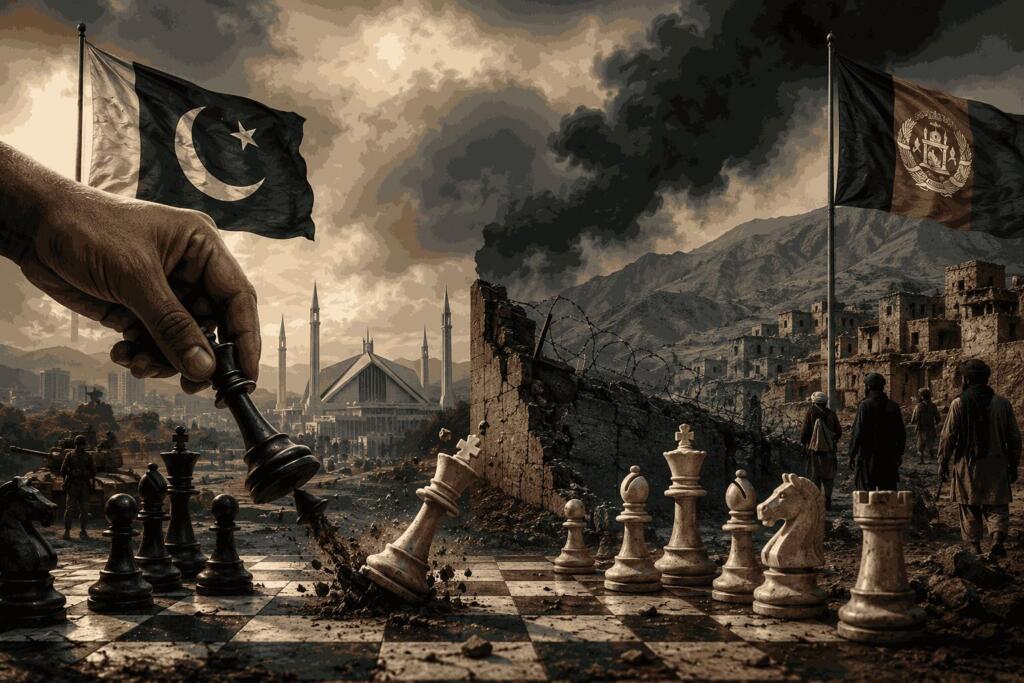
Pakistan’s decades-long Afghan policy has entered a deeply uncomfortable phase, with the Afghan Debacle exposing the consequences of a strategy built around influence, militant proxies and the pursuit of “strategic depth.” What Pakistani military planners once imagined as a protective western buffer has increasingly become a source of insecurity, terrorism and political strain inside Pakistan itself. The transformation has been gradual, but its consequences are now difficult for Islamabad to ignore.
The roots of the policy stretch back to the Cold War and the rule of General Zia-ul-Haq. Pakistan’s military establishment feared being squeezed between India in the east and an unfriendly Afghanistan in the west. Afghanistan’s refusal to accept the Durand Line as a permanent international border added another layer of anxiety. When the Soviet Union invaded Afghanistan in 1979, Islamabad saw an opportunity to turn that insecurity into strategic advantage. With American and Saudi assistance flowing into the Afghan resistance, Pakistan’s intelligence apparatus became a central player in supporting selected militant groups.
The Afghan Debacle was therefore not created overnight. It emerged from a series of decisions that treated Afghanistan less as a sovereign neighbour and more as an arena in which Pakistan could pursue its own security calculations. The Inter-Services Intelligence agency became deeply involved in the Afghan conflict, distributing weapons, money and logistical support to factions considered useful to Pakistani interests. The immediate objective was understandable from the military establishment’s perspective: keep Afghanistan friendly and prevent hostile forces from gaining influence along Pakistan’s western frontier.
But the strategy carried a dangerous contradiction. Militancy could be encouraged beyond Pakistan’s borders only so long as those armed networks remained controllable. The rise of the Taliban during the 1990s appeared to offer Islamabad a solution. Pakistan hoped a Taliban-led government would provide a dependable partner in Kabul and reduce the possibility of an unfriendly Afghan regime cooperating with India. Yet the Afghan Debacle demonstrated the limits of attempting to manufacture political outcomes in a neighbouring country.
The Taliban did not become the obedient strategic instrument many Pakistani planners had anticipated. Questions surrounding the Durand Line remained unresolved, while militant ideology crossed the frontier in the opposite direction. Groups operating against Pakistan increasingly found opportunities in Afghanistan. After the Taliban returned to power in Kabul in 2021, Islamabad initially welcomed the development as a vindication of its longstanding policy. That optimism soon collided with reality as tensions intensified along the border and Pakistan faced renewed attacks by the Tehreek-e-Taliban Pakistan.
The Afghan Debacle has consequently become an internal-security problem for Pakistan. Militancy in Khyber Pakhtunkhwa and parts of Balochistan has placed enormous pressure on the security establishment. Pakistani soldiers and civilians have continued to face violence, while border disputes and cross-border attacks have complicated relations between Islamabad and Kabul. A policy originally designed to provide greater strategic security has thus produced precisely the kind of instability it was supposed to prevent.
Another cost has been the institutional power accumulated by the military and intelligence establishment. Years of involvement in Afghan affairs strengthened intelligence networks and encouraged a culture in which covert operations and militant proxies became instruments of foreign policy. Critics argue that this approach weakened civilian oversight and made it harder for successive governments to fundamentally change course. The Afghan Debacle is therefore also a story about institutional inertia: once a strategy becomes embedded within powerful state structures, abandoning it can become politically and bureaucratically difficult.
Pakistan’s broader difficulties have magnified the consequences. Economic instability, political polarization, inflation, debt pressures and tensions between civilian institutions and the military have reduced Islamabad’s room for manoeuvre. Instead of possessing a stable strategic environment on both frontiers, Pakistan now confronts serious challenges from multiple directions. The Afghan Debacle has added another burden to a country already struggling to reconcile security priorities with economic and political realities.
There is also a larger lesson in Pakistan’s experience. A neighbouring country cannot easily be converted into strategic “depth” simply through military influence or ideological affinity. Afghanistan has repeatedly demonstrated its resistance to outside control, whether attempted by great powers or regional actors. The Afghan Debacle underscores how short-term geopolitical calculations can create long-term consequences that become increasingly difficult to reverse.
For Pakistan, the way forward requires a reassessment of assumptions that have shaped Afghan policy for generations. Sustainable security is unlikely to come from proxy organisations or attempts to dominate political developments across the border. It will depend more heavily on secure borders, diplomacy, economic resilience, effective civilian institutions and the ability to distinguish national interests from ideological ambitions.
The Afghan Debacle ultimately represents more than the failure of one foreign-policy doctrine. It is a warning about the dangers of believing that instability can be controlled once it has been deliberately cultivated. Pakistan sought strategic leverage in Afghanistan for decades, but the forces unleashed by that policy eventually turned inward. What began as an effort to create security beyond Pakistan’s borders has instead contributed to insecurity within them, leaving Islamabad to confront the consequences of a gamble whose costs have become increasingly difficult to contain.